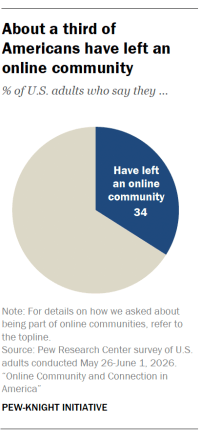
The digital landscape, once heralded as the ultimate frontier for human connection and community building, is facing a quiet but significant phenomenon: the mass departure of users from their chosen online spaces. According to a comprehensive new study released by the Pew Research Center as part of the Pew-Knight Initiative, approximately one-third of American adults have officially cut ties with at least one online community. This trend, captured in data collected between May 26 and June 1, 2026, highlights a shifting sentiment toward digital interaction, where the promise of belonging is increasingly being weighed against the realities of fatigue, toxicity, and changing life stages.
The study, which surveyed 9,750 U.S. adults via the American Trends Panel, reveals that the decision to leave an online group is rarely the result of a single event. Instead, it is often a cumulative process driven by a combination of waning personal interest, the perceived degradation of community quality, and the increasing intrusion of political discourse into spaces originally designed for niche hobbies or support.
The Evolution of Online Connection
To understand why Americans are leaving these spaces, one must first understand what they represent. The Pew-Knight Initiative defines an online community broadly, encompassing any digital space where individuals connect—be it through social media groups, discussion forums, email lists, or the collaborative environments found within multiplayer video games. For decades, these spaces served as digital town squares, offering users the ability to transcend geographical limitations to find like-minded individuals.
However, the 2026 data indicates a potential turning point. With fewer than half of Americans reporting high satisfaction with their local, physical social lives, the pressure on online communities to fill that void has intensified. When these platforms fail to provide the expected emotional or social return, users are increasingly opting out. This reflects a broader trend in American society where digital "burnout" is leading to more intentional curation of one’s online environment.
Primary Drivers of Digital Departure
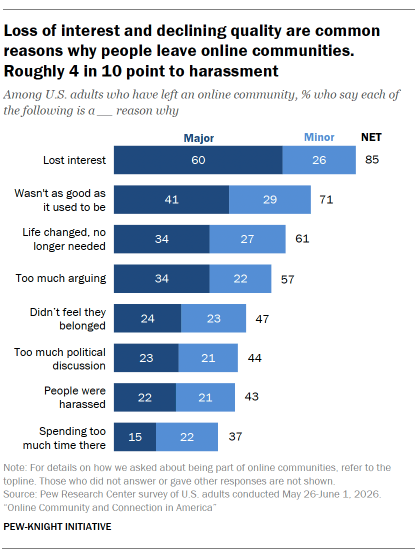
The reasons for leaving these digital enclaves are as diverse as the communities themselves, yet clear patterns have emerged in the data. The most prominent driver, cited by more than 80% of those who have left an online community, is a simple loss of interest. While this might seem benign, the frequency with which it is cited as a "major" factor suggests that many online groups struggle to maintain long-term user engagement once the initial novelty of the platform or the specific shared interest wanes.
Beyond personal interest, the structural integrity of these communities plays a critical role. Over half of those who have exited a community (57%) pointed to excessive arguing as a primary deterrent. This prevalence of toxicity is compounded by harassment, with 43% of respondents citing it as a reason for their departure. These findings align with previous research from the Center that has documented the pervasive nature of cyberbullying and online harassment among both teenagers and adults, suggesting that the digital social contract in many forums has become strained.
Political polarization also exerts a significant pull on users. Approximately 40% of those who have left an online space reported that politics was brought up too frequently. In an era where political identity has become increasingly central to public discourse, the "politicization of everything" appears to be actively driving users away from spaces they previously viewed as neutral or safe havens for specific interests.
Demographic Disparities in Online Engagement
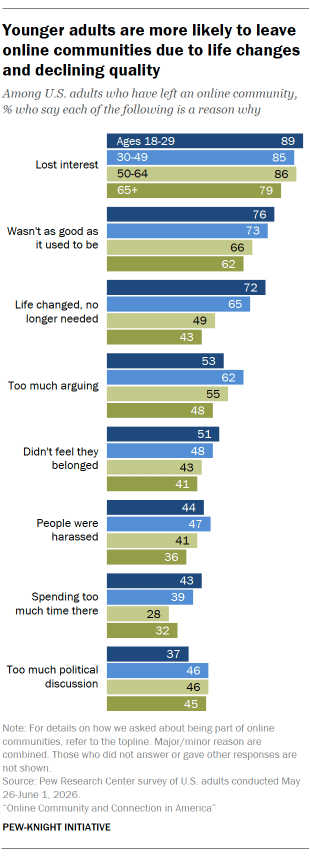
The patterns of departure are not uniform across the American population. Age, in particular, serves as a significant predictor of how and why individuals leave digital communities. Younger adults, specifically those aged 18 to 49, are significantly more likely to participate in online communities than their older counterparts; however, they are also more likely to leave them.
This demographic, often navigating rapid life transitions—such as moving, changing careers, or starting families—frequently finds that the communities they joined during one phase of life no longer serve their needs in the next. Consequently, "life changes" is a much more common justification for leaving among younger users compared to those over the age of 50.
Conversely, older Americans (those 65 and older) demonstrate higher stability in their online participation, with only 19% reporting that they have ever left an online community. This suggests that while older generations may adopt digital platforms more slowly, their commitment to the communities they do join tends to be more enduring.
Political Party and the "Politics" Factor
Perhaps one of the most striking findings in the report concerns the role of political ideology. While Republicans and Democrats are roughly equally likely to have left an online community in total (32% vs. 36%), the underlying motivations differ sharply. Republicans are significantly more likely to cite the intrusion of politics as their reason for leaving. Among those who have departed a group, 50% of Republicans pointed to the prevalence of political discourse as a deciding factor, compared to 39% of Democrats.
This discrepancy may reflect broader cultural disagreements regarding the appropriateness of political expression in non-political spaces. Liberal Democrats, in particular, were the least likely to cite politics as a reason for leaving, suggesting a higher tolerance for or alignment with the political content currently circulating in their online circles.
Methodological Context and Research Scope
The findings from this analysis are rooted in a rigorous methodology designed to capture a representative snapshot of the American experience. By surveying a diverse panel of 9,750 adults, the Pew-Knight Initiative aimed to move beyond anecdotal evidence of "digital fatigue." The research highlights that online community participation is a dynamic, fluid process. The study also acknowledges that the definition of "community" is subjective, relying on the participant’s own interpretation of what constitutes a group, whether it is a small, intimate gaming clan or a large-scale social media interest group.
Implications for the Future of Digital Society
The implications of this mass exodus are profound for platform developers, community moderators, and the broader digital economy. As users become more selective, the platforms that survive will likely be those that can successfully mitigate toxicity, offer robust moderation tools, and provide meaningful utility beyond mere content consumption.
The rise of "closed" or "private" communities—such as private servers or invite-only groups—may be a direct response to the issues of harassment and political over-saturation identified in the study. If users feel that public or large-scale forums have become too combative, they will inevitably retreat into smaller, more homogeneous, or more strictly moderated spaces.
Furthermore, the fact that a significant portion of the population is choosing to reduce their screen time or curate their digital intake suggests a growing cultural emphasis on "digital wellness." As users begin to value the quality of their interactions over the quantity of their connections, the business models of many social platforms—which rely heavily on high engagement metrics and time-on-site—may face a fundamental challenge.
Conclusion
The data provided by the Pew-Knight Initiative serves as a necessary reality check for the digital age. While online communities remain a vital component of modern American life, they are not immune to the same social frictions that define physical-world interactions. The trend of users stepping away is not necessarily a rejection of technology itself, but rather a reflection of a growing desire for healthier, more relevant, and less combative environments. For researchers and platform architects alike, the path forward involves addressing the structural issues of toxicity and political friction, ensuring that the digital town square remains a place where individuals can find support and belonging rather than conflict and exhaustion.