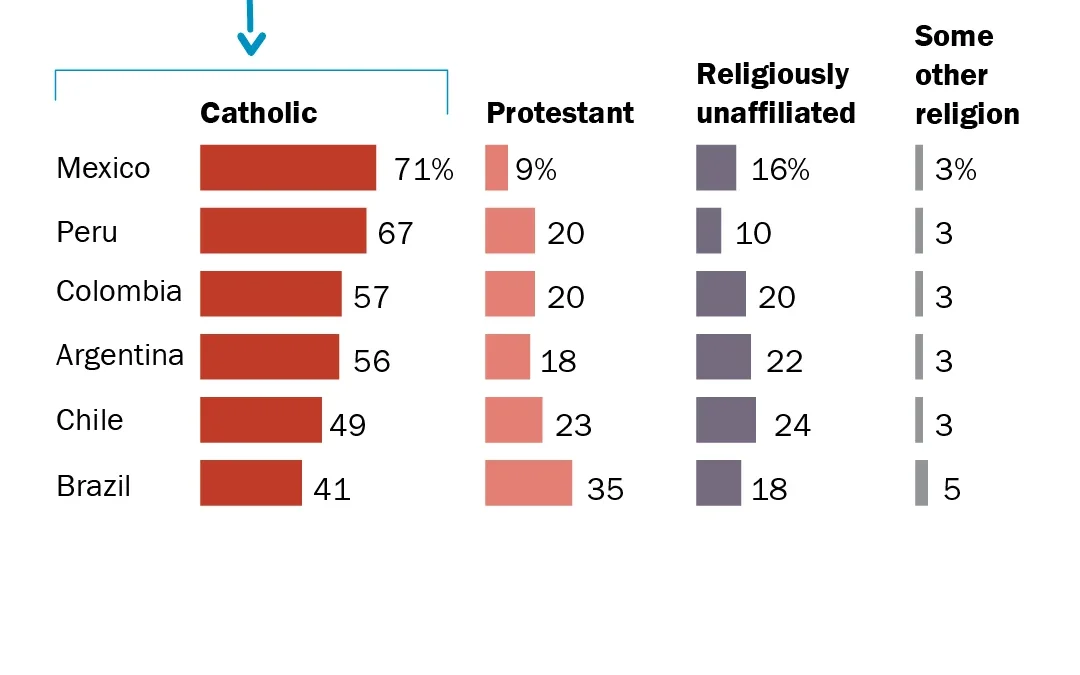
The religious identity of Latin America is undergoing a profound and measurable transformation, according to extensive new survey data released by the Pew Research Center. As the region moves further into the 21st century, the long-standing dominance of Catholicism is facing steady erosion, even as the faith remains the primary religious affiliation for millions across the continent. Drawing from a comprehensive survey of over 6,100 adults conducted in the spring of 2026, researchers have mapped a complex transition characterized by shifting demographics, evolving personal practices, and varying levels of public sentiment toward institutional leadership, including the papacy of Pope Leo XIV. This analysis, which focuses on Brazil, Mexico, Colombia, Argentina, Peru, and Chile, offers a granular look at how these six nations—which represent the most populous and influential demographic centers in the region—are navigating the changing role of religion in public and private life.
A Chronology of Religious Decline and Transformation
To understand the current state of faith in Latin America, one must look at the historical trajectory of the last decade. Since the mid-2010s, sociological indicators have consistently signaled a retreat from traditional institutional affiliation. In 2013 and 2014, Pew Research Center’s initial benchmarking studies highlighted a region that was overwhelmingly Catholic, though already showing the early signs of a drift toward secularism or Protestant denominations. By 2026, that trend has not only persisted but accelerated.
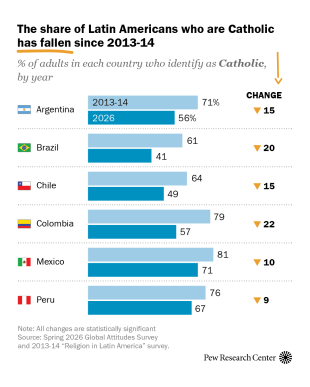
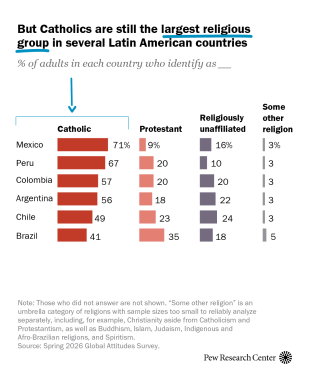
The timeline of this shift is marked by several key inflection points. Following the election of Pope Leo XIV, there was an initial period of cautious optimism across many Latin American dioceses. However, the subsequent decade saw a steady decline in nominal Catholic identification. By 2020, economic instability and the global health crisis began to further strain the traditional bonds between the Church and its laity. By 2026, the data confirms that while the Catholic Church remains the largest religious institution in the region, its hold on the public imagination has weakened, with significant portions of the younger population identifying as unaffiliated or moving toward evangelical and Pentecostal movements.
Supporting Data: The Statistical Reality
The data released in November 2026 presents a multifaceted picture of this decline. The primary finding is a marked decrease in the percentage of the population that identifies as Catholic compared to the 2013-14 period. While the raw numbers remain significant, the "market share" of Catholicism is shrinking. In Brazil, the region’s largest country by population, the erosion of the Catholic majority has been particularly pronounced, mirroring broader trends of religious pluralization.
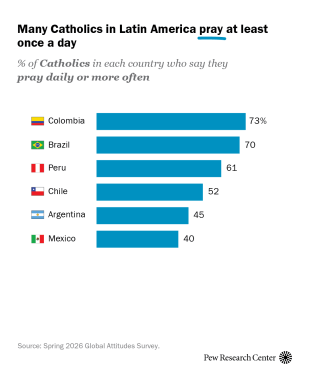
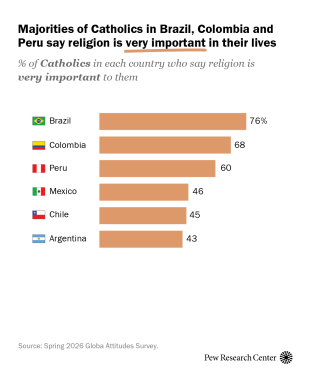
Conversely, the intensity of practice among those who remain within the fold varies significantly by country. While fewer people may identify as Catholic, the survey reveals that for a core demographic, religion remains a central pillar of identity. In countries like Colombia and Peru, a clear majority of those identifying as Catholic report that religion is "very important" in their daily lives. Furthermore, daily prayer remains a common practice among practicing Catholics, suggesting that while the breadth of the Church’s reach is narrowing, the depth of commitment among the remaining faithful remains resilient.
The survey also provides insights into the regional perception of Pope Leo XIV. One of the most intriguing findings is the correlation between personal history and institutional favorability. In Peru, where Pope Leo XIV spent two decades of his life and ascended to the rank of bishop in 2014, his approval ratings remain among the highest in the region. This suggests that the perceived accessibility and personal connection of religious leadership play a significant role in maintaining the relevance of the institution, even in an era of waning religious institutionalism.
Institutional Responses and Theological Implications
The findings have sparked a quiet but intense period of reflection within ecclesiastical circles. Church leaders in the region have acknowledged the data, noting that the transition away from traditional structures is not merely a rejection of faith, but a reconfiguration of how citizens engage with the sacred. Theological observers point out that the rise of independent religious movements—often characterized by more informal, community-centric worship—is a direct response to the perceived rigidity of older, more hierarchical institutions.
While the Catholic hierarchy has not released a formal manifesto in response to this specific 2026 report, the sentiments expressed by regional cardinals and bishops in recent months emphasize a focus on "missionary outreach" and "pastoral proximity." There is an implicit recognition that the era of cultural Catholicism—where identity was assumed by birth rather than chosen by practice—has come to an end. The challenge now, as framed by many church sociologists, is to transition from a default religious model to a model of intentional, individual commitment.
Broader Social and Political Impacts
The implications of this shift extend far beyond the pews of a cathedral. Religion in Latin America has historically been a significant driver of public policy, social welfare, and political discourse. As the influence of the Catholic Church wanes, the political landscape is becoming increasingly contested. Religious groups are no longer monolithic voting blocs, and politicians across the region are having to navigate a more diverse religious constituency.
In Brazil, the rise of a politically active evangelical movement has already shifted the legislative agenda on issues ranging from education to social morality. In Mexico and Argentina, the decline of religious affiliation is often linked to the rise of more secular political ideologies that prioritize individual rights and state-led social programs over the traditional moral guidance of the Church. This creates a more complex environment for policymakers, who must balance the demands of a growing secular population with the enduring influence of religious moral frameworks.
Moreover, the survey findings suggest that the "unaffiliated" segment of the population is growing, a group that is increasingly vocal in demanding separation of church and state in legislative matters. This demographic, often younger and more urbanized, is less likely to view religious institutions as legitimate arbiters of social policy.
Future Outlook: The Road Ahead
As the Pew-Templeton Global Religious Futures project continues to monitor these developments, the central question remains: what will be the terminal point of this decline? If the current trajectory continues, the religious landscape of Latin America will likely mirror the secularization patterns observed in parts of Europe and North America, though with a distinct Latin American character—one that retains a stronger emphasis on spiritual expression and prayer, even outside of formal institutions.
The funding provided by The Pew Charitable Trusts and the John Templeton Foundation underscores the international importance of this research. By analyzing the intersection of religious change and societal impact, researchers hope to provide a blueprint for understanding how modern societies grapple with the loss of traditional pillars. While the data from 2026 does not necessarily reflect the views of these funders, it provides a crucial, objective baseline for future sociological research.
The transition from a continent defined by a singular faith to one characterized by religious pluralism and secularism is not a sudden event, but a long-term, structural realignment. For the leaders of the Catholic Church, the challenge is to adapt to a landscape where their voice is one of many. For the nations of Latin America, the challenge is to integrate these changing belief systems into a cohesive national identity that respects both the historical heritage of the region and the evolving values of its people. As the demographic data continues to show, the only constant in the Latin American religious experience is change itself. The next decade will likely be defined by how these countries manage the tension between their deeply religious past and a, by all accounts, increasingly secular future.