As modern buyer research decisively shifts from traditional search engines toward generative answer engines, digital marketing teams face an entirely new operational challenge: determining how frequently to collect, analyze, and act upon Answer Engine Optimization (AEO) data. Unlike traditional search engine optimization (SEO), where rankings fluctuate within a relatively predictable matrix, AI-driven platforms like ChatGPT, Perplexity, and Google Gemini introduce high levels of response variability. Consequently, establishing an optimal prompt-tracking cadence has become a critical priority for modern marketing executives seeking to accurately measure brand visibility without falling victim to statistical noise.
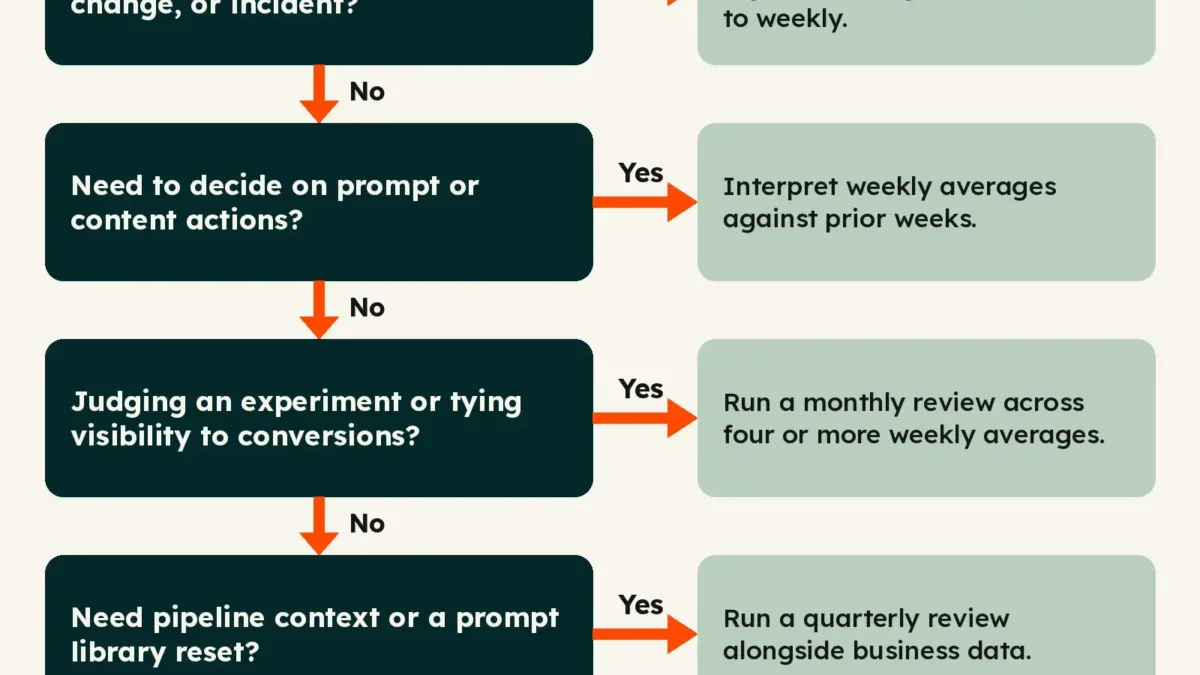
The core dilemma facing marketing departments is twofold: distinguishing between automated data collection frequencies and human decision-making intervals. Industry standard frameworks suggest a structured rhythm: automated daily data collection where tool architecture permits, weekly interpretation of aggregated averages, monthly reviews centered on conversion and experimental outcomes, and quarterly assessments focused on broader pipeline context. Daily monitoring is generally reserved exclusively for major corporate launches or significant brand pivots.

The Evolving Landscape of AI Search and Buyer Behavior
The urgency behind establishing a disciplined AEO cadence is underscored by shifting consumer habits. According to a 2026 HubSpot survey of 3,063 CRM software purchase decision-makers, 42% of buyers now rely on artificial intelligence search tools as a primary component of their software evaluation process. Because a substantial portion of enterprise and consumer discovery occurs inside conversational interfaces, measurement habits that mistakenly react to random fluctuations—rather than genuine shifts in market positioning—can easily derail a content strategy.
Platforms designed to address this paradigm, such as HubSpot AEO, automatically execute tracked prompts on a daily basis across major LLMs including ChatGPT, Perplexity, and Gemini. However, the automated accumulation of data is only the first step. The primary operational hurdle lies in filtering out the inherent volatility of generative systems to make informed, strategic decisions.
Understanding Model Volatility and Non-Deterministic Drift
To build an effective tracking rhythm, marketing leaders must understand the technical reality of generative artificial intelligence: answers change constantly, even under identical conditions. A landmark study on non-deterministic drift, which examined repeated-run experiments across multiple language models, revealed that non-determinism persists even when models are set to a zero temperature configuration. Identical prompts frequently yield divergent outputs across consecutive queries.

Further compounding this challenge, research published by SparkToro examining AI recommendation consistency across nearly 3,000 runs found that the statistical probability of receiving the exact same list of recommended brands twice was less than one in one hundred. The odds of receiving those brands in the exact same rank order approached one in one thousand.
These findings carry profound implications for marketing analytics. Analysts note that while static ranking positions in AI search results remain highly volatile and unreliable as short-term indicators, aggregate visibility percentages calculated across multiple prompts and repeated runs serve as strong directional metrics. Consequently, digital marketing teams must establish a baseline noise floor during their first four to six weeks of tracking, observing how much weekly averages swing organically before attributing changes to content updates or marketing campaigns.
Establishing the Optimal Tracking and Review Cadence
Designing a sustainable workflow requires organizations to separate the mechanics of data gathering from strategic evaluation. A robust cadence typically incorporates four distinct operational tiers:

- Daily Collection: Automated systems capture prompt outputs, brand mentions, competitor citations, and sentiment daily to build a comprehensive statistical sample.
- Weekly Interpretation: Teams review aggregated weekly averages to identify legitimate upward or downward trends, insulating themselves from single-day anomalies.
- Monthly Experimentation: Marketers analyze conversion data, test new prompt variations, and evaluate the performance of distinct content experiments.
- Quarterly Pipeline Reviews: Leadership connects AEO visibility trends to broader pipeline context, CRM data, and revenue attribution models.
+--------------------+---------------------------------------------------+
| Review Cadence     | Primary Operational Focus                         |
+--------------------+---------------------------------------------------+
| Daily Collection   | Automated ingestion across ChatGPT, Gemini, etc.  |
| Weekly Read        | Analyzing aggregated averages to filter out noise |
| Monthly Review     | Conversion metrics and exploratory prompt testing |
| Quarterly Audit    | Pipeline context, CRM integration, and strategy   |
+--------------------+---------------------------------------------------+
When structuring a prompt library, specialists recommend segmenting queries by intent, product line, and Ideal Customer Profile (ICP). Mixing unbranded, solution-seeking prompts with highly specific branded queries into a single blended score often obscures crucial insights. Unbranded prompts serve as an accurate trend line for overall market visibility, whereas branded queries function as a competitive positioning check.
Fact-Based Implications and Industry Analysis
The transition toward AI-driven discovery mandates a fundamental reevaluation of content marketing and public relations. Because answer engines frequently synthesize information and cite external authority domains rather than simply listing corporate landing pages, visibility is increasingly tied to digital PR and third-party validation.
Industry analysts emphasize that organizations reacting impulsively to daily score drops risk wasting resources on unnecessary content rewrites. Conversely, enterprises that fail to monitor their share of voice within generative engines risk ceding thought leadership to competitors in early-stage buyer research. By anchoring decisions to multi-week moving averages and rigorous verification rules—such as requiring visibility shifts to persist across consecutive weeks before altering strategy—marketing teams can successfully navigate the complexities of answer engine optimization and secure sustainable digital prominence.