The 2026 midterm elections are poised to become a landmark moment in American political history as voters in multiple states prepare to shatter long-standing gender barriers. In high-stakes gubernatorial contests in Minnesota and Tennessee, the outcome is statistically certain to result in the swearing-in of the first female governor in each state’s history. These races represent the latest chapter in a century-long, incremental climb for women in U.S. executive and legislative power, a journey that began with symbolic appointments and has evolved into the current era of competitive, high-level political campaigns.
According to data provided by the Center for American Women and Politics at Rutgers University, 17 states remain that have never been led by a woman governor. As the nation approaches the final ballots of the 2026 cycle, the significance of these elections extends beyond the individual winners; it reflects a systemic shift in the candidate pipeline and the growing normalization of women at the helm of state executive branches.
The Landscape of the 2026 Gubernatorial Races
In Minnesota, the race has captured national attention as Democratic U.S. Senator Amy Klobuchar faces off against Republican state House Speaker Lisa Demuth. Regardless of the partisan result, the state is guaranteed to elect its first woman governor, signaling a decisive end to a streak of male-only leadership that has persisted since the state’s admission to the union.
A similar scenario is unfolding in Tennessee, where Republican U.S. Senator Marsha Blackburn is competing against Democratic Memphis City Council member Jerri Green. Like Minnesota, Tennessee has yet to see a woman occupy the governor’s mansion. These races highlight a broader trend where, even in deeply partisan environments, party establishments are increasingly fielding female candidates for the highest state offices, effectively removing the gender barrier in those specific jurisdictions.

While Minnesota and Tennessee are the most prominent examples, three other states are seeing major-party nominees who, if successful, would also make history as their state’s first female governor. This collective movement underscores a tightening of the gap between the number of men and women who have ascended to the governorship since the mid-20th century.
A Chronology of Women in Executive Power
The road to the current 2026 milestones began exactly a century ago. The history of women governors is brief, dating back only to 1925. In that year, Wyoming’s Nellie Tayloe Ross and Texas’s Miriam "Ma" Ferguson became the first women to serve as governors. Their paths were different but equally foundational: Ross won a special election following the death of her husband, while Ferguson successfully campaigned in a general election, taking office just over two weeks after Ross.
For decades following those pioneering terms, progress remained sluggish. It was not until the late 20th century that the number of women serving as governors began to climb with any degree of consistency. Between 1975 and 2000, the number of women serving concurrently in governorships grew from one to two. The 21st century brought more rapid growth, with the count reaching 14 by 2025.
Arizona stands as an outlier in this history. Since 1988, the state has elected five women governors, including a streak of consecutive leadership that spanned nearly two decades. From the swearing-in of Republican Jane Hull in 1997 through the conclusion of Jan Brewer’s term in 2015, Arizona demonstrated that women could maintain sustained executive power in a major state, providing a blueprint that many other states are only now beginning to emulate.
The U.S. Senate: A Century of Representation
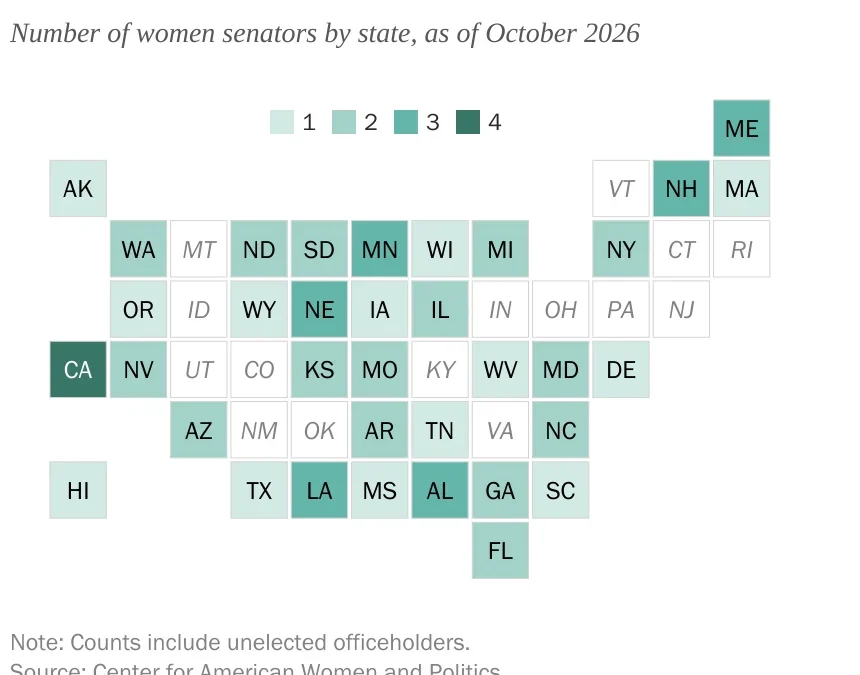
While the gubernatorial landscape is shifting, the U.S. Senate presents a different, yet equally significant, trajectory. As of October 2026, 65 women have served as U.S. senators, representing 35 different states. Much of this progress is concentrated in the modern era; approximately 78% of all women who have ever served in the Senate took office after 1980.

The first woman to serve in the Senate was Rebecca Latimer Felton of Georgia, appointed in 1922 at the age of 87. Her term was strictly symbolic, lasting a single day. It would be decades before the Senate became a place where women served for full, substantive terms.
Currently, women hold a record 27 of the 100 seats in the U.S. Senate. This record is marked by a clear partisan disparity: 16 of these senators are Democrats, while 11 are Republicans. Women constitute 34% of the Democratic caucus, compared to 21% of the Republican conference. This discrepancy suggests that while both parties are moving toward gender parity, the mechanisms for recruiting and supporting women candidates remain more entrenched within the Democratic infrastructure.
Despite these gains, 15 states have never been represented by a woman in the U.S. Senate. This list includes states with diverse political histories, suggesting that the barrier to entry for the upper chamber of Congress remains high. In the current 2026 election cycle, however, two of these states—Montana and Oklahoma—have women on the ballot as major-party nominees, specifically Alani Bankhead and N’Kiyla Jasmine Thomas, respectively. Their candidacies represent a significant effort to bridge the remaining gap in the Senate’s demographic makeup.
Institutional Barriers and Future Implications
The data from the Center for American Women and Politics reveals that four states—Colorado, Idaho, Indiana, and Pennsylvania—have never had a woman senator or a woman governor. This persistent void in these states highlights the structural challenges that persist in state politics, ranging from incumbent advantages that favor long-standing political dynasties to local fundraising networks that may inadvertently favor traditional candidate profiles.
However, the fact that every state in the U.S. has now sent at least one woman to Congress—either to the House or the Senate—suggests that the threshold for women in national politics has been permanently crossed. Vermont, the final state to reach this milestone, did so as recently as 2022.

The political implications of these "firsts" are far-reaching. When a state elects its first woman governor, it often alters the political culture of that state, expanding the pool of potential future candidates and changing the priorities addressed in the governor’s office. Research has consistently shown that the presence of women in executive roles can lead to shifts in legislative agendas, particularly concerning education, healthcare, and family support systems.
Analyzing the Shift
Political analysts note that the 2026 midterms are not merely about the symbolic value of electing women. The rise in female candidates at the gubernatorial level is a function of a maturing pipeline. Many of the women running for governor in 2026 have extensive experience in state legislatures, local government, or as members of the U.S. House.
The transition from "the first" to "the norm" is a delicate process. For many years, women in politics faced a "double bind," where they were often viewed as either too aggressive or too soft, depending on their leadership style. Today’s candidates, as seen in the debates between Klobuchar and Demuth, are largely judged on traditional political metrics: economic policy, infrastructure, and partisan alignment. This shift toward a focus on policy substance over gender-based stereotypes is arguably the most significant development in the 2026 cycle.
Furthermore, the influence of appointed officials cannot be overlooked. A notable portion of the women who have served as senators and governors were originally appointed to their positions to fill vacancies caused by death or resignation. Many of these women subsequently ran for election to keep their seats and were successful, proving that while the path to office may vary, the ability to win and hold onto power is increasingly gender-neutral.
Conclusion
As the 2026 midterms conclude, the map of the United States will look significantly different. The addition of new states to the list of those that have elected a woman governor is not an isolated event; it is a continuation of a trajectory that has seen women move from the fringes of political life to the center of the executive and legislative chambers.

While 17 states have yet to break the gubernatorial glass ceiling and 15 have yet to do so in the Senate, the momentum of the current cycle suggests that these numbers will continue to dwindle. The progress is slow, often occurring over decades rather than election cycles, but the cumulative effect of these individual milestones is a more representative government that more closely reflects the demographic reality of the American public. The voters in 2026 are not just choosing candidates; they are finalizing a century-long shift in the definition of who can lead.