The fundamental mechanics of information discovery are undergoing a profound transformation. Rather than navigating through traditional search engine results pages defined by lists of blue links, consumers and enterprise buyers alike are increasingly turning to generative artificial intelligence platforms and conversational interfaces such as ChatGPT, Google AI Overviews, and Perplexity. These AI-driven tools synthesize vast datasets to deliver direct, consolidated answers to complex queries.

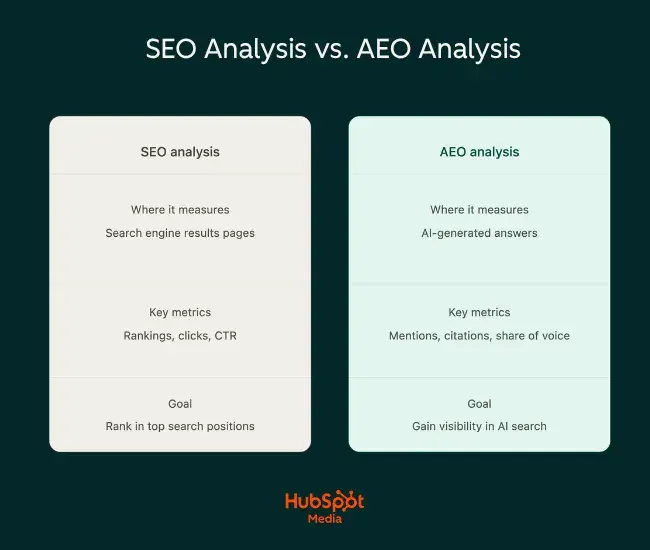
This behavioral pivot has catalyzed the rapid development of Answer Engine Optimization (AEO), a specialized digital marketing discipline focused on ensuring that a brand’s content is selected, cited, and favorably surfaced by AI answer engines. Unlike legacy search engine optimization (SEO), which primarily targets keyword rankings and click-through rates on a static results page, AEO analysis requires organizations to measure and manage their underlying presence, framing, and share of voice within dynamic AI responses.

The Evolution of Search: From Keyword Indexing to AI Synthesis
For decades, digital marketing strategies relied heavily on traditional SEO metrics. Brands competed for top positions based on keyword density, domain authority, and backlink profiles. However, the rise of answer engines has fundamentally altered this paradigm. An answer engine does not merely return a directory of external links; it aggregates information across multiple sources, extracts relevant data points, and generates a single, cohesive response, often citing its sources along the way.

This shift presents a critical challenge and a unique opportunity for market visibility. When a potential buyer begins their research phase using an AI chatbot, appearing prominently and favorably within the generated response provides an immediate strategic advantage. Conversely, an absence or mischaracterization in these responses represents a visibility deficit that traditional keyword rankings fail to diagnose.

Industry data underscores this accelerating trend. According to recent market research, nearly 32 percent of B2B buyers now initiate their product and service research using generative AI chatbots, rivaling traditional web search at 33 percent. Within specialized sectors such as technology and software, reliance on generative AI for initial queries climbs as high as 56 percent. Furthermore, demographic shifts indicate that approximately 31 percent of Generation Z default directly to AI assistants for everyday information retrieval, signaling a generational change in how audiences consume content.

Defining AEO Analysis: Metrics, Measurements, and Methodologies
Conducting a thorough AEO analysis involves evaluating how a brand is represented within AI-generated outputs. Key performance indicators extend beyond simple traffic metrics to encompass brand visibility, citation frequency, sentiment analysis, and competitor share of voice.

Brand Visibility and Sentiment
Brand visibility tracks the absolute frequency with which AI platforms reference a brand name in response to specified prompts. While some critics dismiss raw visibility as a vanity metric, industry analysts argue that it serves as a necessary top-of-funnel prerequisite. Without initial visibility, a brand cannot earn a citation, secure a click, or ultimately drive a conversion. Sentiment analysis evaluates whether the AI platform characterizes the brand favorably, neutrally, or critically, ensuring that the narrative aligns with corporate positioning.

Mentions Versus Citations
A crucial distinction in AEO analysis lies between a brand "mention" and a "citation." A mention occurs when an AI model includes the brand name within the text response without providing a direct hyperlink. A citation, however, designates the brand’s specific piece of content as a verified source supporting the AI’s claim, complete with a clickable link directing the user back to the brand’s domain. Citations carry significantly higher value, signaling to both searchers and algorithms that the content possesses authoritative credibility.

Competitive Share of Voice
Measuring performance in isolation can obscure broader market trends. Competitive share of voice evaluates how frequently a brand appears relative to its primary competitors for identical prompts. Even if a brand maintains stable visibility, a rising share of voice among competitors indicates a declining competitive posture.

Developing a Repeatable AEO Analysis Framework
To transition AEO analysis from a static audit to an ongoing operational process, organizations must establish a structured, repeatable framework.

- Constructing a Reliable Prompt Set: Rather than attempting to track an infinite number of conversational variations, marketing teams must group test queries into logical categories, such as pricing questions, product comparisons, and use-case queries. Utilizing data from sources like Google Search Console alongside qualitative insights from customer support tickets and sales calls ensures that the prompt set accurately reflects real-world search intent.
- Standardizing Evidence Capture: Every prompt execution must document comprehensive qualitative and quantitative data points, including exact mention status, citation presence, sentiment framing, and source attribution.
- Establishing Review Cadences: Because generative AI models undergo frequent algorithmic updates and source reweighting, single-week fluctuations can often represent systemic noise rather than true performance shifts. Industry experts recommend monthly tracking intervals to accurately identify genuine trends, seasonality, and long-term positioning adjustments.
Evaluating Modern AEO Analysis Tools
As the demand for specialized measurement grows, a robust ecosystem of AEO analysis tools has emerged to assist marketing teams in auditing and tracking their AI visibility.

- HubSpot AI Search Grader: A widely utilized diagnostic tool that provides a free, point-in-time score across five core dimensions: sentiment, presence quality, brand recognition, share of voice, and market position. It serves as an accessible baseline assessment before committing to comprehensive, long-term optimization strategies.
- Peec AI: A dedicated AEO tracking platform capable of monitoring visibility across up to eleven distinct AI engines, including ChatGPT, Google AI Overviews, Microsoft Copilot, Perplexity, and Claude. While offering extensive platform coverage, organizations must carefully evaluate pricing structures as monitoring tiers scale with the number of integrated engines.
- Profound: An enterprise-grade solution offering multi-engine and multi-region tracking capabilities. Designed for large organizations requiring deep analytical insights into prompt volumes and citation sources, Profound’s advanced features primarily reside within custom-quoted enterprise tiers.
- Semrush One: Integrating traditional SEO data with a dedicated AI Visibility module, Semrush leverages its extensive legacy in search behavior analysis to help organizations monitor how their domains appear across both standard search engines and AI-generated answers.
Strategic Implications and Implementation
Translating AEO data into actionable corporate strategy requires a multifaceted approach focused on technical and content enhancements. Organizations looking to improve their standing within AI answer engines must prioritize the development of clear, well-defined corporate entities through structured schema markup and consistent brand nomenclature. Furthermore, content must be structured specifically for algorithmic extraction—utilizing concise definitions, bulleted lists, and FAQ formats that allow AI models to easily synthesize and cite the underlying information.

Additionally, maintaining robust third-party source coverage is vital. Because generative AI models rely heavily on external validation, ensuring accurate representation across industry review sites, third-party publications, and comparison portals directly influences how AI engines perceive and weight a brand’s authority.

As generative search continues to mature through 2026 and beyond, organizations that integrate rigorous AEO analysis into their broader marketing operations will secure a distinct competitive advantage, ensuring their continued relevance as artificial intelligence redefines the digital landscape.