Artificial intelligence has rapidly transitioned from an experimental novelty into an embedded pillar of modern digital culture. As billions of internet users integrate algorithmic assistants into their daily routines, technology companies are racing to understand how public perception is evolving alongside these powerful capabilities. Snapchat has officially entered this discourse with the release of a comprehensive new industry report titled "Navigating the Age of AI." Based on robust data collected by research firms Ipsos and WPP, the publication explores the shifting psychological and practical relationship between everyday consumers and conversational artificial intelligence.
The findings present a fascinating paradox. While millions of people increasingly rely on AI chatbots to organize their thoughts, spark creativity, and navigate complex social landscapes, they simultaneously harbor deep-seated anxieties regarding data privacy, targeted advertising, and the authenticity of machine-generated media. By examining responses from more than 4,200 active AI users, Snapchat’s report attempts to map out the psychological boundaries that govern modern digital interaction, offering crucial insights for marketers, platform developers, and policymakers alike.
Main Facts and Core Survey Findings
At the heart of Snapchat’s newly published report are staggering usage statistics that underscore how deeply entrenched artificial intelligence has become in contemporary consumer behavior. According to the research, 48% of surveyed consumers now utilize artificial intelligence tools on a daily basis. The adoption rate is even higher among professional creators and marketers, half of whom—50%—identify AI as a core, indispensable component of their daily operational routines.
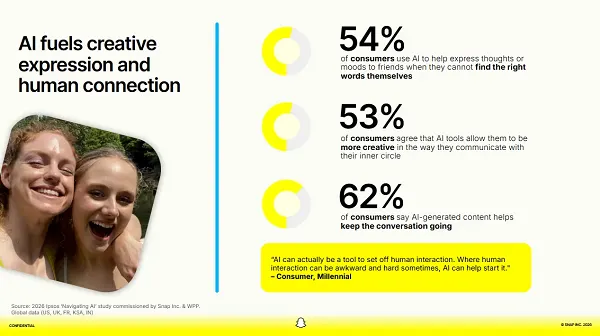
The study demonstrates that artificial intelligence is no longer viewed merely as a search engine alternative or a novelty text generator. Instead, it is increasingly regarded as a trusted, collaborative partner capable of guiding complex decision-making processes, including consumer product research and interpersonal communications. A significant majority of respondents—62%—reported that AI tools actively assist them in maintaining and enriching their conversations. This indicates a growing trend of individuals utilizing algorithmic assistants as sounding boards to refine their ideas, structure their thoughts, and rehearse difficult discussions before bringing them into the public sphere.
Furthermore, the data highlights unique behavioral patterns among the platform’s core demographic. Snapchat users surveyed in the study proved to be 2.2 times more likely to agree that artificial intelligence positively impacts their social lives, and 1.6 times more likely to leverage AI tools for planning real-world activities, ranging from social outings to travel itineraries.
The Psychological Appeal of the Chatbot Companion
To understand why adoption rates remain exceptionally high, one must examine the psychological environment cultivated by modern conversational AI. According to the report, over 80% of users describe their experiences with artificial intelligence as friendly and collaborative. More importantly, 74% of respondents view AI chat interfaces as a strictly judgment-free zone.
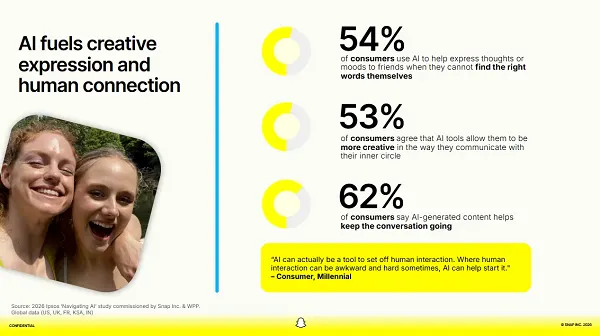
This perception of safety has transformed AI chatbots into private coaching spaces. Users are turning to these digital assistants to articulate complex emotional states, draft delicate messages, and process personal dilemmas without the immediate fear of social repercussion or embarrassment. In an era marked by rising levels of social anxiety and digital fatigue, the algorithmic listener offers a frictionless outlet that demands nothing in return other than computational engagement.
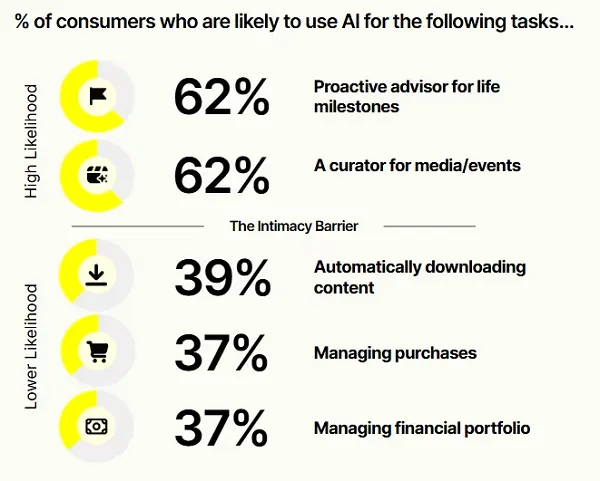
However, this high degree of trust does not uniformly extend across all digital domains. While users are remarkably comfortable treating AI as a confidant or creative partner, reservations persist regarding high-stakes applications. The survey data reveals that consumers remain hesitant to lean on AI when it comes to managing personal finances, executing financial transactions, or making significant monetary purchases. The threshold of trust, it appears, is heavily dependent on the perceived risk associated with the task at hand.
The Privacy Paradox: The Sliding Scale of Value and Data
One of the most provocative arguments presented in Snapchat’s report centers on the evolving definition of digital privacy. For decades, the dominant narrative surrounding consumer technology has focused on absolute privacy—whether a platform or tool is secure against unauthorized data harvesting. Snapchat’s research suggests this paradigm has fundamentally shifted.
"Privacy today isn’t an absolute—it’s a sliding scale," the report states. "Consumers aren’t asking, ‘Is this private?’ They’re asking, ‘Is this worth it?’ The reality is that users will willingly trade data for personalized AI experiences when the immediate value is obvious. But that value exchange has boundaries."
This transactional view of privacy has long been an unwritten rule of the social media ecosystem, where free services are exchanged for behavioral data used to fuel targeted advertising. However, Snapchat’s explicit acknowledgment and promotion of this dynamic mark a notable moment of transparency within the tech industry. By framing data collection as a fair trade-off for superior utility, platforms are attempting to normalize the integration of AI-driven data harvesting.
Yet, this logic exposes a glaring contradiction within consumer sentiment—a tension that the report itself inadvertently brings to light. While users may tolerate data collection in exchange for a responsive chat interface, their patience wears thin when that same data is repurposed for commercial gain.
The Backlash Against Hyper-Personalization and Soulless Media
Even as consumers embrace AI as a personal companion, they draw a hard line against aggressive commercial intrusion and synthetic content. The Snapchat report reveals a profound counter-movement against the unchecked monetization of artificial intelligence.
Specifically, 70% of consumers reported finding the use of personal data in hyper-personalized AI advertisements to be overtly intrusive. This statistic highlights a critical disconnect between what users expect from their direct interactions with a chatbot and how they expect platform operators to monetize those interactions. A user may appreciate an AI assistant remembering their conversational preferences within a private chat session, but they feel violated when those same insights are weaponized by brands to serve hyper-targeted ads across their feeds.
Additionally, public skepticism toward purely synthetic media remains high. The report notes that 56% of consumers consider 100% AI-generated content to be "soulless." This finding underscores the enduring value of human authenticity in creative expression. While users are eager to use AI as a scaffolding tool to jumpstart their own creativity or draft communications, they place little value on art, writing, or media produced entirely by an algorithm without human intervention.
This dichotomy exposes a central challenge for the technology sector: bridging the gap between functional utility and creative emptiness. People want tools that enhance their human capabilities, not replacements that render human expression obsolete.
Broader Industry Implications and Future Outlook
The release of Snapchat’s report arrives at a critical juncture in the maturation of the artificial intelligence market. As generative AI moves past the initial wave of consumer fascination, companies are under immense pressure to demonstrate long-term commercial viability and sustainable monetization strategies.
For brands and marketers, the implications of the Ipsos and WPP data are clear. Integrating AI into marketing funnels cannot rely on a blanket approach of intrusive hyper-personalization. Instead, brands must respect the boundaries established by consumers, focusing on utility, transparency, and consent. If consumers perceive an AI tool as genuinely helpful rather than purely exploitative, they are far more likely to engage willingly.
For platform developers, the challenge lies in reconciling the paradox identified in the research. Users are willing to trade elements of their privacy for immediate utility in conversational contexts, but they simultaneously reject the broader commercial applications of that data. Navigating this tightrope will require companies to build robust privacy-preserving technologies—such as on-device processing and zero-knowledge data architectures—that can deliver personalized AI experiences without triggering consumer backlash.
Ultimately, Snapchat’s "Navigating the Age of AI" report serves as both a roadmap and a warning. Artificial intelligence has secured its place as an integral part of the modern digital toolkit, fundamentally altering how people communicate, create, and seek guidance. However, as the boundaries between human intuition and machine intelligence continue to blur, the ultimate success of these technologies will depend not on computational power alone, but on maintaining the fragile, hard-earned trust of the human beings using them.