The digital landscape is undergoing a seismic shift, moving away from the rigid, menu-heavy architectures that have defined the internet for over forty years toward a new paradigm centered on human intent. For decades, the user experience (UX) has been predicated on the "point-and-click" model, a design philosophy rooted in the Xerox Star and the original Apple Macintosh. In this traditional framework, users are forced to navigate complex labyrinths of tabs, sliders, forms, and navigation bars to reach a desired outcome. However, the rise of large language models (LLMs) and advanced artificial intelligence is enabling a fundamental pivot: the transition from "software management" to "intent execution."
The historical reliance on graphical user interfaces (GUI) established a contract where the computer acted as a passive container of data, requiring the human user to serve as the active orchestrator. Whether booking a flight or researching a medical symptom, the user was expected to perform the "grunt work"—manually inputting parameters, interpreting raw outputs, and executing micro-steps. Industry analysts now suggest this era of high-friction interaction is rapidly nearing its conclusion, giving way to an era where the interface acts as a transparent, intelligent agent that executes tasks on behalf of the user.

A Chronology of the Interface Evolution
To understand this transition, one must look at the evolution of the web’s primary interaction models. In the early 1980s, the introduction of the GUI was a revolutionary step toward accessibility, abstracting command-line code into visual metaphors. By the late 1990s and early 2000s, the "Web 2.0" era solidified the dominance of the browser-based form and the click-heavy funnel.
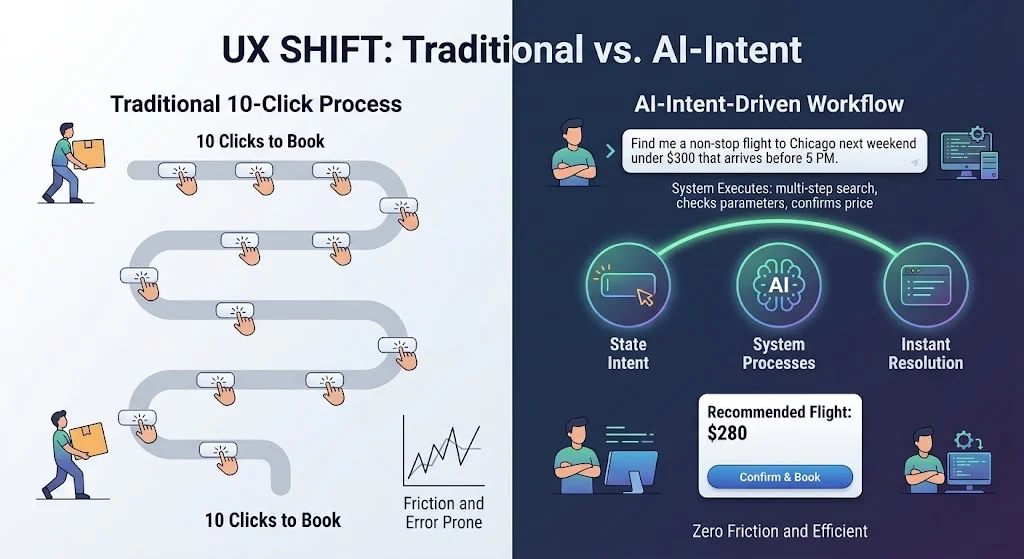
Data from the Nielsen Norman Group, a leading authority on user interface research, indicates that the average user spends approximately 60% of their time on the web navigating interfaces rather than engaging with the actual content they seek. This "navigation tax" has long been considered a necessary cost of doing business online. However, the 2023-2026 period has served as an inflection point. With the integration of generative AI into consumer-facing search and design tools, the "10-click process" is being systematically replaced by "zero-click" outcomes.
The Mechanism of Intent-Driven Design
Intent-driven design operates on a different logic than its predecessor. Instead of presenting a static menu of options, these systems employ a tripartite architecture: natural language processing for input, generative UI for output, and autonomous agents for execution.
This philosophy draws heavily from the principles of "No Interface" design, pioneered by authors like Golden Krishna, and human-centered design principles established by Don Norman. The core tenet is that the ultimate goal of software is to be so intuitive that it effectively eliminates the user interface entirely. By capturing a user’s high-level goal—such as "Find me a flight to Chicago under $300 arriving before 5 PM"—the software bypasses the need for the user to manually filter results, compare prices, and manage open browser tabs.
Industry Examples and Technological Implementation
Several platforms have already begun to operationalize this shift. Perplexity AI, for example, has transformed the traditional search experience. Rather than serving as a directory of links that requires the user to perform the labor of synthesizing information, it aggregates and summarizes data in real-time. This reduces the cognitive load on the user and minimizes the "tab-switching" behavior that has defined internet research for two decades.
Similarly, in the design sector, Vercel’s v0 has begun to replace the manual labor of web development. Where designers once spent hours manipulating rectangles, CSS code, and padding values in tools like Figma, they can now prompt a generative system to render functional components instantly. This represents a transition from "creating the interface" to "directing the interface’s creation."

Furthermore, tools like Goblin.tools are addressing the needs of neurodivergent users by automating the breakdown of overwhelming, complex tasks into actionable checklists. By stripping away the requirement for manual project management, the tool functions as an extension of the user’s intent, providing structure without the friction of a traditional Kanban board.
Supporting Data and Statistical Implications
Market research suggests that this shift is not merely a design trend but a response to consumer fatigue. Recent studies on "digital friction" reveal that abandonment rates for complex multi-step forms increase by roughly 12% for every additional click required beyond the third step. Consequently, companies that adopt intent-driven architectures are seeing significant improvements in conversion rates and user retention.
According to a 2025 white paper by the Stanford Human-Computer Interaction (HCI) Group, the integration of autonomous agents can reduce the time-to-completion for complex, multi-variable tasks by up to 70%. These metrics have caught the attention of major technology firms, which are currently re-allocating R&D budgets away from "click-stream optimization" and toward "intent-fulfillment systems."
Challenges: The Black Box and the Illusion of Control
Despite the efficiency gains, the transition to intent-driven interfaces brings significant challenges. The "Black Box" problem—where the user does not understand how an AI arrived at a specific conclusion—remains a major barrier to trust. If a system provides an incorrect flight or an erroneous financial calculation, the lack of a clear, traceable process can leave the user feeling helpless.
To mitigate this, organizations like the Google People + AI Research (PAIR) team have advocated for "transparent feedback loops." These systems must provide clear, concise explanations of their interpretation of the user’s intent before executing high-stakes actions. Furthermore, designers must balance the desire for automation with the necessity of human oversight. The Center for Humane Technology has warned that without strict ethical boundaries, intent-driven systems could inadvertently manipulate user choices, creating a feedback loop of biased or self-serving defaults.
Implications for the Future of UX Design
The role of the UX designer is evolving from a visual architect to a "behavioral orchestrator." In the past, a designer’s portfolio was measured by the aesthetics of their buttons and the smoothness of their navigation paths. Today, the focus is shifting toward mapping and presenting dynamic, generative components that adapt to user needs in real-time.
Professional organizations are now emphasizing that the future of web design will rely on "ambient feedback." This involves building interfaces that exist only when they are needed and recede when they are not. This is a radical departure from the "engagement-first" model, which sought to maximize "time spent on site." Instead, the new metric of success is "seamless completion"—the speed and accuracy with which a system solves a user’s problem and allows them to move on with their life.
Conclusion and Broader Impact
As we move toward the end of the 2020s, the digital world is entering an era of "invisible completion." The success of future web applications will no longer be measured by the beauty of their layouts or the complexity of their feature sets, but by their ability to anticipate and fulfill user intent without unnecessary interaction.
The transition from a command-based paradigm to an outcome-based one is perhaps the most significant shift in the history of human-computer interaction. It forces a reckoning with the fundamental question of why we design: are we building tools to occupy the user’s attention, or are we building tools to solve their problems? The evidence suggests that the industry is finally moving toward the latter, with the ultimate ambition being a digital experience where the most effective interface is, quite simply, no interface at all. As designers and developers continue to refine these agent-driven systems, the focus must remain on ensuring that the move toward invisibility does not sacrifice the autonomy, transparency, and ethical safety that users require in an increasingly automated world.