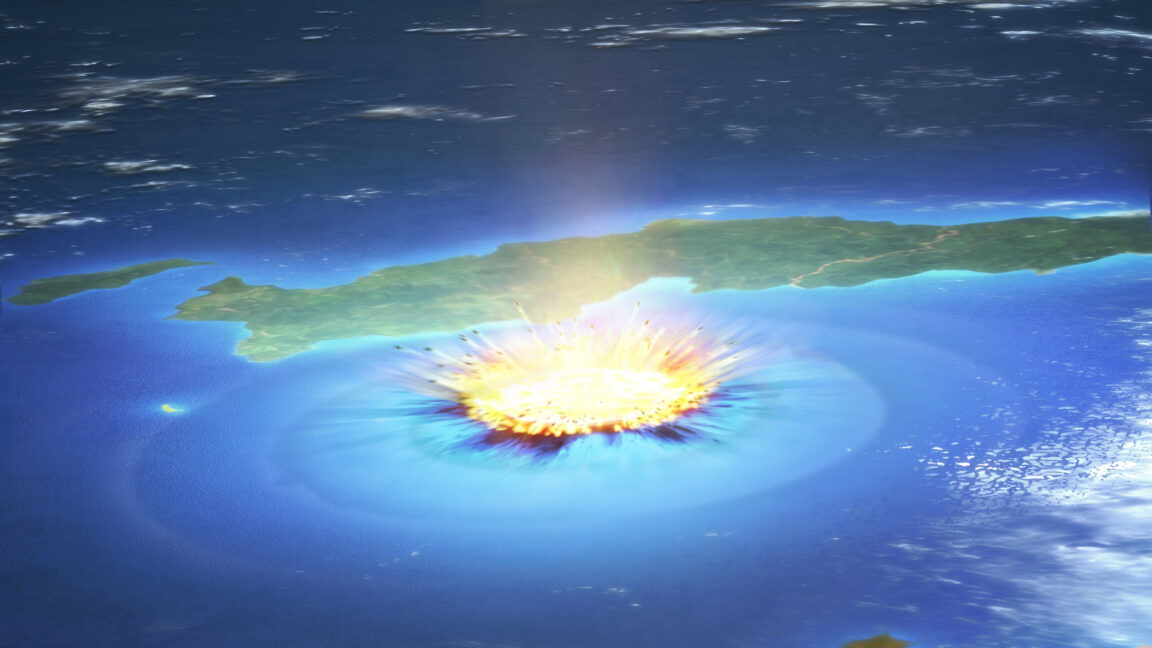
The cataclysmic asteroid impact that brought an end to the reign of the non-avian dinosaurs 66 million years ago is traditionally viewed solely as an engine of extinction. When the Chicxulub impactor—a celestial body roughly 10 kilometers in diameter—slammed into the shallow carbonate-rich seas of the modern-day Yucatan Peninsula, it triggered a global environmental collapse, massive tsunamis, and intense thermal pulses. However, recent geological research suggests that this same event simultaneously birthed a subterranean environment capable of fostering life. A new study, published in the journal Communications Earth & Environment, indicates that the energy released during the impact generated a vast, long-lasting hydrothermal system that remained active for approximately 8 million years, providing a potential sanctuary for microbial colonies in the immediate aftermath of the mass extinction.
The Mechanics of a Subterranean Oasis
The collision at Chicxulub was of such magnitude that it fundamentally altered the Earth’s crust to depths of at least 35 kilometers. The intense kinetic energy vaporized and melted vast quantities of target rock, creating a massive crater roughly 150 kilometers in diameter. As the crater floor settled and fractured, the porous, heat-soaked rock was inundated by seawater from the surrounding Gulf of Mexico.
This influx of water into the superheated subterranean environment triggered a process of convective cooling. As cold seawater descended through fractures in the crust, it was heated by the cooling magma and hot impact-melted rock. This heated, mineral-rich fluid then rose toward the surface, establishing a hydrothermal circulation system. While these systems are common in volcanic regions or along tectonic plate boundaries, the Chicxulub impact created a localized, intense, and exceptionally durable version of this phenomenon.
For decades, the consensus among geologists was that such impact-induced hydrothermal systems were short-lived, potentially lasting for a maximum of 2 million years. However, new isotopic analysis conducted by a team led by geologist Annemarie Pickersgill of the SUERC Center for Isotope Sciences at the University of Glasgow has challenged this timeline, revealing that the thermal activity persisted for at least four times longer than previously estimated.
Chronology of a Geologic Phenomenon
To determine the longevity of this hydrothermal system, the research team utilized rock samples recovered from a 2016 drilling project at the Chicxulub crater site. By extracting cores from approximately one kilometer below the surface, scientists were able to analyze the mineralogical composition of the crater’s basement rocks.
The primary tool for this dating process was potassium-argon radioisotopic analysis. Feldspar, a common mineral found in the crater, contains potassium-40, which decays into argon-40 over time. Because argon is a gas, it escapes from rock when it is in a molten or highly heated state. Once the rock cools below a certain threshold, the argon becomes trapped within the mineral lattice. By measuring the ratio of potassium-40 to argon-40, researchers can determine the precise moment the rock cooled and, by extension, how long the hydrothermal system remained active.
The findings suggest a clear timeline:
- 66 million years ago: The Chicxulub impact occurs, creating the crater and initiating the initial hydrothermal surge.
- 66 to 64.5 million years ago: The system maintains extreme temperatures, with cooling simulations indicating that temperatures at a depth of one kilometer remained near 90°C (194°F).
- 64.5 to 61 million years ago: The system continues to circulate, with temperatures gradually dropping to approximately 50°C (122°F). During this period, the environment would have been highly hospitable for thermophilic (heat-loving) microorganisms.
- 60 to 58 million years ago: The hydrothermal flow begins to wane significantly as the internal heat of the impact site dissipates.
- 58 million years ago: The hydrothermal circulation ceases entirely, marking the end of an 8-million-year period of subterranean activity.
Biological Implications and Habitability
The duration of this system is the most significant finding for astrobiologists and evolutionary biologists. In the wake of the K-Pg (Cretaceous-Paleogene) extinction event, surface conditions on Earth were hostile. Sunlight was obscured by atmospheric debris, causing a collapse in photosynthetic food chains. While the surface suffered, the hydrothermal system at Chicxulub offered a sheltered environment.
"Longer periods of hydrothermal activity will generate extended windows of opportunity for prebiotic chemical reactions to occur, life to develop, and micro-organisms to thrive and propagate beyond their point of origin," Pickersgill noted in the study.
The availability of heat, combined with the chemical nutrients leached from the fractured basement rocks, would have provided the necessary ingredients for microbial life. While the current study does not provide direct evidence of fossilized microbes within the crater, it proves that the conditions for life were present for a duration exceeding the time required for simple organisms to colonize and form sustainable colonies. Similar hydrothermal systems on Earth, such as those found at the bottom of the ocean today, are known to support diverse, self-sustaining ecosystems independent of solar energy.
Comparative Planetary Science
The implications of this research extend far beyond the history of Earth. Impact craters are ubiquitous features across the solar system, appearing on the Moon, Mars, and various icy moons of the outer planets. If a mid-sized impact like Chicxulub can sustain a hydrothermal system for 8 million years, the implications for the search for life on other worlds are profound.

Planetary scientists have long debated whether large-scale impacts on early Earth or ancient Mars could have served as "cradles" for life. If impacts are capable of creating long-lived, habitable niches, it suggests that the history of life in the universe may be inextricably linked to the history of planetary bombardment.
Pickersgill emphasized that Chicxulub, while massive, is relatively small compared to the impact basins observed on other planetary bodies. Larger impacts would have produced deeper, hotter, and more expansive hydrothermal systems. If the energy of the Chicxulub event could sustain a habitable environment for 8 million years, the potential for life-sustaining hydrothermal systems in larger impact basins on early Earth or Mars could have spanned tens of millions of years.
Future Directions for Research
While the data provided by the 2016 drilling samples is robust, the scientific community recognizes that this is only the beginning of understanding the "hidden" legacy of the Chicxulub impact. Future studies will likely focus on identifying potential biosignatures—chemical or structural evidence of past life—within the minerals dated by the current research.
The research also highlights a significant gap in our understanding of the 70 known underwater impact craters on Earth. Of these, only eight have been identified as having confirmed hydrothermal activity. The methodology employed by Pickersgill and her team—utilizing high-precision radioisotopic dating of minerals within core samples—provides a new roadmap for investigating these other sites. By applying these techniques to other craters, scientists may be able to construct a global database of how long and how effectively impact-induced hydrothermal systems contributed to the evolution and persistence of life on Earth.
Ultimately, the study shifts the narrative of the Chicxulub impact. While it remains the primary culprit for the extinction of the dinosaurs, it also stands as a testament to the resilience of life. In the deep, dark, and hot interior of a broken planet, the aftermath of the most destructive event in the history of the Cenozoic era may have paradoxically served as a long-term engine for biological continuity and development. This discovery challenges researchers to look beneath the surface of impact craters, suggesting that the most vital stories of our planet’s history may be written in the chemistry of the rocks buried deep within its crust.