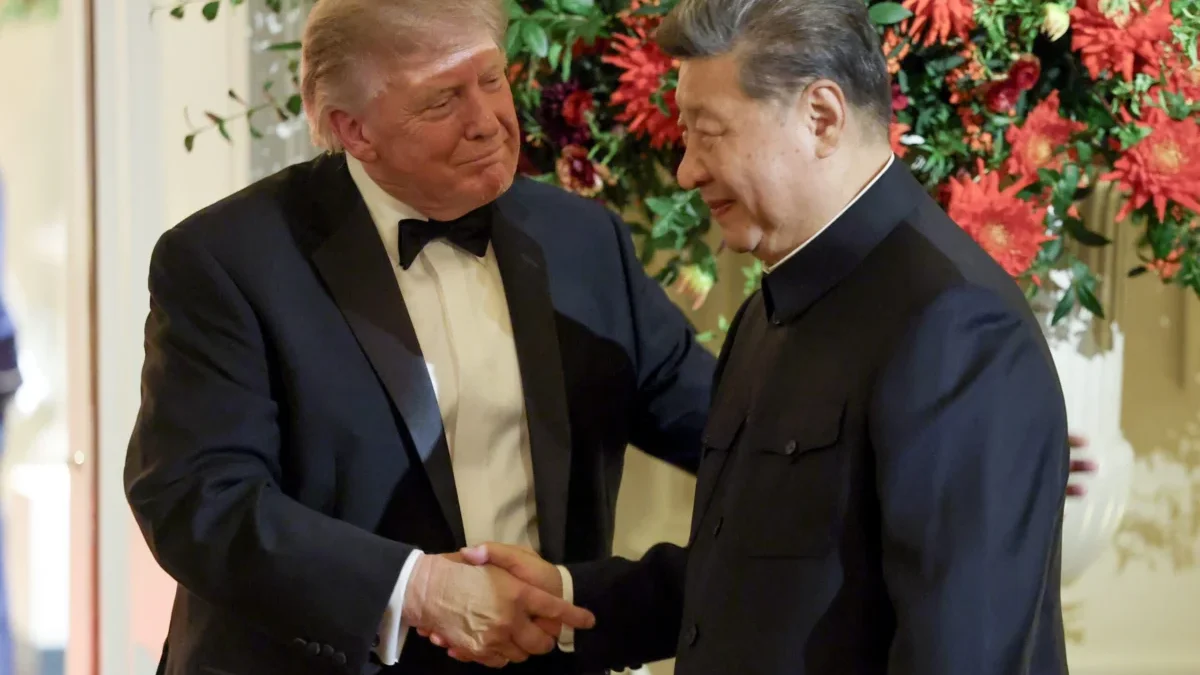
The recent summit between President Donald Trump and Chinese President Xi Jinping in Washington has ignited a firestorm of controversy within the international defense community. During the high-stakes diplomatic engagement, President Trump reportedly extended an informal offer to sell U.S. military hardware to China, a gesture that has left foreign policy experts, congressional leaders, and long-standing American allies in a state of profound apprehension. The revelation, first confirmed by U.S. Ambassador to China David Perdue, stands in stark contrast to the administration’s own stated policy of curbing China’s rapid military modernization and geopolitical expansion.
The diplomatic fallout was immediate. During an appearance on Fox News Sunday, Ambassador Perdue defended the President’s unconventional approach, noting that the administration views arms sales through a strictly commercial lens. "President Trump continues to say, ‘Hey, we sell arms to other people around the world,’" Perdue stated. "He actually asked President Xi, would he like to buy some at one point." While the White House has subsequently clarified that there are no active plans to finalize such a sale, the mere suggestion of arming a primary strategic competitor has sent shockwaves through the Washington policy establishment, raising questions about the stability of U.S. national security priorities.
A Chronology of Strategic Ambiguity
To understand the gravity of this offer, one must examine the timeline of the current administration’s approach to the U.S.-China relationship. For years, the Trump administration has characterized China as the primary existential challenge to American global dominance. This narrative has been bolstered by a series of aggressive trade restrictions, technology export controls, and public condemnations of China’s military-civil fusion strategy.
However, the recent summit marked a pivot—or perhaps a contradiction—in this posture. In May 2026, a bipartisan group of senators issued a formal letter urging the President to expedite a $14 billion arms package for Taiwan, citing the 1979 Taiwan Relations Act, which mandates that the U.S. provide the island with the means to defend itself. Despite these pleas, the administration has held the package in limbo, with the President publicly characterizing the potential sale as a "very good negotiating chip."
The summit with President Xi last week provided the stage for this strategy to materialize. Ahead of the meeting, Senate Minority Leader Mitch McConnell and other Republican leaders submitted a final, urgent appeal to the Department of Defense to authorize the Taiwan transaction. Instead of moving forward with the arms delivery to Taiwan, the President chose to leverage the meeting to propose a bilateral military exchange with Beijing, effectively signaling that the security of democratic partners remains secondary to his broader transactional agenda.
The Financial Lens of Transactional Diplomacy
The President’s overture to Beijing reflects a consistent, if controversial, governing philosophy: "The Art of the Deal" applied to the international stage. In this framework, geopolitical alliances and security commitments are often subordinated to immediate commercial gains. This trend is not new; it has been observed in the administration’s handling of global trade, regional peace deals, and technology licensing.
For instance, earlier this year, the White House carved out a specific exemption for semiconductor giants Nvidia and AMD, allowing them to continue selling high-end AI-capable chips to China despite widespread concerns that these technologies would accelerate the People’s Liberation Army’s (PLA) autonomous weapons development. The deal was structured as a revenue-sharing model, with the U.S. government reportedly capturing a 25% tax on the transactions. Critics argue that by prioritizing a 25% stake in corporate revenue over the long-term containment of a military rival, the administration has effectively incentivized the erosion of American technological superiority.
This pattern extends to other regions. Last year, the administration brokered a peace deal between Armenia and Azerbaijan, which included the construction of the "Trump Route for International Peace and Prosperity." While the White House presented the deal as a triumph of mediation, geopolitical analysts pointed out that the agreement served primarily to secure exclusive U.S. commercial transit rights, highlighting a preference for infrastructure projects that offer direct financial returns over the messy, non-commercial work of lasting regional stabilization.
Implications for Global Security and Military Readiness
The national security implications of an arms sale to China—or even the offer of one—are significant. China has spent the better part of the last decade aggressively closing the military gap with the United States. According to reports from the Pentagon’s annual China Military Power Report, the PLA has made massive strides in stealth technology, anti-access/area-denial (A2/AD) systems, and hypersonic missiles.
Recent incidents, such as the discovery that China had obtained sensitive components from the F-35 fighter jet program via third-party intermediaries, have underscored the vulnerability of American hardware. Providing China with official access to U.S. defense platforms, even if only through a commercial sale, would essentially grant Beijing a roadmap to neutralize some of the most critical assets in the U.S. arsenal.
"You would not want to help China to modernize its military and turn against yourself," said Zhiqun Zhu, a professor of political science and international relations at Bucknell University. "Especially with the intense competition between the two powers now. It doesn’t make sense from a strategic standpoint."
Furthermore, the offer has created a credibility gap with U.S. allies. Countries in the Indo-Pacific—including Japan, South Korea, and Australia—have aligned their defense strategies with the assumption that the U.S. is committed to a "Free and Open Indo-Pacific." By dangling the prospect of military cooperation with their primary threat, the President has inadvertently signaled to these nations that their security is, at best, a bargaining chip in a larger negotiation with Beijing.
Official Responses and Expert Analysis
The official silence from the State Department, which did not immediately respond to requests for comment, has left a void filled by criticism from the foreign policy community. Ryan Hass, a senior fellow at the Brookings Institution, summarized the sentiment on social media: "If there was any ambiguity about whether President Trump views China as a security threat, this disclosure by Ambassador Perdue puts the question to rest. Trump’s offer to sell weapons to China will be unsettling to American partners at the pointy edge of China’s spear."
The disconnect between the President’s rhetoric and his actions remains the central puzzle for observers. While the administration continues to frame China as a "strategic competitor" in public documents and press briefings, the operational reality appears to be one of "transactional engagement." This creates a dangerous level of unpredictability for the U.S. military and diplomatic corps. If the President’s core objective is to maximize commercial profit, long-term strategic containment strategies become nearly impossible to execute.
The Future of the Taiwan Question
The most immediate casualty of this diplomatic pivot is the status of Taiwan. By characterizing the $14 billion arms package as a "bargaining chip," the administration has effectively tied the survival of Taiwan’s defense infrastructure to the whims of a deal-making President. If China offers "something really effective"—such as a favorable trade agreement or a promise to purchase American debt—the fear among analysts is that the President would have no hesitation in sacrificing the arms sale to Taiwan to secure a "win" for his domestic agenda.
The bipartisan pressure from Congress suggests a widening divide between the legislative and executive branches on China policy. With senators from both parties pushing for a harder line against Beijing, the President’s willingness to offer weapons to the Chinese government creates a constitutional and political friction point.
Conclusion: A Shift in Paradigms
As the dust settles from the summit, the core question remains whether the U.S. is witnessing a strategic evolution or a fundamental abandonment of post-WWII containment policies. If the administration continues to view every geopolitical challenge as a commercial transaction, the traditional alliances that have anchored global security for eighty years may undergo a period of forced, and potentially irreversible, realignment.
For now, the world is left to contend with a new reality: an America that is increasingly comfortable with the idea of arming its adversaries if the price is right. Whether this approach yields the dividends the President anticipates or results in a catastrophic weakening of the U.S. security posture remains the central question facing the international order in the coming months. As tensions rise in the Taiwan Strait and the global arms race accelerates, the price of such "deals" may eventually prove to be higher than any revenue they manage to generate.