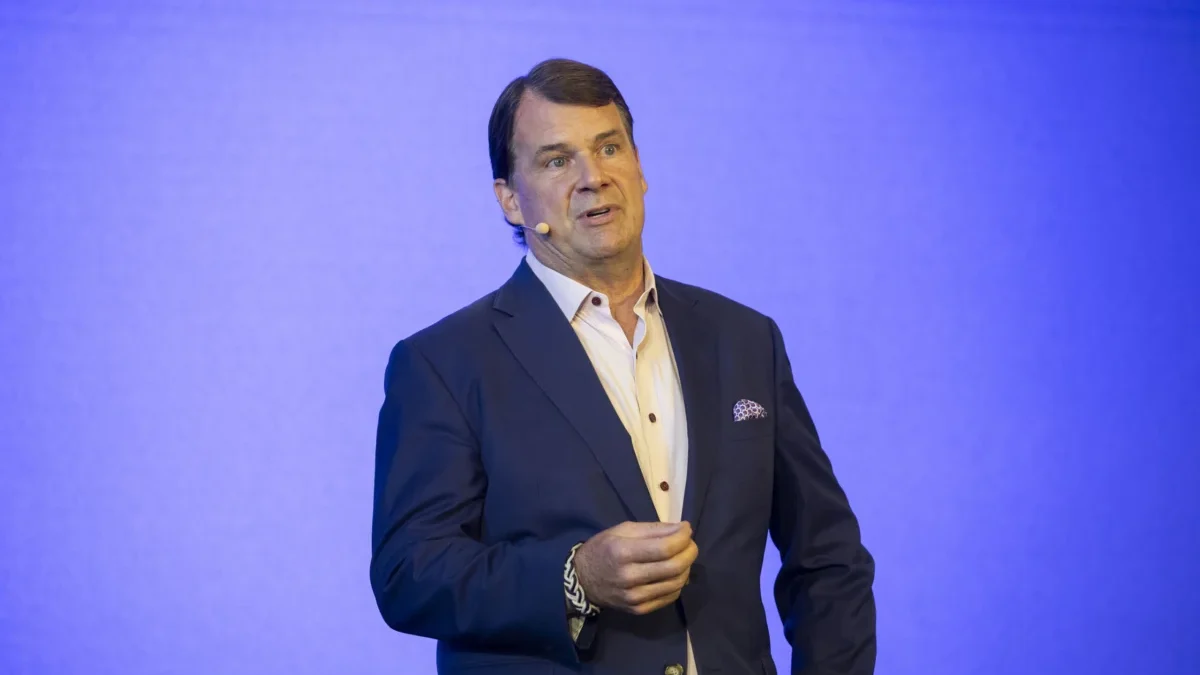
The American industrial landscape stands at a critical juncture as the nation faces a profound deficit in skilled labor, a shortfall that industry leaders now argue is too vast and regionally fragmented for any single entity to rectify. Ford CEO Jim Farley has emerged as a central figure in this conversation, characterizing the current labor gap not merely as a business hurdle, but as a fundamental threat to the American dream and the future of domestic manufacturing. The urgency of this crisis has prompted the formation of the Alliance for America’s Skilled Trades, a high-profile coalition comprising corporate giants Ford, BlackRock, Google, and Carhartt, which aims to move beyond isolated corporate initiatives toward a comprehensive, data-driven national strategy.
The Anatomy of the Labor Gap
The core of the challenge lies in the staggering volume of demand. According to the inaugural State of America’s Skilled Trades report, the United States will require approximately 1.7 million new skilled-trades workers annually through 2035 to meet the needs of an expanding economy. Currently, the trades employ roughly 18 million people, a cohort that contributed an estimated $3.8 trillion to the U.S. Gross Domestic Product (GDP) in 2025. Despite these impressive figures, the training pipeline is fundamentally broken. Data indicates that for every 100 workers needed, the nation is currently producing only 55 qualified individuals through formal educational and certification pathways.
This shortfall is exacerbated by a demographic "silver tsunami." Nearly 25% of the current skilled-trades workforce is aged 55 or older, while fewer than 12% of workers are under the age of 25. As veteran tradespeople reach retirement age, they take with them decades of institutional knowledge and, crucially, the capacity to mentor the next generation. This creates a feedback loop of decline: as the pool of experienced mentors shrinks, the effectiveness of on-the-job training diminishes, further depressing completion rates for new apprentices.
Chronology of a Coordinated Response
The formation of the Alliance for America’s Skilled Trades this past summer marked a departure from the fragmented approaches of previous decades. The timeline of this initiative reflects a rapid escalation in corporate concern regarding labor stability:
- Mid-2025: Initial discussions between executives at Ford, BlackRock, Google, and Carhartt begin, centered on the shared observation that labor shortages were stalling capital projects across sectors, from data center construction to automotive manufacturing.
- July 2026: The Alliance for America’s Skilled Trades is officially launched, with a mandate to synthesize labor data and lobby for policy changes.
- July 21, 2026: The Alliance releases its first comprehensive report, providing the most granular look to date at the regional variations of the skilled-trades shortage.
- July 22, 2026: Ford CEO Jim Farley and JPMorgan CEO Jamie Dimon announce the Michigan LIFT (Launchpad for Industrial Innovation & Transformation) initiative, a $2 billion public-private investment designed to bridge the gap between capital access and supplier growth.
The Michigan LIFT initiative is particularly significant because it addresses the "chicken-and-egg" problem of industrial expansion: suppliers are often hesitant to invest in new capacity without a guaranteed workforce, while workers are hesitant to enter a trade without a clear path to stable, long-term employment. By pledging $1 billion in contracts and $1 billion in financing, Ford and JPMorgan are attempting to de-risk the growth of the supply chain.
Regional Disparities and the "Importation" Paradox
One of the most revealing findings of the Alliance’s report is the rejection of a "one-size-fits-all" national narrative. The labor market is defined by extreme regional volatility. For instance, states like Texas and North Carolina are experiencing a net influx of roughly 5,000 trades workers annually due to interstate migration. Conversely, states like New York are witnessing a net exodus of approximately 9,000 workers per year.
Matt Sigelman, president of the Burning Glass Institute, which led the report’s quantitative analysis, provided a stark assessment of this trend: "These fast-growing states are essentially importing the workers that they are failing to train." This indicates that the current labor market is not solving the shortage through training, but rather by shifting the burden of recruitment from one region to another.
Furthermore, the pressure is not distributed equally across occupations. The report identifies industrial machinery mechanics, maintenance workers, and millwrights as being in the 98th percentile of shortage pressure. Electricians follow at the 85th percentile, while automotive technicians occupy the 54th percentile. These differences mean that a training program designed to produce HVAC technicians may do little to alleviate the critical shortage of millwrights, requiring highly localized and trade-specific curriculum development.
The Retention and Completion Crisis
A central argument of the report is that the crisis is not merely an intake problem, but a retention failure. Even when individuals are funneled into apprenticeships or technical programs, the "leaky pipeline" results in significant attrition. Analysis by the Burning Glass Institute found that for every 100 people who begin a skilled-trades apprenticeship, only 48 complete it. More concerningly, only 29 of those original 100 individuals are found working in a trade occupation within five years of leaving their program.
Similar trends exist in postsecondary vocational programs, where only 48 of every 100 students complete their course, and only 34 eventually enter the workforce in a related field. These figures suggest that the barriers to entry are not only financial but also structural and cultural. Potential workers are often deterred by a lack of support systems, such as affordable child care, reliable transportation, or a lack of visibility into the long-term career progression of a trade.
The Path Forward: Breaking the Silos
The Alliance for America’s Skilled Trades is advocating for a radical shift in how stakeholders interact. The report emphasizes the need to plan workforce requirements at the inception of large-scale infrastructure and industrial projects, rather than treating labor as an afterthought during the hiring phase.
For policymakers, the recommendations are clear:
- Alignment of Education and Industry: Strengthening the transition from high school career and technical education (CTE) programs directly into registered apprenticeships.
- Wraparound Services: Increasing public and private funding for the social infrastructure—child care and transit—that allows individuals to complete training programs.
- Data Transparency: Utilizing tools like the new America’s Skilled Trades Dashboard to allow educators and policymakers to predict labor needs based on upcoming capital project investments.
"It takes people breaking out of their silos," Jim Farley remarked during the announcement of the report. "It takes large and small and medium-sized employers, educators, policymakers, local leaders, and politicians all actually working together."
Broader Economic Implications
The economic stakes of this initiative extend far beyond the automotive sector. As the United States pushes for the onshoring of semiconductor manufacturing, the expansion of the energy grid, and the massive upgrading of aging infrastructure, the inability to field a skilled workforce acts as a hard ceiling on national GDP growth. If the 1.7 million annual vacancies remain unfilled, the cost of labor inflation will inevitably rise, project timelines will extend indefinitely, and the competitive advantage of American manufacturing will erode.
The collaboration between Ford, BlackRock, Google, and Carhartt represents an acknowledgment that the "invisible hand" of the market has failed to self-correct the labor supply. By centralizing data and providing the financial scaffolding for suppliers, these companies are attempting to exert a level of "industrial stewardship." Whether this coalition can effectively move the needle on completion rates and regional migration imbalances remains to be seen, but the sheer scale of the investment—and the high-level backing from financial and industrial leaders—signals that the era of treating skilled labor as a secondary concern has officially concluded.
Ultimately, the future of American manufacturing will be determined not just by the technology developed in corporate laboratories, but by the ability of the nation to cultivate, train, and retain the people necessary to build, maintain, and innovate within the physical world. As Farley concluded, "Ford is America’s automaker, and we believe American manufacturing’s best days are ahead"—provided the foundation of that manufacturing, the skilled trades, can be restored to its rightful place at the center of the national economy.