Modern business operations face an unprecedented challenge: consumer interactions have fundamentally shifted away from traditional, controlled channels like corporate email and phone helplines. Instead, prospective buyers and long-term customers voice their feedback, inquiries, complaints, and purchasing intent directly within the comments, direct messages, and brand mentions of social media platforms. To address this paradigm shift, organizations across all industries are increasingly turning to Social Customer Relationship Management (Social CRM)—a strategy that bridges the gap between unstructured social data and unified customer databases.
By integrating social media streams directly into centralized customer relationship management systems, brands can fundamentally alter how marketing, sales, and support teams collaborate. Rather than operating in isolated silos, cross-functional teams gain immediate access to real-time context, sentiment signals, and historical purchase data. This evolution is no longer optional for competitive enterprises; it is a vital operational necessity driven by rising consumer expectations and the massive scale of modern digital engagement.

The Evolution of Customer Relationship Management: Traditional vs. Social CRM
To understand the mechanics of Social CRM, it is helpful to examine its predecessor. Traditional CRM platforms were engineered around structured, historical data. They primarily track past actions such as completed financial transactions, email correspondences, support ticketing histories, and phone call logs. While this approach remains foundational for internal accounting and sales pipeline management, it is inherently reactive and relies heavily on structured inputs.
In contrast, Social CRM expands the operational scope by capturing unstructured, real-time data. This includes public comments, direct messages, brand tags, and broader social conversations captured via advanced listening tools. While a traditional CRM tells an organization what a customer did months ago, a Social CRM illuminates what that same customer is feeling, experiencing, or demanding right at this exact moment.

Furthermore, traditional CRMs have historically been guarded by a single department—typically sales or customer service. Social CRM, however, functions as a shared ecosystem. Marketing teams utilize social insights to refine messaging and content strategy; sales representatives leverage high-intent social signals to identify warm leads; and support agents resolve public complaints with comprehensive account history readily visible.
Navigating the Three Architecture Models of Social CRM
Organizations looking to implement these capabilities typically choose among three distinct architectural approaches: built-in solutions, standalone platforms, and hybrid systems.
Built-in options integrate basic social management tools directly into an existing CRM infrastructure. While this keeps all customer touchpoints within a single system, these native social features occasionally lack the deep analytical depth required for complex multi-channel campaigns.
Conversely, standalone social CRM platforms specialize intensely in social media management, subsequently syncing gathered data back into primary CRM databases via API integrations. This methodology guarantees top-tier social functionality while maintaining the integrity of central customer records.
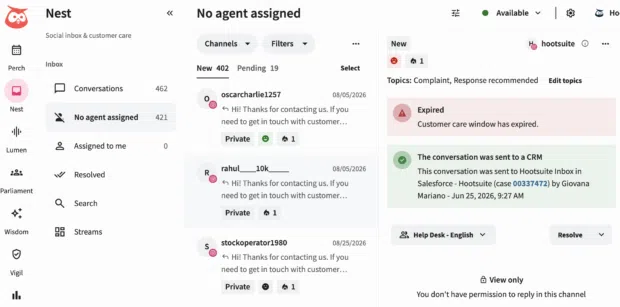
A third, increasingly popular hybrid model relies on modern social operating systems—such as Hootsuite Social OS—which sit purposefully between the two categories. These platforms handle native publishing, listening, and engagement, apply advanced artificial intelligence to synthesize the data, and route actionable intelligence directly into major enterprise systems like Salesforce or Microsoft Dynamics 365. This architectural convergence blurs the traditional line between a pure social tool and an enterprise database, delivering significant operational efficiency.
The Rising Urgency: Bridging the Consumer Expectations Gap
The strategic imperative for Social CRM in 2026 is underscored by stark metrics regarding consumer behavior and brand responsiveness. According to recent findings from Forrester’s Global Customer Experience Index, the gap between the customer experience brands believe they are delivering and the reality experienced by consumers is widening. Social media platforms serve as the public stage where this gap becomes glaringly evident.
Hootsuite’s Social Media Consumer Report reveals that 53 percent of surveyed consumers consider rapid responses to direct questions and comments to be the single most appealing action a brand can take on social channels. Conversely, the cost of corporate silence is severe: 32 percent of consumers report that they will unfollow a brand that fails to interact with its community or ignores direct inquiries. Furthermore, statistics compiled by Statista indicate that approximately 37 percent of modern consumers expect a direct response to customer service inquiries made via social media on the very same day.
At historical volumes, manual data entry—where a support agent copy-pasted social media inquiries into CRM text fields—was marginally sustainable. At the scale of modern digital commerce, manual workflows collapse under the sheer weight of incoming mentions. Automated data synchronization is now the only viable mechanism to maintain operational velocity.
Core Benefits: Speed, Alignment, and Deeper Insights
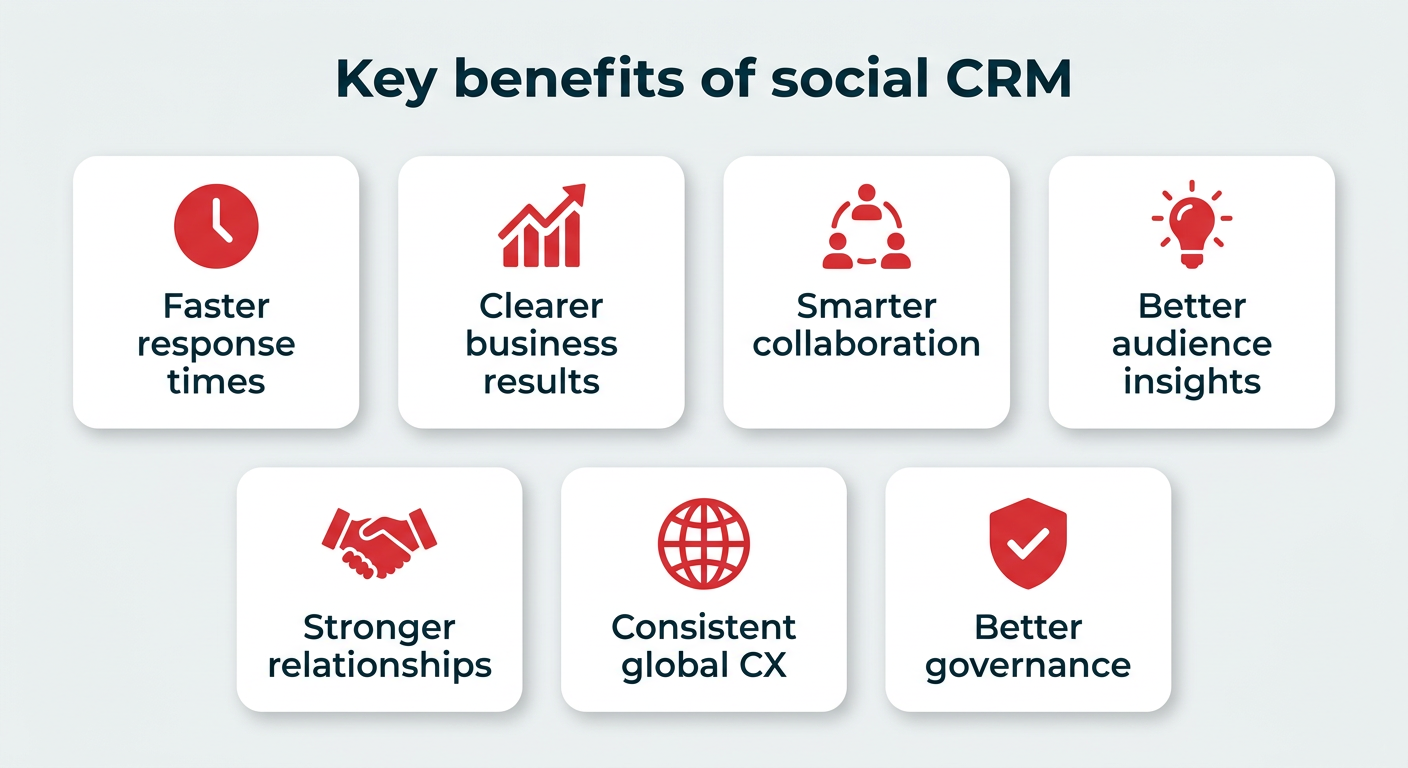
Implementing a robust Social CRM framework yields measurable operational advantages across multiple business units. The primary payoff is velocity. By equipping front-line agents with immediate customer context, organizations transform potential public relations crises into successful customer retention stories.
Among the chief operational benefits are:
- Dramatically accelerated response times to critical public inquiries and direct messages.
- Enhanced cross-departmental collaboration, preventing duplicate outreach and mixed messaging.
- Richer audience insights derived from qualitative social listening rather than quantitative follower counts alone.
- Stronger, relationship-focused customer lifecycles that foster long-term brand loyalty.
- Consistent global customer experience governance across disparate regional markets.
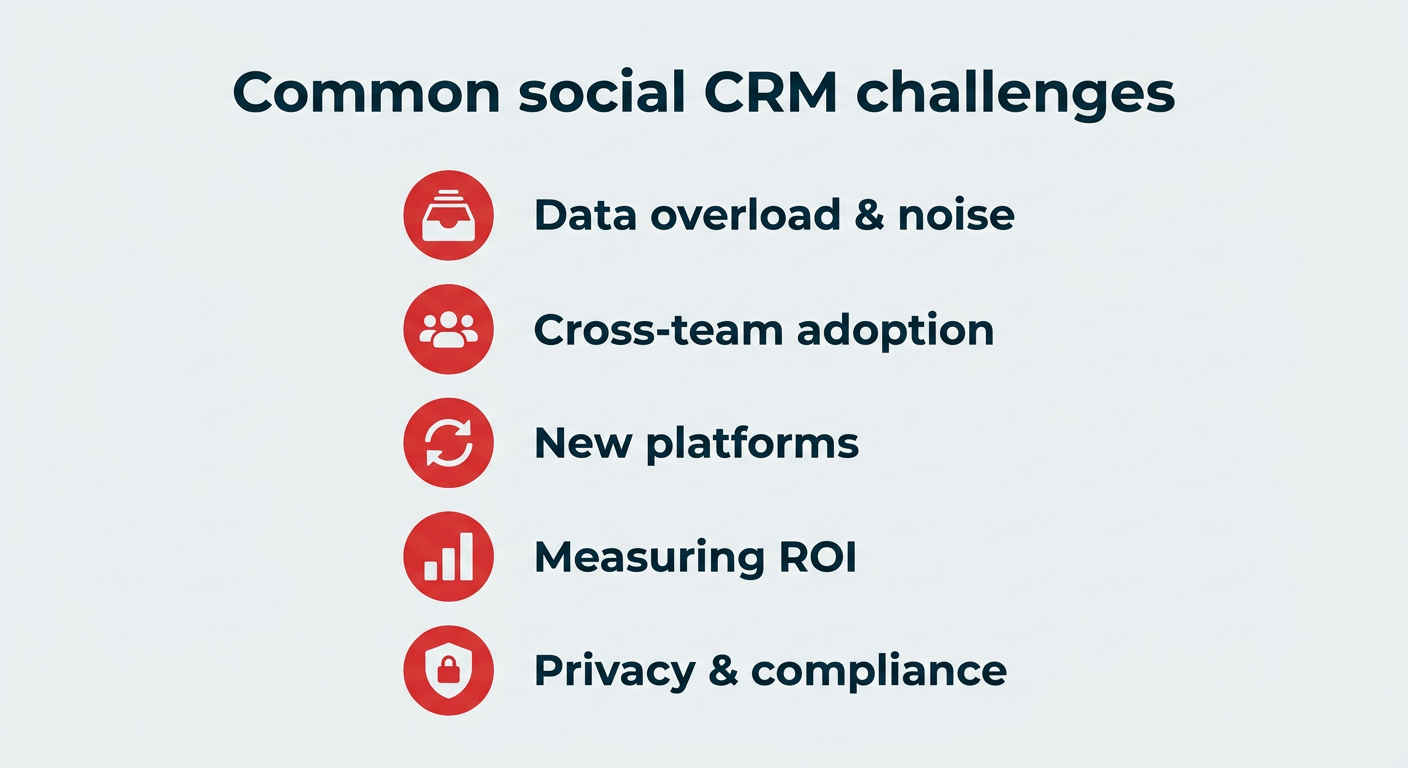
Despite these clear advantages, implementation is not without obstacles. Organizations frequently encounter challenges related to massive data volume, cross-departmental change management, and the rapid pace of platform evolution. Overcoming these hurdles requires strict alignment among leadership teams, comprehensive staff training, and the selection of scalable, intuitive software solutions.
The Data Flow Mechanics of Social CRM

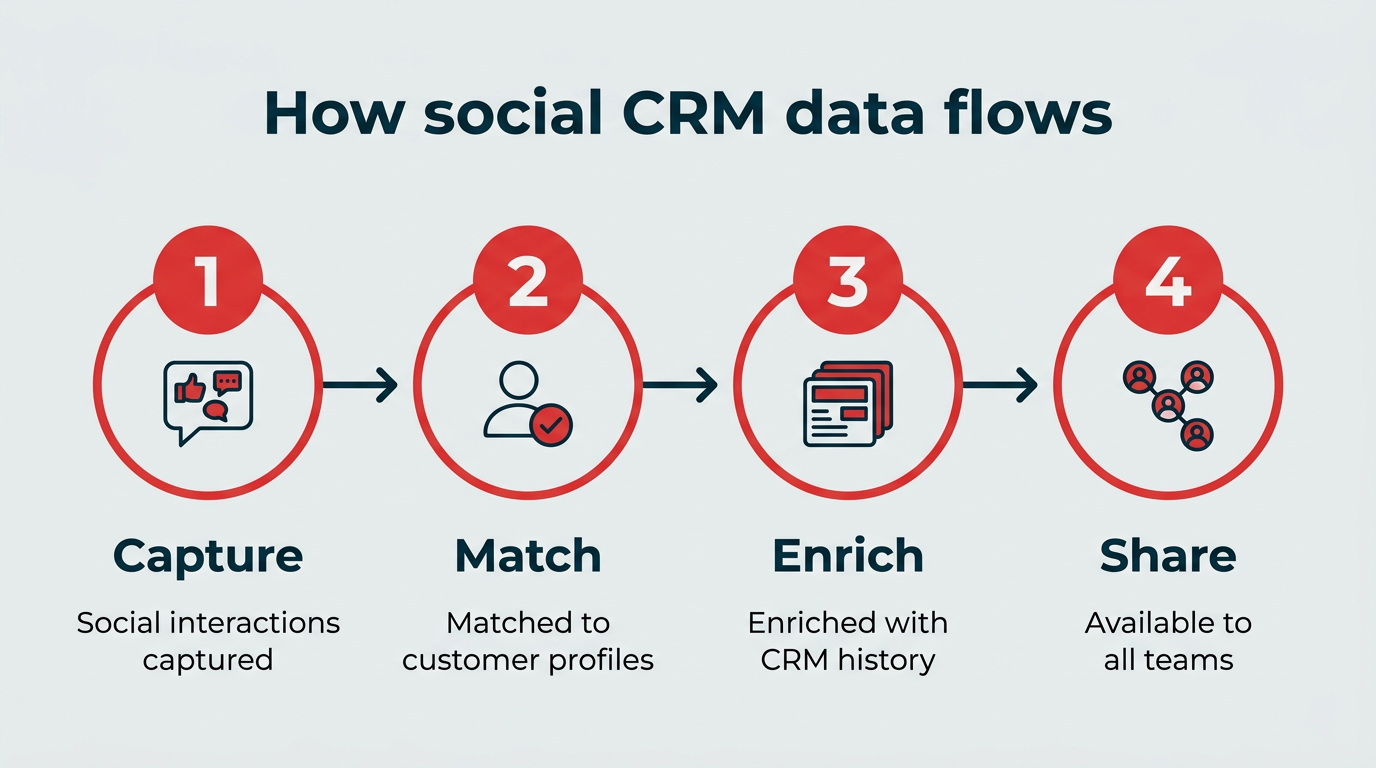
The technical lifecycle of a Social CRM interaction follows a disciplined, four-step architectural flow.
First, the system captures social interactions—including comments, direct messages, and global brand mentions—across platforms like Instagram, X (formerly Twitter), Facebook, and LinkedIn.
Second, the software matches these incoming interactions to existing customer profiles within the database or dynamically instantiates a new profile if the user is a prospective lead.
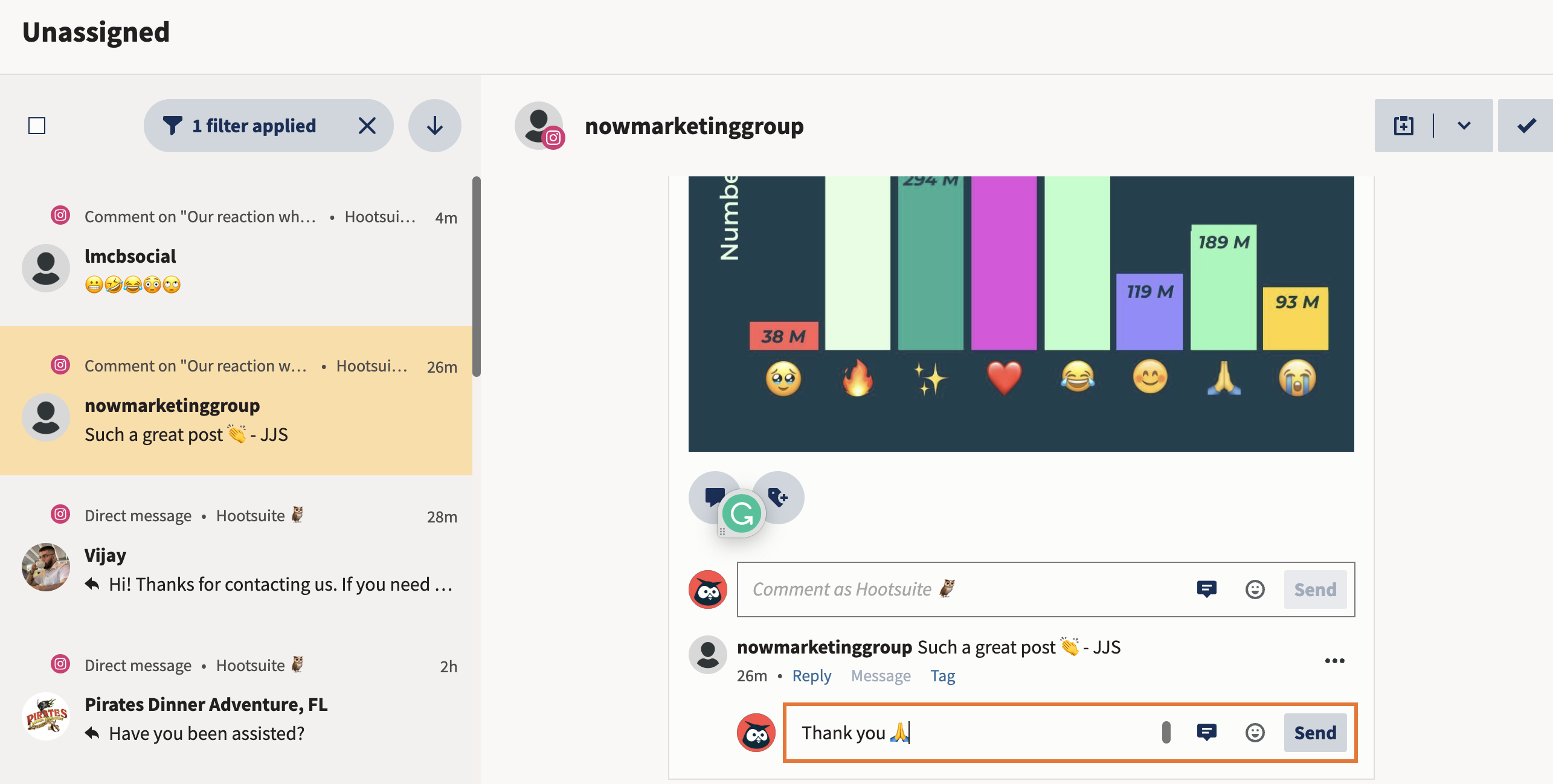
Third, the profile is automatically enriched with historical context pulled from the CRM, including past purchases, open support tickets, and previous multi-channel interactions.
Fourth, this comprehensive, unified customer view is made instantly accessible to any authorized team member across marketing, sales, or support.
For instance, if a high-value customer encounters a product defect and sends a direct message via Instagram, the support agent handling the queue does not see an anonymous social handle. Instead, they view the incoming message juxtaposed against the customer’s complete account history, enabling an empathetic, highly contextual, and rapid resolution.

The Artificial Intelligence Transformation
Artificial intelligence has fundamentally redefined the capabilities of Social CRM systems. As Gartner notes in its enterprise software evaluations, modern CRM sales platforms are increasingly defined as AI-driven systems capable of predictive automation. The primary function of AI in this context is triage and enablement—ensuring that human workers possess precise context at the exact moment a reply must be formulated.
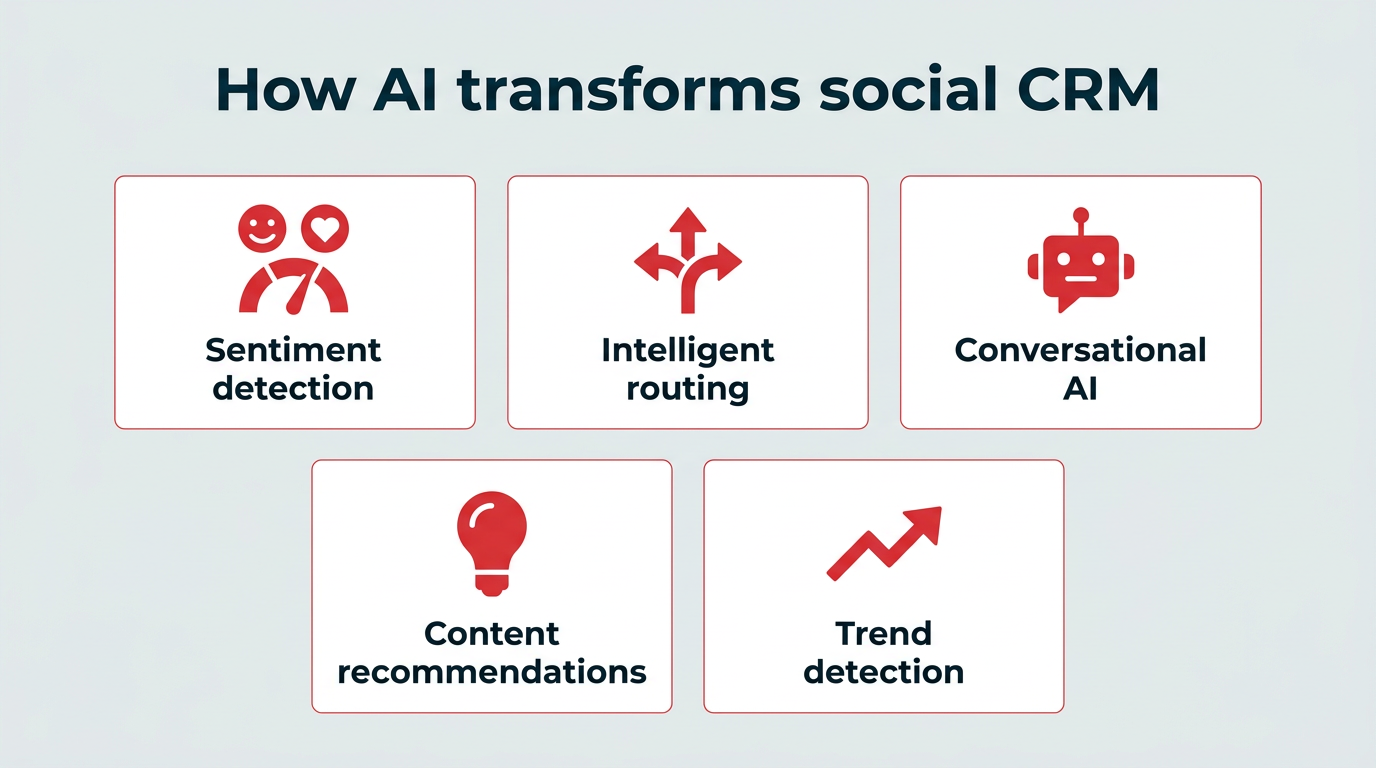
Key practical applications of AI within modern Social CRM frameworks include:
- Automated sentiment analysis to gauge emotional tone, sarcasm, and intent within unstructured text.
- Intelligent routing that sorts incoming queues, pushing urgent complaints to priority tiers and handling routine inquiries automatically.
- AI-assisted response generation that suggests contextually accurate replies for human agent approval.
- Predictive lead scoring based on continuous social engagement patterns and behavioral intent signals.
Advanced listening tools further amplify these capabilities by monitoring conversations across multiple languages simultaneously. Rather than relying on manual keyword searches, AI models detect emerging frustration trends or preference shifts in isolated regional markets before they escalate into global brand issues.
Driving Customer Service Excellence
Customer care operations experience immediate qualitative improvements upon adopting Social CRM infrastructure. Research highlights a direct correlation between active social media engagement and elevated customer relationship quality. When brands respond personally and promptly, customer lifetime value increases.
Consider the operational strategy of global brands like Starbucks. When negative feedback or operational complaints surface publicly on platforms like Instagram, the customer care division responds swiftly. Rather than letting complaints linger, agents offer immediate public assistance or smoothly transition the dialogue to private direct messages for sensitive account resolution. This public demonstration of accountability mitigates churn and protects brand equity.
Empowering Sales Teams and Lead Generation
While initial social media contact is rarely the appropriate moment for an aggressive sales pitch, social channels represent fertile ground for qualified lead generation. Social CRM systems inject behavioral intent signals into the sales pipeline.
A prospective buyer who repeatedly comments on product launch videos, saves educational tutorials, and submits a direct message regarding pricing is signaling high commercial intent. When these signals are synchronized with CRM databases, sales representatives can prioritize outreach based on actionable behavioral data rather than cold alphabetical lists.
Furthermore, by tagging social-sourced leads within standard pipeline reporting, organizations can accurately calculate social media return on investment (ROI). Tying social interactions directly to closed-won deals and contract renewals finally bridges the persistent gap between marketing metrics and hard business revenue.
Strategic Framework for Implementation
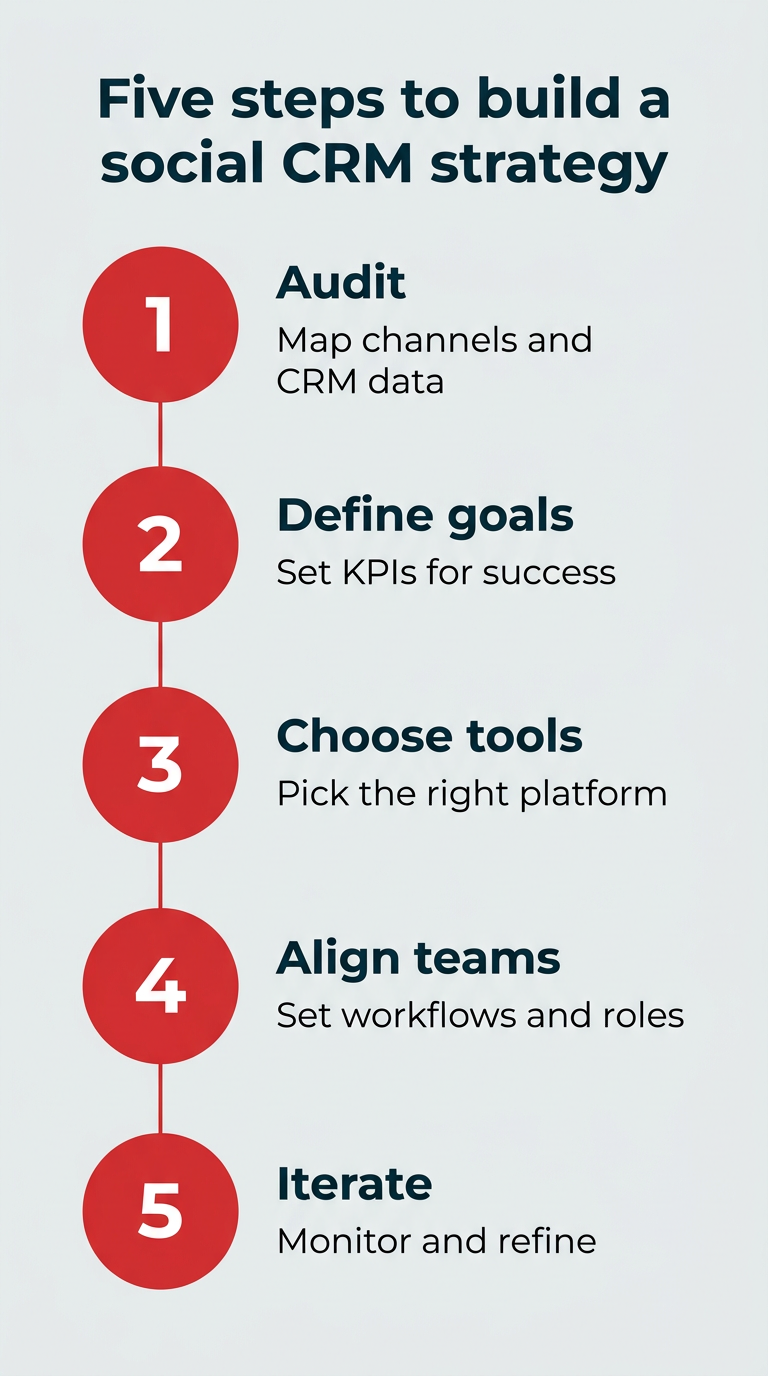
Deploying a successful Social CRM strategy requires a structured, multi-phase implementation roadmap. Organizations should adhere to a clear five-step framework:
- Audit the current tech stack and social landscape to identify existing data silos and operational gaps.
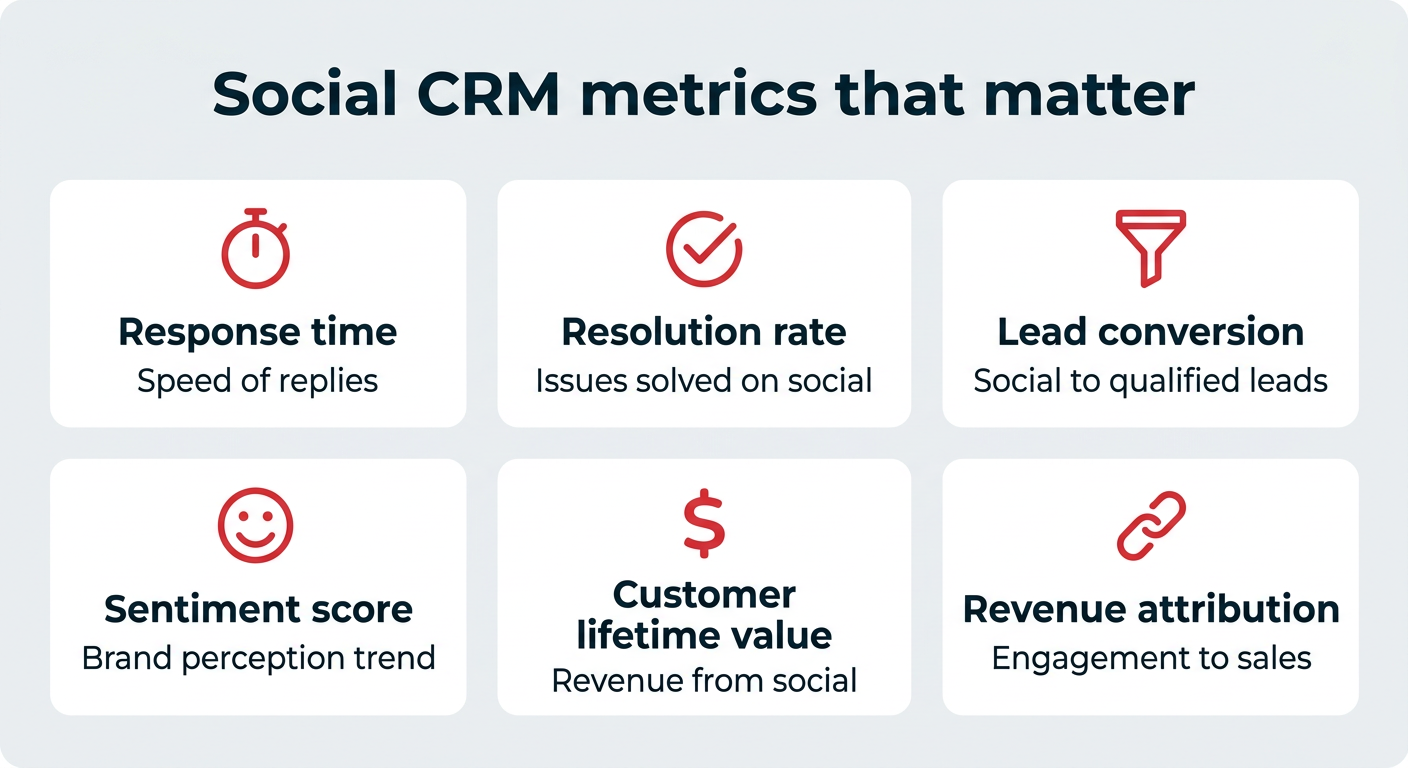
- Define clear, measurable goals and key performance indicators (KPIs)—such as targeted response times, lead conversion rates, and sentiment scores.
- Select appropriate software tools and integrations that link social conversations to primary CRM databases with minimal manual friction.
- Align cross-functional teams by establishing clear routing rules, governance policies, and response guidelines.
- Continuously monitor, measure, and iterate performance metrics using AI-driven insights to refine the strategy over time.
Leading Software Solutions for Social CRM
Organizations seeking to deploy or upgrade their social CRM capabilities can choose from several industry-leading platforms, each tailored to distinct operational requirements:
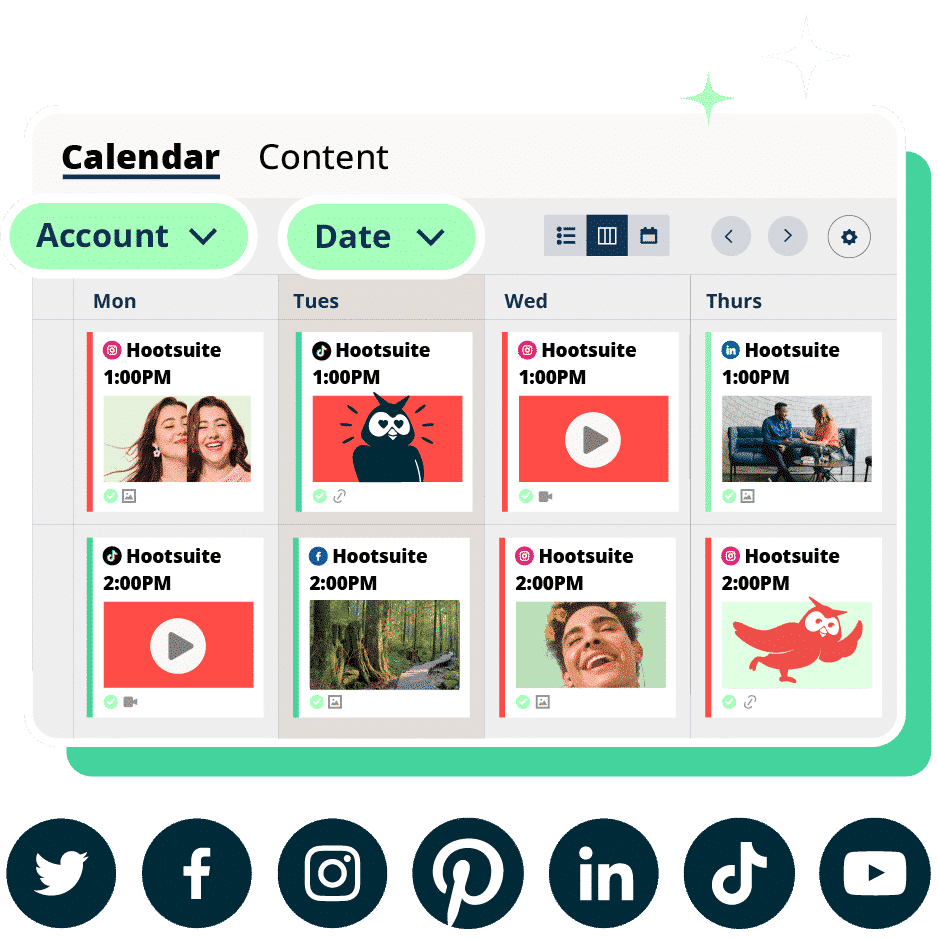
- Hootsuite: Widely recognized as the premier all-in-one social media management, listening, and engagement platform. Featuring native inbox aggregation (Nest), advanced listening (Lumen), and robust CRM integrations, Hootsuite starts at $99 per user per month.
- HubSpot: An exceptional CRM platform designed for full-funnel marketing, sales, and service alignment. HubSpot offers free basic tools, with paid tiers scaling from $20 per seat per month.
- Salesforce: The gold standard for enterprise sales intelligence, leveraging conversational AI assistants and deep predictive data capabilities. Basic small business plans start at $25 per user per month.
- Microsoft Dynamics 365: A highly modular and customizable enterprise ecosystem utilizing AI to predict customer intent and optimize audience segmentation. Individual components start at $65 per user per month.
- SugarCRM: A flexible, highly customizable CRM focusing on streamlined marketing and sales tracking, with entry-level plans beginning at $19 per user per month.
Conclusion
As digital channels continue to evolve, the boundary between social media engagement and core customer relationship management will continue to dissolve. Organizations that successfully bridge this divide through integrated Social CRM architectures will empower their marketing, sales, and support teams to act with unprecedented speed and contextual awareness. By transforming unstructured public conversations into structured, actionable business intelligence, forward-thinking brands can secure enduring customer loyalty and demonstrable return on investment in an increasingly competitive marketplace.