The European Union’s regulatory landscape for artificial intelligence shifted decisively on August 2, 2026, as new transparency obligations under the EU AI Act officially entered into force. These guidelines establish rigorous mandates for how AI-generated content must be identified and presented to users. While the initial announcement triggered widespread industry concern regarding the potential for massive regulatory fines and operational hurdles, the reality of the mandate is a focused, risk-based approach designed to ensure that European citizens can distinguish between human-authored and machine-generated information.
The core of this legislation is Article 50 of the EU AI Act, which requires providers and deployers of AI systems to ensure that output is marked as artificially generated or manipulated in a clear and distinguishable manner. Crucially, these rules are not confined to businesses headquartered within the European Union. Similar to the extraterritorial reach of the General Data Protection Regulation (GDPR) and the European Accessibility Act (EAA), the transparency obligations apply to any organization worldwide that serves EU citizens or operates within the single market.
A Chronology of Implementation
The path to these requirements began with the broader adoption of the EU AI Act, a landmark legislative package aimed at fostering trustworthy AI development. Following the initial legislative consensus, the European Commission spent the intervening period drafting specific codes of practice to clarify how companies should operationalize transparency.

- Early 2024: EU AI Act reaches political agreement, setting the stage for standardized transparency frameworks.
- Mid-2025: Regulatory bodies release preliminary guidance on "clear and distinguishable" labeling, warning against ambiguous icons.
- August 2, 2026: The mandatory transparency and disclosure obligations under Article 50 take effect for all relevant AI-powered products and services.
- Post-2026: Ongoing assessment by national supervisory authorities to ensure compliance and evaluate the effectiveness of standardized labeling icons.
Defining the Scope of Disclosure
A common misconception among developers is that every instance of AI-assisted productivity requires a formal disclosure label. The reality is more nuanced. The legislation specifically targets content that could be mistaken for human-authored output, particularly in contexts where such a mistake would carry societal, financial, or political weight.
According to the European Commission, the obligation to label applies primarily to content that is likely to deceive or cause confusion. However, the legislation provides a critical carve-out: if AI-generated text or media has undergone substantive human review and editing—and is published under the editorial responsibility of a named person or entity—it is generally exempt from the labeling requirement.

This creates a clear distinction between "assistive" AI and "generative" AI. Minor technical adjustments, such as spellcheck, grammatical corrections, basic formatting, or automated translations, are not considered AI generation for the purposes of these rules. Conversely, the creation of synthetic imagery, deepfake-style manipulations, or the drafting of entire articles without significant human editorial intervention must be labeled.
The Failure of the "Sparkle" Icon
For years, the tech industry has relied on the "sparkle" icon—often represented by a cluster of four-pointed stars—to denote the presence of AI features. While effective for marketing, the European Commission has signaled that this icon is insufficient for legal compliance. Research, including findings from the Nielsen Norman Group, indicates that users often find the sparkle icon ambiguous. It is frequently used to indicate that a feature is "AI-powered" (e.g., an AI-enhanced search bar) rather than "AI-generated" (e.g., a photo generated by a diffusion model).

To address this, the Commission has introduced an official set of EU AI labels. These icons are designed to be standardized, ensuring that when a user encounters an AI-generated asset, the disclosure is immediate and recognizable. Critically, the Commission has warned that simply slapping an icon on a piece of content does not guarantee compliance. The labeling must be persistent—meaning it must remain attached to the file or content even if the user downloads or reshapes it—and it must be accessible to individuals using assistive technologies.
Global Implications and Regulatory Patterns
While the EU is currently the most prominent architect of these transparency laws, it is not acting in a vacuum. Similar legislative efforts are emerging in various jurisdictions, suggesting a global shift toward standardized digital provenance. In the United States, several states have moved to regulate "synthetic performers" and the use of AI in political advertising, attempting to curb the influence of deepfakes and automated misinformation.

This international trend suggests that multinational corporations can no longer afford to treat transparency as a localized "EU problem." Instead, the current trajectory points toward a unified global standard for AI disclosure. Companies that build compliance workflows now—differentiating between human-verified work and raw machine output—will be better positioned to navigate the fragmented regulatory environment of the coming decade.
Operational Challenges for Design and Engineering
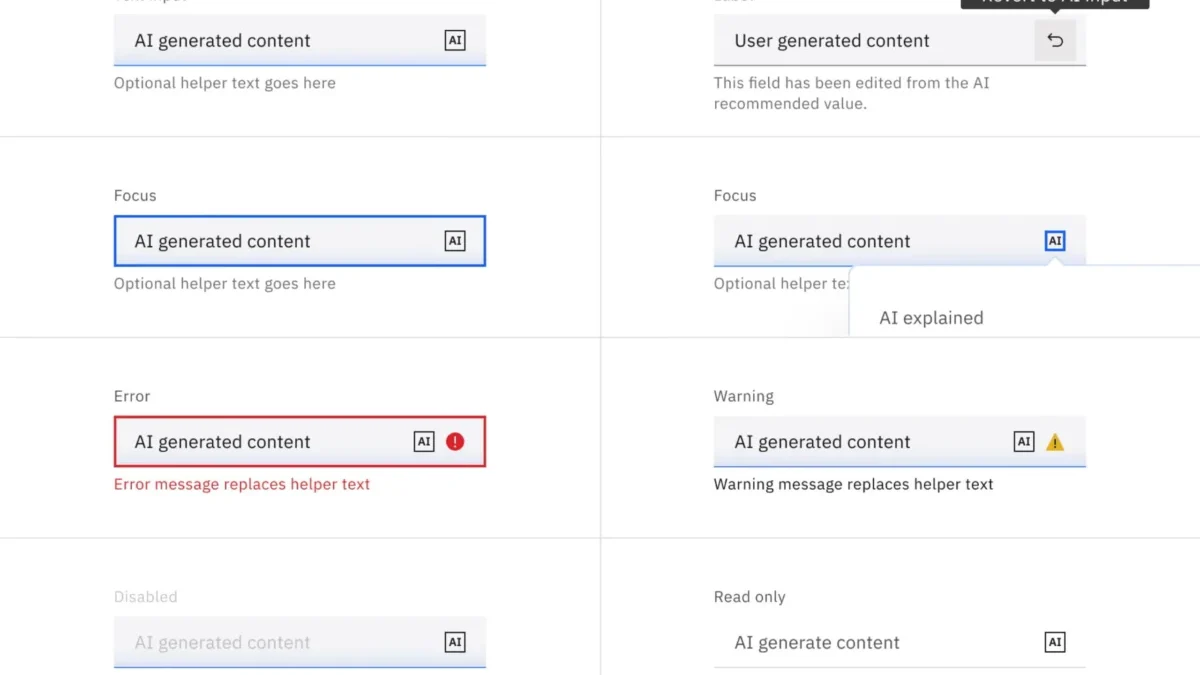
For product designers, the new rules necessitate a shift in interface architecture. The integration of AI labels requires more than just an icon; it requires an "explainability" layer. When a user interacts with a system, they must be able to understand the source of the information presented.

Industry standards, such as IBM’s Carbon Design System, have already begun incorporating these requirements into their component libraries. These designs emphasize that labeling should not be an afterthought or a hidden footnote in a terms-of-service agreement. Instead, transparency should be an integrated element of the UI, providing users with the necessary context to assess the validity of the content they are consuming.
The Human-in-the-Loop Requirement
The most significant impact of the 2026 regulations is the emphasis on "editorial responsibility." The Commission’s stance is that AI should act as a tool for human expression, not a replacement for human accountability. If an organization generates content using a Large Language Model (LLM), it cannot simply attribute the output to the AI. To avoid the mandatory labeling, a human must perform a "substantive" review.

This does not mean a quick skim before hitting publish. It implies a process of verification and refinement where a human author takes ownership of the claims and the quality of the content. For large-scale operations, this may require a change in workflow—implementing internal audit trails that document the human review process, effectively treating AI as a draft-generation tool rather than an automated publishing engine.
Future-Proofing AI Products
The goal of these regulations is to combat the rise of "AI slop"—a term used to describe the proliferation of low-quality, automated content that degrades the information ecosystem. By mandating transparency, the EU is attempting to preserve the integrity of public interest information, including health, safety, environmental, and financial news.

Organizations that proactively adopt these transparency standards will likely find a competitive advantage in building user trust. As consumers become more sophisticated, the ability to distinguish between verified human content and automated output will become a hallmark of premium, reliable services. Conversely, companies that attempt to mask the use of AI behind ambiguous symbols or hidden disclosures risk not only heavy fines but also a long-term erosion of their brand credibility.
In conclusion, the August 2026 guidelines are not a signal for the tech industry to halt innovation. Rather, they are a framework for responsible deployment. By focusing on clarity, persistent labeling, and the assertion of human editorial responsibility, the EU is setting a precedent that the rest of the world is likely to follow. The transition to a transparent AI future requires a fundamental rethink of product design and content production, ensuring that at every stage of the user experience, the line between machine output and human intent remains clear.