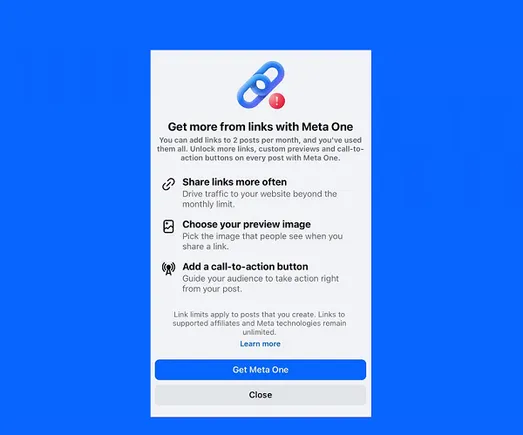
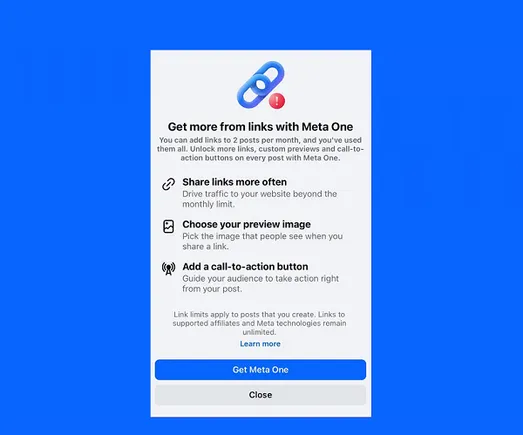
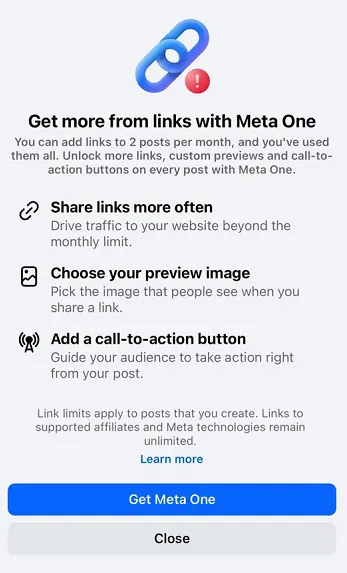
The social media landscape is undergoing another significant shift as Meta expands its trials restricting unpaid professional accounts and business pages from sharing outbound links freely. Following the rollout of the Meta One for Business subscription packages, platform managers across Facebook have reported receiving pop-up alerts limiting their unmonetized accounts to a maximum of two link-containing posts per calendar month. This move signals a broader monetization strategy by the tech giant, effectively gating a feature that businesses have historically used to drive external web traffic, unless they upgrade to a paid tier.
The expansion of this test has sent ripples through the digital marketing community. While publishers remain temporarily exempt to maintain a steady flow of news and information across the platform, other commercial entities face tough choices regarding their organic outreach strategies. As Meta increasingly ties basic publishing capabilities to financial contributions, brands must reevaluate how they allocate resources between organic social media management and paid advertising campaigns.
Background Context and Evolution of the Link Restriction Policy
The groundwork for these recent limitations was laid late last year. In December 2025, Meta quietly initiated a limited pilot program that restricted a select group of business pages to just two link posts per month. At the time, the company framed the trial as an exploratory measure designed to understand whether granting an increased volume of outbound links adds genuine value for commercial users.
However, the strategic importance of this test has crystallized with the recent introduction of Meta One for Business. Marketed as a comprehensive suite of add-on packages, Meta One provides various tiers of benefits, including the ability to include a predetermined, limited number of outbound links in Instagram posts and Reels each month. Although Facebook-specific link allocations were not initially highlighted as a core benefit of the initial launch documentation, the sudden surge of pop-up alerts experienced by Facebook page managers indicates that cross-platform enforcement is imminent or already underway.
By bundling basic operational features into subscription packages, Meta is transforming fundamental social media functionalities into premium services. For years, businesses could freely direct followers to external e-commerce sites, blogs, and landing pages. Under the evolving Meta One framework, unrestricted outbound linking is rapidly becoming a paid privilege.
A Chronological Look at Meta’s Monetization Playbook
To understand the current policy shift, it is helpful to examine Meta’s historical approach to platform monetization. CEO Mark Zuckerberg famously outlined a three-stage monetization strategy for the company’s family of applications back in 2016 during an annual stockholder meeting.
The first phase focuses on building utility and attracting a massive, engaged consumer base. During this initial window, tools and features are offered entirely free of charge to encourage widespread adoption and habit formation. The second phase involves encouraging organic business use, convincing brands that maintaining a robust presence on the platform is essential for reaching consumers. Businesses invest heavily in building audiences, designing custom graphics, and cultivating brand communities under the assumption that organic reach will remain viable.
The third and final phase—which platforms like Facebook and Instagram have been traversing for several years—involves rolling out monetization mechanics. Once businesses become deeply dependent on the ecosystem to reach their customer base, the platform introduces friction, reduces organic visibility, and ultimately charges fees for access and distribution. The limitation of link posts to two per month for unpaid accounts fits neatly into this well-documented playbook, shifting commercial users from a free-tier ecosystem to a pay-for-performance model.
Supporting Data: The Declining Value and Exposure of Link Posts
While business managers often view the restriction on link posts as a severe operational handicap, empirical platform data suggests that the practical impact on overall reach may be less catastrophic than anticipated. Meta’s published metrics consistently demonstrate that posts containing external links receive exceptionally low visibility compared to native content.
According to Meta’s Widely Viewed Content report for the first quarter of 2026, an overwhelming 98.7% of all post views in the United States during that period did not include a link to a source outside of Facebook. Users overwhelmingly consume native text, images, and video content directly within the application feed, actively scrolling past or ignoring outbound links.

This trend is part of a multi-year decline in link post exposure. Back in 2022, when Meta first began publishing transparency insights regarding widely viewed content, approximately 9.8% of viewed content included an external link. Over the subsequent four years, that figure has steadily dropped, hitting a historic low of 1.3% by Q1 2026.
The algorithmic demotion of link posts is intentional. Social media platforms fundamentally prioritize user retention, designing their recommendation engines to keep audiences inside the walled garden of the app for as long as possible. Because outbound links direct users away from the platform—thereby interrupting ad exposure—algorithms naturally throttle the organic distribution of link-heavy content.
Industry Reactions and Strategic Implications for Businesses
The expansion of the link restriction policy has prompted mixed reactions across the digital marketing sector. Many brand managers and small business owners have expressed frustration, characterizing the policy as a aggressive bait-and-switch maneuver. Organizations that spent years building organic Facebook communities find themselves cornered, forced to choose between paying for a Meta One subscription or abandoning outbound link sharing altogether.
Conversely, industry analysts point out that marketing strategies should have already adapted to the reality of declining organic link reach. Because organic visibility for external links has hovered near zero for quite some time, relying on free link posts was already an inefficient method for driving traffic. Forward-thinking brands have largely shifted their strategies toward native engagement tactics—such as utilizing direct messaging funnels, investing in paid Meta advertisements, or directing users to links placed safely within profile bios rather than feed posts.
Exemptions for Publishers and the Flow of News
A critical nuance in Meta’s current test parameters is the explicit exemption granted to publisher pages. Recognizing the vital role that news organizations and media outlets play in maintaining active platform engagement and timely information sharing, Meta has ensured that recognized publishers are not currently subjected to the two-link-per-month cap.
This carve-out prevents potential regulatory scrutiny regarding the suppression of news content, a sensitive issue that has previously brought heavy criticism upon tech conglomerates. By allowing publishers to continue sharing breaking news stories and external articles freely, Meta protects the foundational utility of the platform as a hub for current events while simultaneously monetizing commercial and corporate accounts.
Looking Ahead: The Future of Paid Social Ecosystems
As Meta continues to refine and expand the Meta One for Business subscription model, the line between organic and paid social media management continues to blur. The days of utilizing social platforms entirely free of charge to build sustainable business funnels are drawing to a close.
For small and medium-sized enterprises, the financial calculus of digital marketing must now factor in recurring platform subscription fees just to maintain baseline operational capabilities. While the immediate restriction to two link posts per month may feel restrictive, the broader data indicates that successful navigation of modern social media requires moving beyond basic link-dropping strategies. Brands must embrace native storytelling, community building, and targeted paid advertising to achieve meaningful engagement in an increasingly pay-to-play digital environment.