The global digital publishing landscape has faced severe disruptions throughout 2026, characterized by deep year-on-year traffic contractions, sweeping algorithm adjustments, and a noticeable shifting of audience engagement across international markets. According to the latest comprehensive data compiled by Similarweb across the world’s fifty largest English-language news websites, legacy media outlets and digital-first properties alike are grappling with unprecedented pressures. India-based digital publishers, in particular, experienced dramatic downward adjustments in readership, mirroring wider systemic changes in how search engines and artificial intelligence tools deliver information to end-users.
The ongoing data highlights a difficult operational environment for digital publishers. Throughout the spring and summer of 2026, mainstream platforms watched historical traffic baselines erode, driven by a combination of platform-level shifts, changing content discovery habits, and the widespread integration of automated AI summaries across major search engines.
Chronology of the 2026 Traffic Contraction
The downward trajectory of global web traffic intensified significantly during the early months of 2026. In February, digital intelligence metrics showed that 40 out of the top 50 English-language news domains suffered year-on-year declines. Among the hardest hit were several prominent Indian news properties—including India.com, The Hindustan Times, and the Indian Express—which saw traffic plummet by 40 to 70 percent compared to the previous year. Concurrently, major Western outlets faced major structural pressures; for instance, The Washington Post executed deep newsroom staff reductions, cutting roughly one-third of its total workforce at the beginning of February.
As the year progressed into spring, the publishing ecosystem absorbed the impact of major search core updates. By June 2026, thirty-two of the top fifty global newsbrands registered month-on-month declines, with Indian publications uniquely accounting for the steepest consecutive monthly losses. Analysts attributed these shifts to algorithmic recalibrations by dominant search engines, which altered visibility metrics for high-volume news aggregation and breaking news cycles.
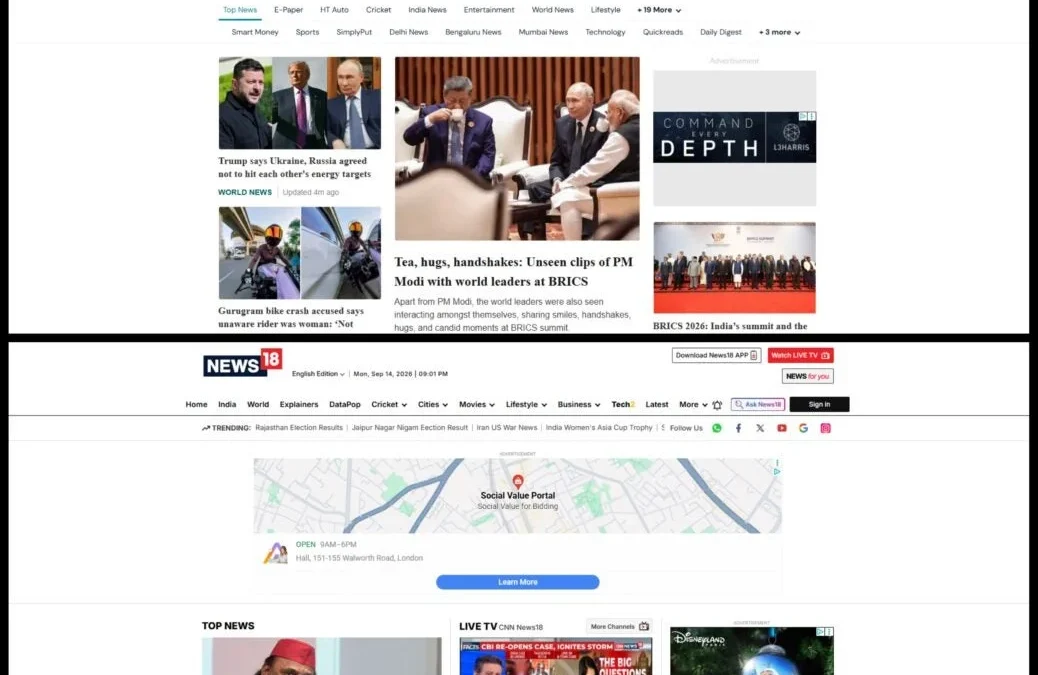
By August 2026, the year-on-year figures underscored a profound industry-wide contraction. Out of the fifty largest English-language news websites worldwide, thirty-nine saw their visitor numbers fall relative to August 2025. The Hindustan Times and News 18 recorded the steepest annual drops among major publications, with traffic falling by more than 50% year-on-year to 84.4 million and 68.6 million visits, respectively.
Divergent Trajectories: Highs and Lows Among Major Publishers
While the prevailing trend across the sector leaned heavily toward contraction, select newsbrands and niche publishers managed to buck the broader decline through specialized coverage or strategic pivots.
Qatar-headquartered Al Jazeera experienced prolonged periods of high engagement, primarily catalyzed by intense geopolitical developments in the Middle East following military escalations involving the United States, Israel, and Iran. Throughout the spring of 2026, Al Jazeera frequently led the global rankings in year-on-year growth, registering traffic surges of nearly 400% during peak conflict reporting cycles in March, before experiencing seasonal corrections later in the summer.
Similarly, subscription-based newsletter and publishing platform Substack sustained a multi-month streak of strong annual growth, capitalizing on the decentralization of independent political commentary and specialized readership models. Among traditional broadcasters, the British Broadcasting Corporation (BBC) temporarily reclaimed a major milestone in July 2026 by crossing the global threshold of one billion total visits—a peak aided by major international sporting events, seasonal weather anomalies, and political shifts in the United Kingdom. However, this high-water mark proved transient, with BBC traffic correcting downward to 818.5 million visits by August.
In the European market, France-based Euronews posted substantial gains, growing its audience significantly through multi-lingual digital adaptations and targeted international distribution, while aggregate platforms like News Now absorbed traffic diverted from traditional media channels.
Underlying Factors and Industry Reactions
Digital publishing executives point to structural shifts in search and discovery architectures as the primary catalyst behind the prolonged traffic slump. The rapid mainstream adoption of artificial intelligence features—such as generative AI summaries and conversational search assistants—has fundamentally altered the top-of-funnel acquisition model for news publishers. Rather than clicking through to original reporting sites, users increasingly consume synthesized answers directly on search engine results pages.
Industry leaders have begun adapting their operational models in response to these algorithmic and technological headwinds. Politico, for instance, initiated technical infrastructure overhauls—such as transitioning to a unified headless Content Management System (CMS)—to streamline digital delivery across its transatlantic domains. Other outlets have focused on audience retention, direct-to-consumer newsletter subscriptions, and paywall optimizations to insulate themselves against the volatility of open-web search traffic.
Broader Implications for the Digital News Economy
The Similarweb datasets from 2026 offer a sobering prognosis for the future of ad-supported digital journalism. As search engines prioritize zero-click answers and algorithmic feeds favor closed ecosystems, general-interest news websites dependent on high-volume programmatic advertising face an existential squeeze.
The disproportionate impact on high-volume Indian news portals and major Western aggregators like MSN and CNN demonstrates that scale alone no longer guarantees stability. Publishers that rely heavily on breaking news search traffic have been forced to accelerate diversification strategies, leaning into membership models, specialized B2B verticals, and audio-visual storytelling formats.
Ultimately, the data from August 2026 marks a transitional chapter for digital journalism. As publishers navigate the dual pressures of generative search integration and shifting reader habits, the global news ecosystem is undergoing a painful structural correction—one that is steadily separating high-margin, niche, or loyal subscriber bases from the volatile economics of open-web search dependency.