Social media platforms have long wrestled with a fundamental design tension: how to foster open, frictionless communication while simultaneously protecting users from harassment, spam, and unwanted intrusions. For years, digital platforms have relied on binary privacy settings—allowing messages exclusively from mutual followers or opening the digital floodgates to accept direct messages from anyone on the platform. This rigid framework often left public figures, content creators, event organizers, and privacy-conscious individuals with inadequate tools to manage their inbound communications effectively.
Addressing this persistent industry-wide challenge, X—formerly known as Twitter—has officially begun rolling out a novel security feature for its revamped X Chat messaging ecosystem. The newly introduced functionality allows users to generate unique, private 10-digit numeric codes. These identifiers act as virtual gatekeepers, permitting non-connected users to initiate direct messages, as well as audio and video calls, without requiring either party to exchange sensitive personal information such as actual telephone numbers or email addresses.
As social media platforms increasingly transition toward encrypted, multi-modal communication hubs that mirror standalone chat applications, features bridging public discovery and private interaction are becoming critical. This rollout represents a calculated step in X’s ongoing strategy to overhaul its messaging infrastructure, transforming the platform from a traditional microblogging site into a comprehensive communications utility.
Mechanics of the New 10-Digit X Number System
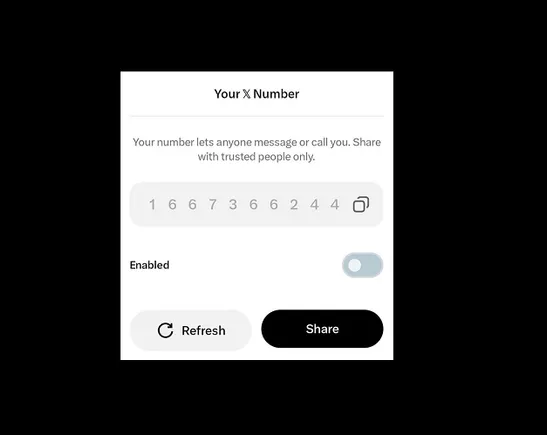
The mechanics of the newly deployed X number feature are designed around user autonomy and strict boundary control. According to early platform demonstrations and user interface captures shared by tech observers, the system operates through a dedicated configuration panel within the X Chat settings.
When a user elects to utilize the feature, the platform’s system algorithmically generates a distinct 10-digit identification code. This sequence closely mimics a traditional phone number format but operates entirely within the digital architecture of the X platform, decoupling communication from physical telecommunications networks and cellular carriers.
Once generated, the user can selectively distribute this 10-digit code across various digital channels—such as embedding it within a standard platform post, sharing it during a live-streamed video broadcast, displaying it on an external website, or distributing it privately through other communication mediums.
When a profile visitor who is not a mutual follower attempts to initiate a direct message conversation, the platform’s interface will present a security prompt requiring the manual entry of the active 10-digit code. Successfully inputting the correct sequence unlocks direct messaging privileges for that specific account. Furthermore, because direct messaging permissions on X inherently govern real-time communication tools, granting DM access via the code simultaneously enables those non-connections to place audio and video calls to the recipient, provided the account’s broader settings permit such interactions.
Crucially, the system features a dynamic refresh capability. Users maintain the administrative authority to invalidate their existing 10-digit code at any moment and generate a new one. This ensures that if a code becomes compromised, publicly overexposed, or shared with an undesired demographic, the account holder can instantly sever access for all previous holders of that code without permanently altering their core profile settings or blocking individual accounts one by one.
Evolution of X Chat and Platform Messaging Infrastructure
To fully understand the strategic weight of the 10-digit number initiative, it is necessary to examine the broader historical evolution of X’s messaging architecture. Under its previous operational structure, Twitter’s direct messaging system was treated largely as an ancillary feature—a basic text-based text utility meant to facilitate side conversations between users who already shared a mutual follow relationship.

Following the platform’s high-profile corporate restructuring and ownership transition, executive leadership articulated a clear vision to transform the service into an "everything app." Central to this ambitious roadmap was a comprehensive modernization of the messaging suite, subsequently rebranded under the internal designation of X Chat. Leadership sought to position the platform to compete directly with dominant standalone messaging monoliths such as WhatsApp, Telegram, Apple’s iMessage, and Meta Messenger.
Over the preceding twenty-four months, X systematically introduced a series of foundational upgrades to accomplish this transformation. The platform rolled out end-to-end encryption (E2EE) for qualifying direct message conversations, elevated media sharing capabilities, and integrated high-definition audio and video calling functionalities directly into the chat interface. These aggressive feature additions successfully drove higher user engagement metrics within private channels, but they simultaneously exacerbated existing moderation and spam concerns.
By default, users faced a difficult choice regarding inbound communication security. They could restrict their inbox strictly to mutual connections—thereby eliminating spam but severely limiting serendipitous networking, business inquiries, and fan engagement. Alternatively, they could open their message requests to anyone on the platform, exposing themselves to malicious actors, automated bot networks, unsolicited commercial solicitations, and targeted harassment campaigns.
The introduction of the 10-digit access code serves as an innovative middle ground. It introduces a friction-based security gate that deters automated bots and casual spammers, who lack the specific numeric key, while allowing human users with legitimate intent to establish a direct communication bridge based on contextual awareness.
Strategic Applications and Practical Use Cases
While the technological mechanics of the 10-digit code are straightforward, the strategic and practical use cases across various user demographics are remarkably diverse. Industry analysts and early digital strategists have identified several primary verticals where this functionality could significantly alter communication workflows:
Event Management and Live Conferencing
For event organizers, trade show coordinators, and conference hosts, managing attendee communication has historically been a logistical hurdle. Organizers frequently rely on public announcements or crowded group chats that quickly become unmanageable. With the new X number feature, an event organizer can project a 10-digit code onto a main presentation screen or include it in a digital attendee packet. Attendees can then input the code to establish a direct, temporary communication line with the event support desk or concierge service. Once the event concludes, the organizer can simply deactivate or refresh the code, instantly terminating the temporary communication window and preventing post-event clutter.
Creator Economy and Fan Engagement
Content creators, independent journalists, musicians, and public figures frequently struggle to balance accessibility with personal privacy. Direct fan engagement is vital for audience growth and monetization, yet opening public DMs invites an overwhelming volume of noise and potential safety risks. The 10-digit code enables tiered accessibility models. A creator might share a specific code during an exclusive subscriber-only live stream, rewarding dedicated supporters with temporary direct access. Alternatively, a public figure could open a limited-time window for fan questions ahead of a media appearance, deactivating the code once an adequate volume of inquiries has been received.
B2B Networking and Professional Lead Generation
Sales professionals, recruiters, and consultants often use X as an active networking hub. However, cold messaging profiles that do not follow back often results in messages landing in obscure message request folders that are rarely checked or actively filtered out by spam detection algorithms. By including a verified 10-digit code within a professional bio or pinned post, industry professionals can signal openness to targeted inquiries from prospective clients or employers, ensuring their outreach bypasses traditional algorithmic friction while maintaining structural control over who initiates contact.
Market Analysis, Security Implications, and Privacy Considerations
The deployment of a pseudo-phone number system within a social media application touches upon complex debates surrounding digital privacy, data security, and platform governance. Cybersecurity researchers have analyzed the architecture of the feature to evaluate its resilience against potential exploitation vectors.
From a privacy standpoint, the primary advantage of the system is absolute data minimization. Traditional messaging platforms often require users to link their physical mobile phone numbers as a mandatory identity verification step to prevent bot creation. This practice has raised valid concerns among privacy advocates, given that centralized phone number databases are frequently targeted by malicious actors for SIM-swapping attacks, data scraping, and cross-platform tracking. By utilizing an internal, platform-generated 10-digit virtual identifier, X allows users to facilitate high-trust connections—including voice and video calls—without exposing their actual telecommunications footprint to strangers.

However, security analysts also emphasize that the effectiveness of the system relies heavily on user behavior. If a user publicly broadcasts their 10-digit code in an unmonitored or highly visible public forum without setting appropriate temporal boundaries, the code risks being harvested by automated scraping scripts designed to flood the target account with solicitations. Consequently, the success of the feature depends on widespread user adoption of best practices, such as regularly refreshing codes and treating them with the same discretion traditionally reserved for private cryptographic keys.
Furthermore, platform moderators note that while the code restricts who can initiate a conversation, it does not exempt participants from the platform’s overarching Terms of Service or automated safety filters. Content transmitted via X Chat remains subject to automated detection algorithms designed to flag hate speech, non-consensual imagery, and fraudulent activity, ensuring that the feature cannot be weaponized to bypass core platform safety standards.
Broader Industry Context and Competitor Landscape
X’s introduction of customizable, temporary communication gates arrives amidst a broader industry shift toward granular privacy controls across major social technology ecosystems. Competitors have likewise sought innovative ways to bridge public discovery with private messaging safety.
Meta platforms, including Instagram and WhatsApp, have experimented extensively with message request filtering, read-receipt toggles, and restricted chat folders to protect users from unsolicited media attachments and text spam. Meanwhile, decentralized platforms operating on protocols like ActivityPub are exploring cryptographic identity keys to authenticate message senders without relying on central phone registries.
By introducing a proprietary numeric access code, X has chosen a distinctly product-driven path that emphasizes user-managed exclusivity. This feature aligns with the platform’s broader commercial strategy of developing utility-driven revenue streams and value-added tools designed to retain high-value power users, verified creators, and enterprise accounts.
Future Outlook and Rollout Timeline
As of the current announcement phase, the 10-digit X number feature is actively rolling out in a phased deployment across global markets, reaching web and mobile application clients progressively. Platform engineers are monitoring system performance metrics, server load handling for dynamic code generation, and initial user feedback to refine the user interface before achieving general availability.
Industry observers anticipate that as users become more familiar with the capabilities of X Chat, additional refinements—such as time-expiring automated codes, analytics tracking for inbound code usage, and integrated scheduling prompts—could be incorporated into subsequent software updates.
Ultimately, the launch of the 10-digit private contact number option marks a significant evolutionary milestone for X’s messaging infrastructure. By offering a sophisticated, flexible mechanism to balance open communication with rigorous personal boundary management, the platform has provided its global user base with an advanced tool designed to navigate the complexities of modern digital connectivity safely and efficiently.