The digital landscape is undergoing a profound transformation, with artificial intelligence rapidly reshaping how consumers discover information and interact with brands online. A recent report indicates that approximately 58% of consumers now leverage AI answer engines for product research weekly, a figure that is experiencing rapid growth. This surge in AI-powered platforms, including ChatGPT, Perplexity, and Google AI Overviews, is elevating them to primary discovery surfaces. Consequently, content and SEO teams are critically examining the long-held tenets of digital authority, particularly the role of backlinks in the context of Answer Engine Optimization (AEO). The prevailing consensus suggests that while contextually relevant backlinks retain significant value, they no longer represent the entirety of an effective authority playbook.
The Dawn of AEO: A Paradigm Shift in Information Discovery
For decades, Search Engine Optimization (SEO) has been the cornerstone of online visibility, primarily focused on ranking web pages in traditional search results to drive organic traffic. The fundamental principle of SEO, particularly off-page SEO, heavily relied on backlinks – external links from other websites pointing to a page – as a primary signal of authority and trustworthiness. Google’s PageRank algorithm, for instance, famously interpreted these links as “votes of confidence,” with the value of a vote weighted by the authority of the linking domain.
However, the advent of sophisticated generative AI and large language models (LLMs) has introduced a new layer of complexity: Answer Engine Optimization (AEO). Unlike traditional search engines that present a list of links, AI answer engines aim to synthesize information from various sources to provide direct, concise answers to user queries. This shift moves the goal from simply ranking high to being cited or grounded as a reliable source within an AI-generated response. The implication is profound: marketers must now consider not just how search engines rank, but how AI systems interpret and trust information.
Redefining Authority: Beyond Traditional Backlink Counts
The core difference lies in how AI systems evaluate authority. While they do not entirely abandon the logic of off-page SEO, they layer a far more nuanced assessment on top. When an AI answer engine constructs a response, it’s not merely counting backlinks. Instead, it meticulously identifies sources that can reliably ground the answer, prioritizing accuracy, relevance, and the semantic alignment of the content. This means that a high-authority backlink profile, while still beneficial, is no longer a sufficient condition for achieving AI visibility. It is a necessary foundation, but the house of AEO requires additional, more intricate architectural elements.
Industry experts have been quick to highlight this evolving dynamic. Nathaniel Miller, Head of Marketing at Ashbrook Technologies, noted in an interview for the Found in AI podcast, "The companies ranking highest across AI platforms tend to be the ones with both strong authority and strong backlink profiles." He further emphasized the qualitative shift, stating, "if you’re not getting qualified traffic from that link, it’s basically a logo slap. The real value is in relevance and authority – not just size." This underscores that the type of link matters far more than its sheer volume.
The Evolving Role of Backlinks in AEO
In the AEO landscape, backlinks still "move the needle," but their influence is recalibrated. The emphasis has shifted from quantity to quality and contextual relevance. A high-domain authority (DA) link from a low-relevance source, which might have provided a significant "domain authority boost" in classic SEO, offers only a weak semantic signal for an AI engine. Conversely, a high-DA, high-relevance link carries "very high" influence in both classic SEO and AEO.
The table below illustrates this differentiation:
| Link Type | Classic SEO Influence | AEO Influence |
|---|---|---|
| High-DA, low-relevance link | High (domain authority boost) | Low (weak semantic signal) |
| High-DA, high-relevance link | Very high | Very high |
| Industry publication link | High | High – especially if the publication is a grounding source for AI |
| Niche blog link with strong topical depth | Moderate | High – semantic adjacency reinforces entity authority |
| Directory or aggregator link | Low–moderate | Minimal |
| Co-citation in expert roundup | Indirect | High – positions brand alongside recognized authorities |
This table clearly demonstrates that AI systems prioritize deep topical alignment and credibility over generic domain strength. An industry publication link or a niche blog with strong topical depth, especially if it’s a recognized "grounding source" for AI, holds significantly more sway in AEO than in traditional SEO.
New Pillars of AEO: Unlinked Mentions, Co-citations, and Entity Clarity
Beyond the refined role of backlinks, AEO introduces several new, critical signals that influence AI citation likelihood:
-
Unlinked Brand Mentions: Every time a brand name appears in a credible source without a hyperlink, it registers as a "mention signal." AI systems leverage these mentions to map brands to specific topic clusters. A brand frequently mentioned alongside a relevant topic, even without a direct link, builds "entity authority" – a broad recognition that positions it as an obvious citation choice. As Charlie Graham, founder of RivalSee, pointed out on the Found in AI podcast, approximately 85% of brands mentioned in ChatGPT responses have no direct citation link. This highlights a "downstream effect" where users remember the brand and search for it later, an authority signal that traditional analytics often miss.
-
Co-citations: A co-citation occurs when two or more brands or sources are referenced together within the same content, not necessarily linked to each other but sharing a common context. For AI answer engines, co-citations serve as a powerful semantic signal, suggesting that a brand belongs in the same authoritative company as others being mentioned. Being consistently co-cited with recognized experts or reputable publications within a specific category is an often-underestimated AEO tactic.
-
Entity Clarity: An "entity" in AI search refers to a clearly defined, consistently described thing – be it a brand, a person, or a concept. Lars Lofgren, an SEO consultant for major brands, emphasized that AI engines are essentially mapping relationships among everything they crawl, focusing on a business’s primary entity, not just its domain. Answer engines are far more inclined to cite brands with robust entity clarity, meaning they exhibit:
- Consistent naming across all digital properties.
- Effective use of structured data (e.g., Organization/Person/sameAs schema).
- A clearly defined area of expertise consistently communicated across all channels.
- A strong presence on authoritative knowledge graphs (e.g., Google’s Knowledge Panel).
If an AI system cannot confidently identify a brand, understand its purpose, and verify that information across diverse channels, it will be hesitant to cite it. "Entity confusion is a silent AEO killer," hindering visibility even for otherwise strong brands.
Bridging the Gap: SEO and AEO as Complementary Strategies
It is crucial to understand that AEO does not replace SEO; it extends it. AEO builds upon SEO’s foundational principles, adapting them for an environment where the interface and evaluation criteria are meaningfully different. While SEO primarily focuses on ranking pages to earn clicks and drive traffic, AEO’s primary objective is to become the trusted source an AI system quotes, paraphrases, or cites in response to a user’s question.
This distinction manifests in different objectives, content structures, authority signals, and key performance indicators (KPIs):
| Dimension | SEO | AEO |
|---|---|---|
| Primary Goal | Rank in search results | Earn citations in AI-generated answers |
| Content Structure | Keyword placement, internal linking | Direct answers, fact statements, FAQ blocks |
| Authority Signal | Backlink profile | Backlinks + mentions + entity clarity + structure |
| Primary KPIs | Organic traffic, ranking position, CTR | AI citation frequency, brand mention share, grounding query coverage |
| Optimization Target | Individual page, keyword cluster | Brand entity, topic authority across multiple pages |
| Measurement Tools | Google Search Console, rank trackers | AI visibility tools, Bing Webmaster Tools (AI Performance), HubSpot AEO |
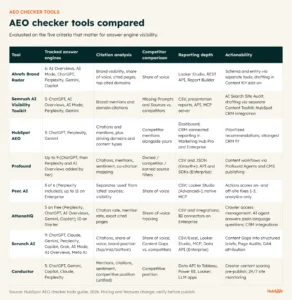
Organizations achieving the strongest AEO results are not abandoning their SEO programs but rather running them with greater precision. They prioritize quality over volume, clarity over keyword density, and strategically layer entity and mention strategies on top of their existing SEO efforts. Tools like HubSpot AEO are emerging to help marketing teams measure this citation-based visibility alongside traditional search metrics, offering a holistic view of content performance across both channels.
Crafting Content for AI Visibility: Structure and Clarity
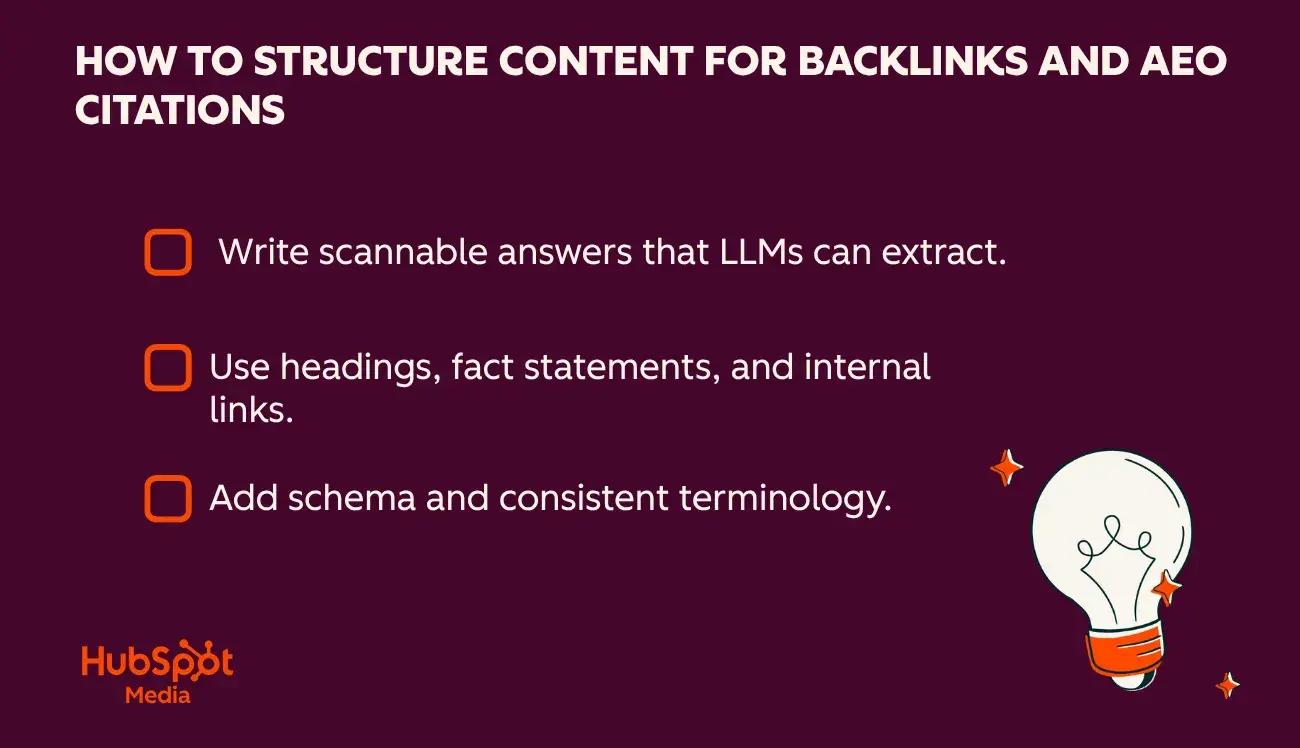
AI systems retrieve information from indexed content, and content that is easily parsable, clearly organized, and directly responsive to questions is systematically more likely to be cited. To optimize content for both backlinks and AEO citations:
-
Write Scannable, Direct Answers: Every major section should provide a direct, self-contained answer to the question implied by its heading. Lead with the answer, then support it with context, data, or examples. Language models are significantly more likely to extract and cite content that follows this "answer first, evidence second" pattern. This means:
- Beginning paragraphs with direct answers.
- Using bullet points and numbered lists for clarity.
- Summarizing key takeaways prominently.
-
Utilize Headings, Fact Statements, and Internal Links:
- Headings (H1, H2, H3): Provide a clear hierarchical structure that guides both human readers and AI crawlers.
- Fact Statements: Incorporate concise, verifiable facts that AI systems can easily extract.
- Internal Links: Create a dense internal linking structure around topic clusters. This signals topical depth and authority to answer engines, reinforcing the brand’s expertise.
-
Implement Schema Markup and Consistent Terminology:
- Schema Markup: This machine-readable metadata clarifies a page’s purpose and structure to both search and AI systems. Valuable schema types for AEO include
Organization,Person,FAQPage,HowTo, andProduct. - Consistent Terminology: Using a canonical term for each concept consistently across all pages, social profiles, and external mentions prevents "entity confusion" for AI systems.
- Schema Markup: This machine-readable metadata clarifies a page’s purpose and structure to both search and AI systems. Valuable schema types for AEO include
Integrated Strategies: Building Backlinks and AEO-Salient Mentions
The most effective AEO strategies treat link building and mention building as an integrated effort. Every outreach action should aim to produce both a structural link signal and a brand mention that AI systems can index.
-
Prioritize AI-Friendly Content Formats: Certain content formats disproportionately attract AI citations:

- Data-rich articles: Presenting original research or compiled statistics.
- How-to guides: Step-by-step instructions.
- FAQ pages: Directly answering common questions.
- Glossaries: Defining industry terms.
- Comparison articles: Analyzing different products or services.
When publishing original research, including a standalone "Key Findings" section with clearly labeled statistics significantly boosts extractability and citation likelihood.
-
Earn Relevant Links and Co-citations with Original Research and Digital PR: Original research is arguably the most efficient way to generate both backlinks and co-citations. A well-executed study or data report provides other publishers with a compelling reason to link to a brand as a primary source. The subsequent coverage often mentions the brand alongside other respected voices, creating valuable co-citation signals. Digital PR, encompassing earned media placements, expert commentary, and podcast appearances, is another powerful strategy. A single well-placed expert quote in an industry publication can simultaneously generate a backlink, a brand mention, and a co-citation with recognized experts. As Miller aptly put it, "Digital PR is the fastest way to start building momentum."
-
Participate Where Answers Form: AI systems index content not just from brand-owned properties but also from platforms where authoritative conversations occur:
- Industry forums and communities.
- Q&A sites (e.g., Quora, Reddit).
- Social media (especially professional networks like LinkedIn).
- Expert roundups and interviews.
- Podcasts and webinars.
- News and trade publications.
Active participation – contributing expert commentary, publishing thought leadership, appearing as a guest – expands a brand’s footprint across sources AI systems trust. Tools like Qwoted and HARO are particularly valuable for connecting with journalists and securing these third-party placements.
Measuring AEO Impact: A Repeatable Loop
Effective AEO requires aggressive experimentation and rigorous measurement. Without a clear feedback loop linking published content, changes in authority signals, and AI citations, optimization becomes guesswork. HubSpot’s Loop Marketing framework, which emphasizes feeding data back into the next iteration, is highly applicable here.
-
Benchmark AI Visibility and Citations: Establish a baseline before optimizing. This involves tracking current AI citation frequency, identifying top-performing content, and understanding which content types and source categories are driving citations. Tools like HubSpot AEO are designed for this, offering a unified dashboard for both SEO and AEO metrics.
-
Tie Changes to Content and Outreach Activity: To make measurement useful, changes in visibility must be linked to specific actions. This requires disciplined logging of when a brand:
- Publishes new content.
- Updates existing pages.
- Secures new backlinks or mentions.
- Implements schema or entity optimizations.
Over time, patterns emerge, revealing which content types, link-building tactics, or outreach efforts most effectively drive AI citations.
-
Report What to Scale and What to Stop: The final step is translating measurements into prioritization decisions. Monthly reviews should address:
- Which content initiatives are generating the most AI citations?
- Which link-building strategies are most effective for AEO?
- Are there specific entity or schema improvements yielding results?
- What should be scaled, and what should be discontinued?
This systematic approach transforms AEO from a reactive project into a compounding strategy, with each measurement cycle producing cleaner inputs for the next.
Conclusion: Backlinks Retain Their Place in a New Ecosystem
The future of SEO does not pit backlinks against AEO. Instead, they represent different, yet interconnected, layers of the same authority infrastructure. Backlinks provide the fundamental structural credibility that enables content to be indexed, trusted, and eventually used as a grounding source by AI. Simultaneously, unlinked brand mentions, co-citations, clear entity definition, and well-structured content collectively build the broader signal that convinces an AI system a brand deserves to be part of the answer.
Content teams making tangible progress in AI visibility are not abandoning their established SEO programs. Rather, they are making them more precise, entity-aware, and consistently structured. They recognize that while the mechanisms of discovery are evolving, the underlying principle of establishing genuine authority and trustworthiness remains paramount. For marketers navigating this new era, understanding the symbiotic relationship between traditional SEO elements and the emerging demands of AEO is not merely advantageous; it is essential for sustained online visibility and brand influence. Tools that offer visibility into AI citation data, like HubSpot AEO, are becoming indispensable for moving from educated guesswork to iterative, data-driven optimization.