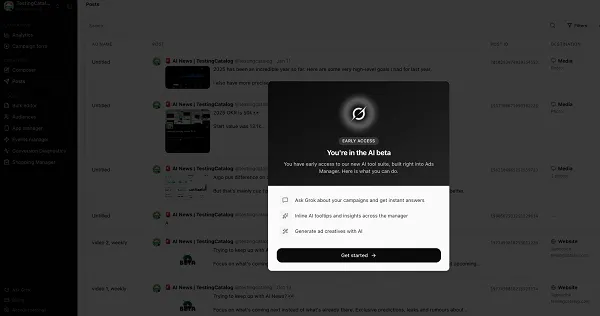
Social media platform X, formerly known as Twitter, has initiated beta testing for the integration of its proprietary artificial intelligence chatbot, Grok, into its Ads Manager. This strategic move is poised to deliver enhanced AI-powered guidance for advertisers, marking a significant step towards the platform’s stated ambition of achieving full advertising automation. The integration represents the latest evolution in X’s aggressive AI development push, aiming to fundamentally reshape how campaigns are conceived, executed, and optimized on the platform.
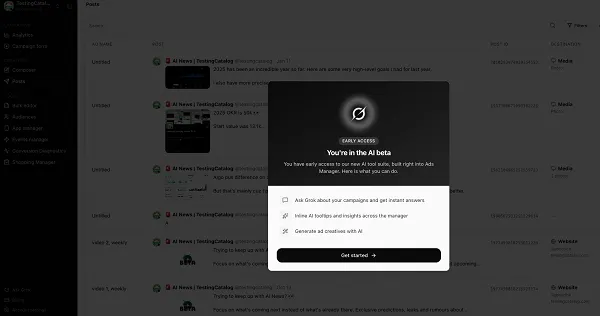
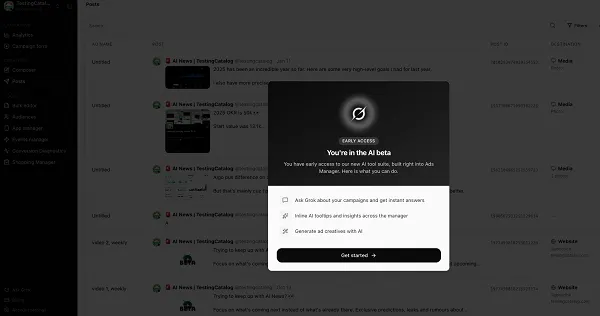
The beta program, currently accessible to a select group of X advertisers, empowers them to leverage xAI’s Grok chatbot for nuanced advice on their advertising strategies. Early observations from participants, first shared on Threads by "testingcatalog," illustrate Grok’s capacity to offer actionable insights. Beyond direct chatbot interaction, the update also introduces intuitive tooltips designed to streamline ad creation processes and generate innovative ideas for in-stream creative content. This development follows X’s comprehensive overhaul of its Ad Manager platform in April, which was rebuilt from the ground up to incorporate AI-driven recommendations at every stage of the advertising lifecycle.
Contextualizing X’s AI Transformation
The current integration of Grok into X’s advertising infrastructure is not an isolated event but rather a crucial milestone in a broader, ambitious vision spearheaded by owner Elon Musk. Since acquiring Twitter in October 2022 and subsequently rebranding it as X, Musk has articulated a clear strategy to transform the platform into an "everything app," mirroring the functionalities of WeChat in China. A cornerstone of this vision is the deep integration of artificial intelligence across all facets of the platform, from content moderation and user experience to, critically, advertising.
Musk’s commitment to AI intensified with the establishment of xAI in July 2023, an independent AI company whose stated mission is "to understand the true nature of the universe." Grok, xAI’s flagship large language model (LLM), was unveiled to a limited audience in November 2023. Distinct from other LLMs, Grok is designed to access real-time information from X, giving it a unique contextual awareness of current events and trending topics—a critical advantage for advertisers seeking to align their campaigns with live cultural moments. The decision to integrate Grok directly into X’s core advertising product underscores the symbiotic relationship between Musk’s various ventures and his overarching strategy to imbue X with cutting-edge AI capabilities.
The advertising landscape on X has undergone significant changes since Musk’s takeover. The platform has faced challenges in maintaining and growing its advertising revenue amidst brand safety concerns and a shifting advertiser base. In response, X has aggressively pursued technological advancements to re-attract advertisers and demonstrate its value proposition. The April 2024 launch of the updated Ad Manager platform, which X hailed as the "biggest ad system update in the company’s history," was a direct response to these challenges. At the time, X asserted that its reformed ad platform was better equipped to understand user interests, thereby improving ad relevance and delivery in alignment with real-time trends within the app. The Grok integration builds directly on these foundational improvements, pushing the boundaries of AI-assisted advertising further.
The Mechanics of Grok’s Advertising Guidance
Grok’s role in Ads Manager extends beyond simple recommendations; it aims to act as an "always-on assistant" for advertisers. By leveraging its advanced natural language processing capabilities and its access to X’s vast data ecosystem, Grok can analyze various data signals to provide comprehensive guidance. This includes:
-
Audience Segmentation and Persona Matching: Grok can process billions of data points related to user profiles, in-app activity, content consumption patterns, and interactions. This allows it to construct highly detailed buyer personas based on existing customer data (e.g., users who have previously purchased from a brand) and identify lookalike audiences with similar traits and interests. For instance, if an advertiser targets individuals interested in sustainable fashion, Grok can analyze the profiles and activities of current customers and then identify other X users exhibiting similar engagement with eco-friendly content, brands, or discussions.
-
Creative Generation and Optimization: The integration offers tooltips and ideas for generating ad creatives. Grok can analyze successful past campaigns, current trends, and the specific nuances of an advertiser’s product or service to suggest compelling ad copy, visual themes, and even calls to action. It can help A/B test different creative elements by predicting potential performance based on historical data and user engagement metrics.
-
Campaign Strategy and Budget Allocation: Advertisers can query Grok for strategic advice, such as optimal bidding strategies, budget allocation across different ad formats or audience segments, and timing for campaign launches. Grok can simulate potential outcomes based on various inputs, helping advertisers make more informed decisions to maximize return on investment (ROI).
-
Real-time Performance Analysis and Adjustments: While not fully autonomous yet, Grok can provide real-time feedback on ongoing campaigns, highlighting underperforming elements or suggesting adjustments to targeting, bidding, or creative to improve efficacy. Its ability to access real-time information from X is particularly valuable here, allowing for rapid adaptation to evolving trends or news cycles.
Elon Musk’s Vision: Full Advertising Automation by 2025

The current beta testing is a stepping stone towards a much grander vision articulated by Elon Musk. In an August 2025 statement to Digiday, Musk outlined his long-term objective: for Grok to eventually enable full advertising automation on the X platform. This ambitious goal transcends mere AI assistance; it envisions a future where Grok can autonomously manage entire ad campaigns, from conception and creative generation to targeting, budget management, and real-time optimization.
Crucially, Musk emphasized that this full automation would encompass critical functions such as ad safety checks and content matching. This implies that Grok would not only identify the most receptive audiences and craft persuasive messages but also ensure that ads are placed in brand-safe environments and are contextually relevant to the surrounding content. This "agentic ad generation" represents a paradigm shift, where AI systems, based on a systematic understanding of X’s audience and an astute grasp of what prospective customers might respond to, build and manage entire campaigns with minimal human intervention.
Such a system would leverage AI tools to:
- Proactively Identify Opportunities: Detecting emerging trends or underserved audience segments where an advertiser’s product could thrive.
- Generate Entire Campaigns: Creating ad copy, visual assets (or guiding their creation), setting targeting parameters, and establishing bidding strategies.
- Continuous Optimization: Monitoring campaign performance around the clock and making real-time adjustments to maximize efficiency and effectiveness.
- Ensure Brand Safety and Compliance: Automatically screening content and placement to prevent ads from appearing alongside inappropriate material or violating regulatory guidelines.
The Competitive Landscape of AI in Advertising
X’s move to integrate Grok deeply into its advertising platform places it firmly within a rapidly evolving competitive landscape where major tech giants are all vying for leadership in AI-powered advertising.
- Meta (Facebook, Instagram): Meta has been a pioneer in AI-driven advertising for years, leveraging its vast user data to power sophisticated targeting algorithms, dynamic creative optimization, and automated campaign management tools like Advantage+. Its AI systems are constantly learning from billions of user interactions to refine ad delivery and relevance, making it a formidable competitor.
- Google (Search, YouTube, Display Network): Google’s AI capabilities are unparalleled in scale and scope. Its Performance Max campaigns, for instance, utilize AI to optimize ad delivery across all Google channels, while its search advertising relies heavily on AI to understand user intent and match it with relevant ads. Google’s AI also plays a crucial role in content recommendation and ad placement on YouTube.
- TikTok: Known for its highly effective algorithmic recommendations, TikTok’s AI is central to its advertising success. Its "For You" page algorithm keeps users engaged and provides advertisers with powerful tools to reach niche audiences based on viewing habits and interactions. TikTok’s creative tools and trends also leverage AI to help advertisers generate viral content.
X’s differentiator with Grok lies in its real-time access to X’s firehose of information, potentially allowing it to react faster to breaking news and trending topics than competitors whose AI models might rely on more historical or generalized data. This "cultural relevance" could be a powerful selling point for advertisers looking to capitalize on immediate social conversations. However, X faces the challenge of rebuilding trust with advertisers and demonstrating the efficacy and safety of its AI systems at scale.
Implications for Advertisers
The integration of Grok carries significant implications for advertisers utilizing the X platform:
- Increased Efficiency and Time Savings: For smaller businesses or those with limited marketing resources, Grok could democratize sophisticated advertising by acting as a virtual marketing assistant, reducing the need for extensive manual optimization and creative brainstorming.
- Enhanced Targeting and Relevance: By leveraging X’s 550 million users and Grok’s analytical capabilities, advertisers could achieve unprecedented levels of audience segmentation and ad relevance, potentially leading to higher engagement rates and improved conversion metrics.
- Data-Driven Creative Optimization: Grok’s ability to suggest and refine ad creatives based on data insights could lead to more impactful and resonant campaigns, moving beyond generic messaging.
- Potential for Cost Reduction: More efficient targeting and optimization could mean advertisers get more value for their ad spend, reducing wasted impressions and clicks.
- Learning Curve and Control Concerns: Advertisers will need to adapt to a more AI-driven workflow. Some may express concerns about relinquishing too much control to an autonomous system, particularly regarding brand voice, nuanced messaging, and ethical considerations. The black-box nature of some AI decisions could also be a point of contention.
- Ethical Considerations: The use of AI in advertising raises questions about data privacy, algorithmic bias, and transparency. Advertisers will need assurances that Grok’s recommendations are fair, unbiased, and compliant with evolving privacy regulations.
Broader Impact and Future Outlook
For X, the successful integration and adoption of Grok in Ads Manager could be a game-changer. It represents a tangible demonstration of Musk’s commitment to AI innovation and could significantly boost the platform’s advertising revenue, which has been a point of focus since the acquisition. By offering a uniquely intelligent and responsive ad platform, X could differentiate itself in a crowded social media market, attracting new advertisers and solidifying its position as an "everything app" where cutting-edge technology enhances core functionalities.
The move also contributes to the broader trend of generative AI’s impact on marketing. As AI models become more sophisticated, their role in automating complex tasks, from content creation to strategic planning, will only grow. X’s approach with Grok could serve as a blueprint or a case study for how other platforms and industries might integrate advanced AI for business-critical functions.
However, the path to full advertising automation is fraught with challenges. Ensuring the accuracy, reliability, and ethical integrity of AI systems at such a massive scale requires continuous development, rigorous testing, and robust oversight. Data privacy regulations, such as GDPR and CCPA, will continue to evolve, demanding that AI systems are designed with privacy by design principles. Addressing potential biases in AI algorithms—which can inadvertently perpetuate stereotypes or exclude certain demographics—will also be paramount.
In conclusion, X’s beta testing of Grok in Ads Manager is more than just another feature update; it signifies a strategic pivot towards an AI-first advertising paradigm. While the journey to full automation is ongoing, this step underscores Elon Musk’s ambitious vision for X and highlights the transformative potential of artificial intelligence in reshaping the future of digital advertising. The success of this integration will undoubtedly be watched closely by advertisers, competitors, and the broader tech industry as X endeavors to establish a new benchmark for intelligent, automated campaign management.