Modern political campaigns operate on a scale that would have been unrecognizable just two decades ago, transitioning from paper phone-bank lists and manual ledger books to sophisticated, multi-channel digital operations. At the heart of this technological evolution is the political campaign Customer Relationship Management (CRM) system. Unlike commercial software designed to sell enterprise software or retail goods, a political campaign CRM is built to manage complex webs of supporter engagement, volunteer mobilization, and donor relations across a compressed election cycle. However, as campaigns increasingly professionalize, political strategists and technologists face a critical architectural challenge: defining where a general-purpose CRM fits within an ecosystem that also requires highly specialized voter files, strict campaign finance compliance tools, and legally regulated communication platforms.
Understanding the Genesis of Modern Campaign Technology
The integration of data management tools into political campaigns accelerated significantly during the 2008 U.S. presidential election,
demonstrating how data-driven voter contact could mobilize unprecedented numbers of volunteers and small-dollar donors. Since then, the software landscape has fractured into distinct niches. Today, a campaign’s technology stack typically comprises several independent but interconnected pillars. On one side are official voter files—authoritative datasets managed by state or local election authorities or licensed aggregators that contain legally regulated information such as voter registration status and historical turnout. On the other side are specialized fundraising software and compliance platforms engineered to satisfy rigorous reporting obligations mandated by regulatory bodies like the Federal Election Commission (FEC).

Between these specialized repositories sits the political campaign CRM. This system does not replace the voter file or act as an official ledger for campaign contributions. Instead, it functions as the operational hub for the campaign’s proprietary relationships. It records individuals who have actively interacted with the campaign—those who have filled out a website form, attended a town hall, signed up to volunteer, or made a contribution. By centralizing these touchpoints, a campaign CRM gives staff a unified view of supporter activity, bridging the gap between high-level outreach and granular field operations.
The Functional Divide: Political CRMs Versus Commercial Software
The core distinction between a commercial business CRM and a political campaign CRM lies in the nature of the data and the urgency of the operational timeline. While a corporate sales CRM focuses on pipeline velocity, deal stages, and customer lifetime value, political software must account for shifting electoral geography, district and precinct boundaries, and compliance constraints that carry severe legal penalties if mishandled.
Data management practices highlight this divergence. Commercial systems are optimized for indefinite customer retention and continuous sales cycles. Conversely, political campaigns are finite enterprises. They must grapple with data ownership, access permissions, and strict archiving or deletion protocols at the conclusion of an election cycle. Furthermore, while a business platform can seamlessly process financial transactions for goods and services, political contributions are subject to strict statutory limits, mandatory donor disclosure rules, and specialized reporting structures that necessitate dedicated financial engines rather than native CRM payment gateways.
Core Capabilities Evaluated by Modern Campaigns

When campaign managers and technology directors evaluate software solutions, they look for several critical capabilities that must operate smoothly without compromising data integrity.
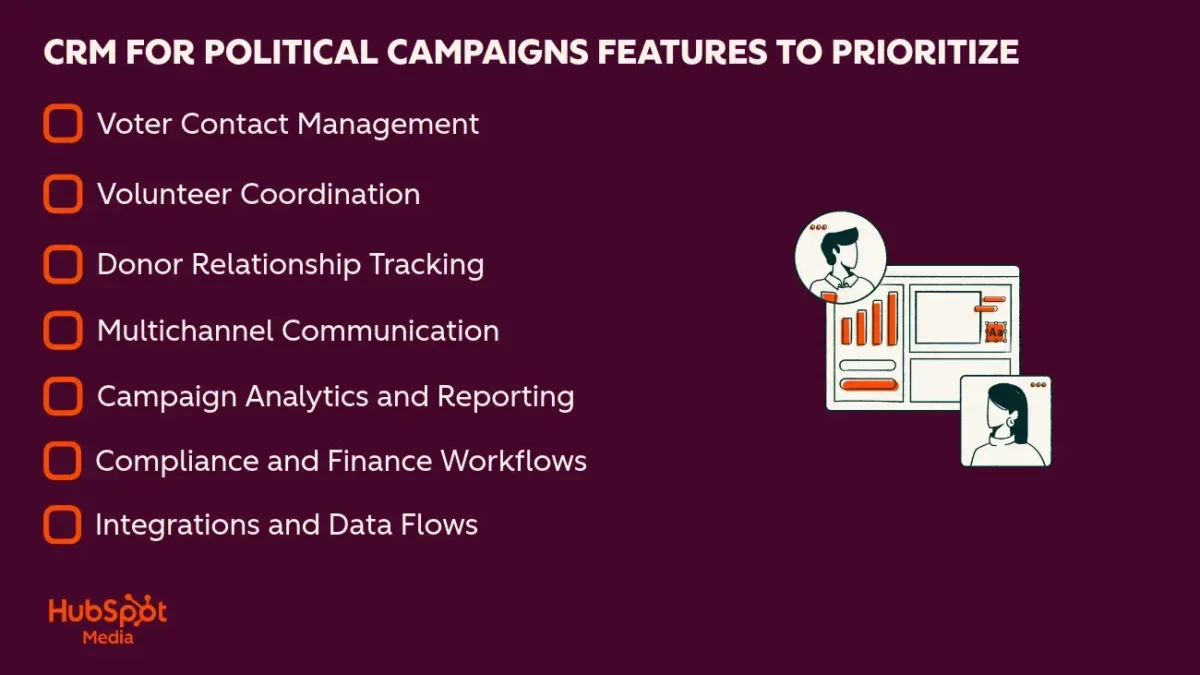
First is voter contact and supporter management. While a CRM holds the campaign’s direct relationship records, it must allow for sophisticated audience segmentation. Campaign teams frequently need to categorize supporters by geographic sub-divisions, issue preferences, or past engagement levels. Because supporter details fluctuate rapidly during an active election season—people move, change phone numbers, or alter their political allegiances—rigorous data maintenance is essential. Regular audits to remove duplicate files, verify consent statuses, and update segmentation criteria prevent outdated information from misdirecting valuable field resources.
Second, volunteer coordination remains a primary driver of electoral success. Historically decentralized and prone to administrative bottlenecks via disconnected spreadsheets and overflowing email inboxes, modern volunteer management relies on automated workflows. When a supporter submits an online intake form, the CRM can instantaneously generate a contact record, trigger a confirmation email, and assign a follow-up task to a field organizer. This automation ensures that enthusiastic volunteers are quickly integrated into phone banks, canvassing shifts, or event logistics before their enthusiasm wanes.
Third, multichannel communication workflows have become standard operating procedure. Modern campaigns utilize a blend of email for long-form messaging and SMS for urgent updates, volunteer alerts, and get-out-the-vote (GOTV) reminders. However, SMS deployment requires strict adherence to legal frameworks and carrier regulations. Text messaging cannot be deployed as a cold-outreach tool; it requires explicit, documented opt-in consent with clear audit trails, automated keyword removal mechanisms (such as replying "STOP"), and strict compliance with regional messaging protocols.
Analytics, Compliance, and the Integration Imperative

Evaluating outreach performance is another vital function of campaign technology. Marketing campaign reporting metrics—such as email open rates, form conversion efficiencies, and event registration volumes—provide campaign leadership with actionable insights into which messaging strategies resonate with the electorate. Crucially, campaign strategists emphasize that these marketing metrics must remain strictly separated from compliance reporting. Outreach analytics evaluate communication effectiveness, whereas financial filings and contribution disclosures must be handled by dedicated compliance architecture.
Because no single platform natively manages every facet of an election—from official voter registration validation to FEC compliance and multi-platform field outreach—integration is paramount. A general-purpose CRM must be capable of syncing data smoothly with external databases via APIs or native data connectors. Before establishing these data pipelines, campaign technical directors must establish a definitive "source of truth" for every data point. For instance, while the CRM may govern general supporter engagement data, the voter file remains the authoritative source for registration status, and the compliance ledger remains the sole authority on financial contributions.
The Role of Enterprise Platforms in the Political Ecosystem
As political technology evolves, major enterprise software providers have adapted their offerings to accommodate political and advocacy use cases. Platforms like HubSpot, through tools like the Smart CRM and Marketing Hub, have carved out a substantial presence in the political technology stack by offering robust relationship management, advanced form builders, list segmentation, and automated communication workflows.
Industry analysts note that while platforms like HubSpot provide exceptional organizational infrastructure for managing campaign-owned contacts, marketing automation, and artificial intelligence-assisted data summarization (such as Breeze Assistant), they are not drop-in replacements for purpose-built political infrastructure. They do not serve as voter-file repositories, nor are they engineered for official campaign-finance reporting or political contribution processing. Instead, their value lies in acting as the central nervous system for outreach and supporter engagement, connected via secure integrations to specialized political applications.

Broader Implications for Democratic Engagement
The increasing sophistication of campaign CRMs and their integration with broader technology stacks carry significant implications for modern democratic participation. On one hand, these tools allow campaigns to run leaner, more targeted operations that can mobilize supporters with unprecedented efficiency. Voters receive tailored communications that address their specific civic interests, and volunteers experience fewer administrative friction points when trying to get involved.
On the other hand, the heavy reliance on complex data ecosystems raises legitimate concerns regarding data privacy, security, and consent management. As campaigns collect vast amounts of digital footprints from supporters, the responsibility to safeguard this information between election cycles becomes paramount. Regulatory scrutiny regarding data retention, secure archiving, and unauthorized data sharing continues to intensify across jurisdictions.
Ultimately, the successful deployment of a political campaign CRM is not about finding a monolithic platform that promises to handle every conceivable election workflow. Rather, it is about disciplined architectural planning: recognizing the distinct boundaries between general relationship management, official voter data, and strict legal compliance. By deploying robust general CRMs where they fit best—managing outreach, communications, and supporter engagement—while relying on dedicated systems for specialized electoral and financial tasks, modern campaigns can build resilient, legally compliant, and highly effective technological operations.