For search engine optimization professionals and digital marketing teams, volatility is an inherent and familiar challenge, with Google having introduced algorithm updates and ranking turbulence for years. However, the rapid emergence of answer engine optimization and generative AI search platforms has introduced a profound new layer of operational complexity. According to findings from HubSpot’s State of AEO report, 58% of surveyed marketers confirmed that their organizations were actively optimizing digital content specifically for answer engines in the first quarter of 2026. Unlike traditional search engine results pages, where a core update can be systematically evaluated using standard rank-tracking software to determine precise page placement, artificial intelligence answers operate without a static, easily verifiable position. Furthermore, a single underlying model update can fundamentally alter how frequently platforms like ChatGPT, Gemini, and Perplexity reference and link to specific business entities.
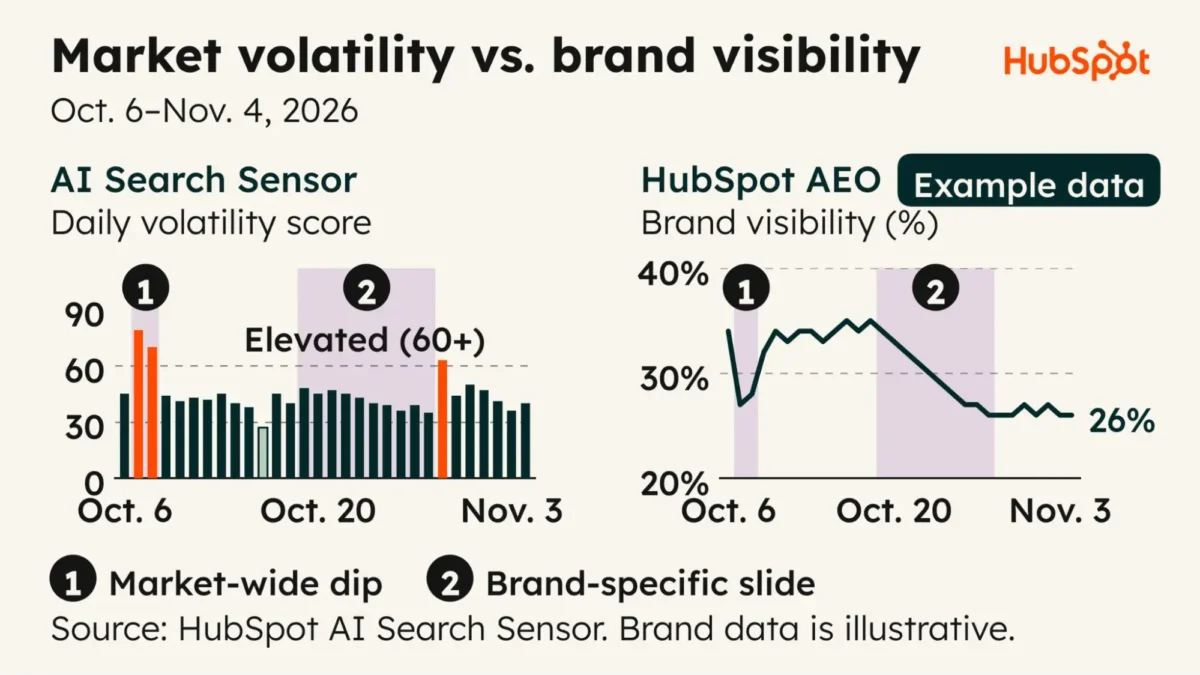
When corporate visibility or AI-referred traffic experiences a sudden downturn, executive leadership naturally demands answers regarding whether the fluctuation stems from internal strategy adjustments or external platform mechanics. To accurately diagnose these movements, digital marketing teams must compare their internal brand answer engine optimization data against a comprehensive, market-wide benchmark for the identical timeframe. If an industry-wide benchmark declines synchronously with a brand’s metrics, the organization is likely witnessing a broader market shift rather than an internal strategic flaw. Conversely, if the broader benchmark remains steady while individual visibility drops, the root cause is typically localized to content quality, technical site health, or tracking configurations.
Defining AI Search Volatility and Its Core Mechanics
AI search volatility describes the daily and prompt-to-prompt fluctuations in which brands, pages, and web sources are explicitly mentioned and cited by conversational answer engines such as OpenAI’s ChatGPT, Google’s Gemini, and Perplexity. While general search instability encompasses broader phenomena—including algorithmic ranking shifts, seasonal shifts in consumer demand, and technical indexing changes that alter how audiences locate a website—AI search volatility specifically targets brand attribution within conversational models rather than standard hypertext ranking positions.
A significant portion of this instability is structurally embedded within the probabilistic nature of large language models. Because these systems are non-deterministic, they do not guarantee an identical response when queried repeatedly. Empirical research conducted by SparkToro and Gumshoe.ai in late 2025 demonstrated that when identical recommendation prompts were executed across ChatGPT and Google’s AI Overviews, the probability of receiving the exact same list of recommended brands twice was less than one in one hundred. Consequently, a sudden dip in brand visibility does not automatically signify a degradation in content quality or site authority.
To separate everyday operational noise from genuine strategic shifts, marketing practitioners require robust market-wide context. Tools such as the HubSpot AI Search Sensor dashboard, which features an Answer Engine Volatility Tracker, calculate daily scores demonstrating the degree to which core signals—including mention rates, citation frequencies, citation typologies, and AI-referred web traffic—drift from rolling averages across major AI platforms.

Contrasting AI Search Volatility with Traditional Ranking Volatility
In conventional search engine optimization, ranking volatility measures the vertical movement of specific web pages within Google’s indexed search results. In the realm of answer engine optimization, however, volatility measures the shifting propensity of conversational engines to name and cite specific corporate entities. Traditional rank tracking systems, such as the Semrush Sensor, quantify day-to-day ranking movements on a localized numeric scale using a fixed sample of keywords. While valuable for classic optimization, these tools cannot capture how generative AI models represent a brand in conversational summaries.
Despite their differences, traditional ranking volatility and AI search volatility frequently intersect. Data from the 2026 State of AEO report indicates that web pages securing higher rankings and broader keyword coverage within traditional Google search results exhibited a statistically higher likelihood of being cited by conversational answer engines. High-ranking pages also demonstrated a stronger correlation with citations inside Google’s AI Overviews compared to third-party answer engines. Consequently, a drop in traditional search rankings can occasionally manifest as a corresponding decline in AI Overview citations, making traditional SERP volatility trackers a useful supplementary diagnostic tool.
Concurrently, the proliferation of generative AI summaries has altered user behavior and click-through dynamics. Research published by the Pew Research Center, analyzing digital browsing habits among United States adults, revealed that search result pages featuring an AI summary generated traditional organic traffic clicks in only 8% of visits, compared to 15% for results without an AI summary. Therefore, a web page can successfully maintain its ranking position while simultaneously experiencing a contraction in inbound traffic, underscoring the inadequacy of relying exclusively on legacy performance metrics.
Methodologies for Measuring Answer Engine Fluctuations
Accurately quantifying AI search volatility requires executing standardized prompts across designated answer engines on a structured schedule, followed by cross-referencing the resulting data against broader market benchmarks and web analytics. While market-wide telemetry tools monitor global trends, brand-specific visibility tools, integrated with Google Search Console and Google Analytics 4, provide granular visibility into clicks and direct site visits.
To ensure data integrity when measuring AI search volatility, practitioners must maintain four variables with strict consistency: prompt phrasing, geographical query context, execution timing, and the specific answer engine platform being queried. Because non-deterministic models yield varied individual responses, single daily readings inherently carry statistical noise. Analysts are advised to evaluate multi-day or multi-week rolling averages before drawing definitive conclusions regarding performance trends.

When establishing an initial baseline for AI search visibility, digital teams must collect structured historical data following prompt configuration. To measure comprehensive business impact, organizations should pair visibility metrics—such as brand share of voice and citation frequency—with traditional commercial indicators, including AI-referred pipeline value, assisted conversions, and branded search volume growth.
Evaluating Market-Wide Shifts Versus Brand-Specific Issues
Determining whether a volatility event is market-wide involves assessing whether answer engines are systematically altering their citation and traffic distribution patterns across an entire industry vertical rather than penalizing a single enterprise. This assessment is achieved by comparing daily market volatility scores against brand-level optimization metrics for identical operational periods.
Industry trackers frequently categorize daily volatility using standardized thresholds, such as calm, moderate, elevated, or extreme. During periods of elevated or extreme market turbulence, industry analysts advise against reactionary overhauls of digital strategy. Empirical observations suggest that reacting prematurely to platform-level algorithmic adjustments frequently introduces greater operational disruption than the underlying platform modification itself. Maintaining operational consistency during turbulent intervals allows marketing teams to accurately separate temporary systemic disruptions from genuine strategic failures.
Structuring Executive Reporting for AI Leadership
Communicating search performance and algorithmic volatility to corporate leadership requires a structured, business-centric reporting framework. Executives are primarily concerned with the direct impact of volatility on commercial metrics, including qualified sales leads, pipeline generation, and recognized revenue.
A comprehensive leadership report on AI search volatility should incorporate five core components:

- An executive summary detailing top-line commercial impact, focusing on pipeline and revenue metrics derived from AI referrals.
- Market context analysis, utilizing benchmark data to explain whether observed performance shifts were industry-wide or brand-specific.
- Visibility and citation trends, outlining how major answer engines referenced the corporate entity over the reporting period.
- Traffic and attribution alignment, reconciling web analytics data with generative search impressions.
- Strategic recommendations, outlining measured, data-driven next steps rather than reactive tactical changes.
By leveraging CRM traffic source properties—such as identifying original and latest traffic sources categorized under AI referrals—marketing teams can successfully attribute pipeline creation directly to conversational search channels. Incorporating qualitative data collection methods, such as utilizing open-ended attribution fields on conversion forms, further captures the commercial value of buyers who initially discovered a brand through an AI-generated answer before completing their buyer journey via direct or branded search channels.
Frequently Asked Questions
How long should an organization monitor volatility before reporting strategic changes?
Marketing teams should monitor AI search volatility for a minimum of several weeks, evaluated in complete weekly cycles, to align with standardized benchmark reporting and filter out the inherent variance of non-deterministic models.
How can marketers reconcile AI search insights with traditional web analytics tools?
Reconciliation requires matching exact date ranges and pairing AEO trends with corresponding analytics metrics, noting that web analytics platforms often categorize traffic from different AI sources across distinct channels, such as grouping assistant referrals separately from organic search summaries.
What steps should be taken if market benchmarks remain stable while a specific brand declines?
A stable market benchmark paired with an individualized brand decline strongly suggests a localized issue. Teams should immediately audit technical crawler access, verify tracking configurations, and analyze content-type citation breakdowns to identify specific areas of lost ground.
Can traditional SERP tracking tools measure generative AI performance?
Traditional SERP trackers alone cannot measure generative AI performance because they are engineered to monitor vertical ranking positions within conventional search indexes rather than brand mentions within conversational, multi-source AI syntheses, though some advanced platforms have integrated conversational tracking capabilities.