
The digital marketing and affiliate publishing sectors have been shaken following a series of decisive disciplinary actions taken against PayPal Honey, one of the most prominent consumer browser extensions and affiliate publishers in the United States. Acquired by fintech giant PayPal for $4 billion six years ago, Honey has now found itself removed or suspended from major American affiliate networks. This unprecedented enforcement action highlights growing industry intolerance toward deceptive traffic-generation practices, specifically targeting conversion misattribution and the intentional circumvention of established affiliate network policies.
The developments underscore a broader tightening of compliance standards across the multi-billion-dollar partnership economy, forcing both merchants and publishers to reevaluate how attribution is tracked, monitored, and rewarded.
Chronology of the Enforcement Actions
The crisis facing PayPal Honey unfolded rapidly across mid-January, coinciding with major industry events. The enforcement actions were catalyzed by independent digital investigations, most notably an extensive technical analysis by researcher Ben Edelman and a detailed investigative report published by content creator MegaLag. These exposures shed light on systemic issues regarding how browser extensions interact with consumer clickstreams and merchant tracking systems.
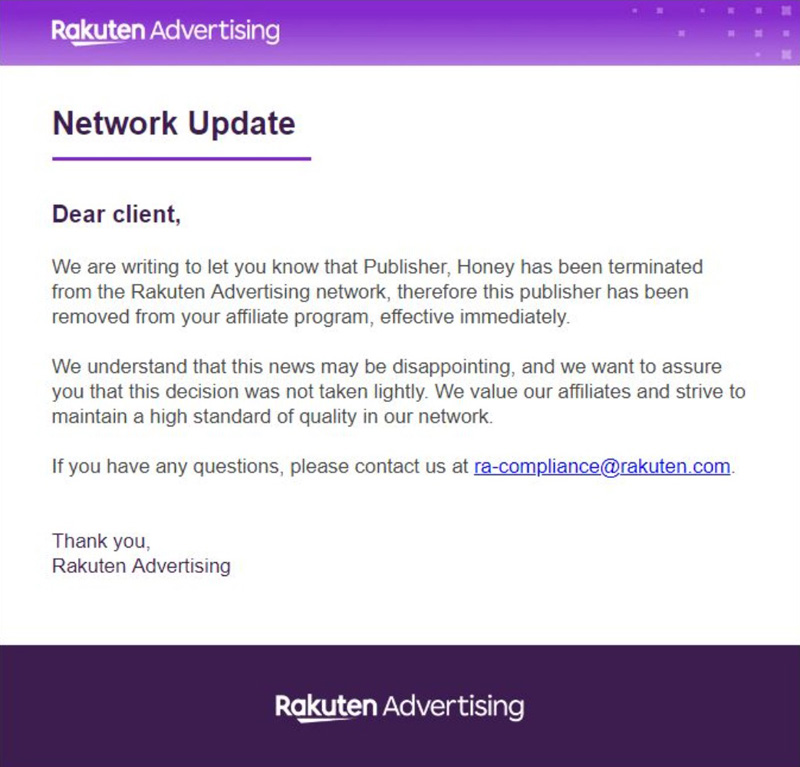
On Monday, January 12—coincidentally the opening day of the prominent Affiliate Summit West conference in Las Vegas—Rakuten Advertising became the first major network to drop the publisher. Rakuten issued an official statement announcing that Honey had been terminated from its network. The network framed the decision as a necessary step to maintain rigorous standards of quality and fairness within its platform ecosystem.
Just days later, on Friday, January 16, impact.com followed suit. The network determined that Honey was out of compliance with its foundational platform policies. Consequently, impact.com removed the publisher from its Discovery Marketplace, though platform representatives noted that the action constituted a temporary suspension rather than a permanent ban, pending further compliance reviews. Industry executives from impact.com explicitly pointed to "attribution manipulation" as the primary driver behind the disciplinary measures, emphasizing that such behavior severely undermines trust across the broader partnership ecosystem.
Understanding the Core Issue: Stand-Down Rules and Affiliate Link Hijacking
At the heart of the controversy are complex mechanics governing how downloadable software publishers (DSPs) and browser extensions operate within standard affiliate programs. The vast majority of affiliate programs operate on a "last-touch-wins-all" attribution model. Under this paradigm, 100% of the commission for a verified purchase is awarded to the final affiliate link or cookie encountered by the consumer immediately prior to checkout.

Because browser extensions like Honey frequently sit quietly in a user’s browser toolbar, they possess unique technical capabilities to inject themselves into the user journey late in the funnel. To maintain fairness, networks and merchants enforce strict "stand-down" rules. These policies mandate that browser extensions must step down—meaning they must not fire their tracking codes or overwrite existing cookies—if another affiliate partner was responsible for introducing the consumer earlier in the clickstream.
Investigations by Edelman and other independent auditors revealed that PayPal Honey allegedly engaged in intentional violations of these stand-down rules, coupled with concealment tactics. By failing to step down when a prior affiliate deserved attribution, the extension effectively hijacked existing referral paths, overwrote previous cookies, and claimed commissions for conversions it did not organically generate. This practice not only deprives rightful content creators and upstream publishers of their earnings but also distorts merchant analytics.
Industry Implications and the Broader Ecosystem Impact
The public penalization of a multi-billion-dollar corporate subsidiary like PayPal Honey sends a powerful signal to the global affiliate marketing industry. Historically, major affiliate networks have occasionally shown reluctance to penalize high-volume, enterprise-level publishers due to the sheer volume of transactions they generate. The swift actions by Rakuten Advertising and impact.com suggest a paradigm shift toward stricter regulatory enforcement and self-policing within the digital advertising supply chain.
The fallout extends far beyond the networks themselves, directly affecting merchants, competing publishers, and the strategic management of affiliate programs.
1. The "Bad Apple" Effect on Merchant Programs
For online merchants, working with non-compliant affiliates carries severe collateral damage. High-value, rule-abiding publishers—such as premium content producers, trusted product reviewers, and niche media outlets—routinely audit the company environments they join. Savvy publishers frequently inspect merchant program rosters to ensure they do not share space with predatory or aggressive cookie-droppers. When merchants permit non-compliant software publishers to operate unchecked, top-tier partners often refuse to join or actively promote the brand, ultimately degrading the overall quality of the merchant’s affiliate program.
2. The Imperative for Independent Program Policing
A critical lesson emerging from the Honey controversy is that merchants cannot rely solely on affiliate networks to protect their programs. While networks maintain broad compliance departments, their primary mandate is to enforce network-wide terms rather than customized brand-specific rules. Furthermore, network oversight can sometimes lag behind real-time violations. Experts advise merchant affiliate managers to establish explicit compliance guidelines within their direct program Terms and Conditions, actively utilize third-party auditing tools, and enforce disciplinary actions independently when infractions are identified.
3. Shifting Standards and Independent Audits
The regulatory scrutiny surrounding DSPs is further evidenced by comprehensive studies within the global marketing community. In the United Kingdom, The Affiliate & Partner Marketing Association (APMA) recently published an independent audit examining attribution rules across multiple networks and publisher types. The findings highlighted the intricate technical distinctions between stand-down mechanisms and alternative tracking methodologies, providing actionable frameworks for networks to protect early-funnel affiliates.
4. Avoiding Dangerous Generalizations
Despite the severe actions taken against PayPal Honey, industry veterans caution against broad generalizations that could penalize entire classes of technology. Just as not all paid search affiliates engage in prohibited trademark bidding, not all browser extensions or shopping assistants violate stand-down rules. Effective program management requires granular, individual evaluation of every publisher rather than sweeping bans that eliminate innovative, consumer-friendly rewards solutions.
5. Strategic Diversification as a Defense Mechanism
Perhaps the most significant structural takeaway for digital marketers is the undeniable danger of publisher concentration. Industry data regularly reveals that poorly managed affiliate programs suffer from severe dependency, with upwards of 80% of all driven revenue originating from a handful of dominant partners, often concentrated within a single publisher category.
When a major player like Honey is abruptly removed, merchants who failed to diversify experience catastrophic drops in affiliate-referred revenue. To build resilient, future-proof marketing ecosystems, brands are increasingly expanding their recruitment efforts across a wider spectrum of partnership models. Modern affiliate diversification strategies now encompass up to 28 distinct publisher categories, ranging from card-linked offers and Connected TV (CTV) integrations to micro-influencers, B2B consultants, charitable fundraisers, and niche content producers.
Outlook for the Future of Partnership Marketing
As the digital marketing landscape matures into 2026 and beyond, the enforcement actions against PayPal Honey mark a watershed moment for attribution integrity. The incident highlights an intolerance for opaque tracking practices and underscores the absolute necessity of transparency, fairness, and rigorous compliance management.
For merchants, the path forward requires proactive governance, independent auditing, and diversified publisher recruitment. By moving away from over-reliance on single dominant entities and enforcing strict adherence to partnership rules, brands can foster a healthier, more sustainable ecosystem that rewards genuine consumer value and protects the trust of every participant in the affiliate economy.