The digital marketing landscape is undergoing its most profound structural shift since the advent of search engine optimization (SEO), driven by the rapid mainstream adoption of artificial intelligence tools such as ChatGPT, Perplexity, Gemini, and Google AI Overviews. As millions of consumers pivot from traditional search engines to conversational AI platforms, a new paradigm has emerged: Answer Engine Optimization (AEO). Unlike conventional search models that present users with a list of blue links directing them to external websites, modern answer engines synthesize vast amounts of data to provide direct, comprehensive replies within a single interface. This evolution has triggered a critical visibility challenge for brands, as consumers increasingly act on AI-generated summaries without ever visiting the underlying source websites.
![AEO checker tools that measure answer engine visibility [2026]](https://53.fs1.hubspotusercontent-na1.net/hubfs/53/aeo-checker-1-20260903-3858273.webp)
The mechanics of this transition represent a fundamental departure from historical web traffic acquisition strategies. Traditional SEO focuses on positioning web pages high within a ranked list of search results. In contrast, AEO prioritizes securing brand mentions, citations, and content references directly inside the synthesized text produced by conversational agents. Industry data and user behavior trends indicate that this zero-click phenomenon is steadily eroding organic click-through rates for informational queries. When a user asks a complex question about enterprise software or consumer products, platforms like Perplexity or ChatGPT parse multiple sources and deliver a definitive answer, embedding source links discreetly or relying entirely on internal training data and real-time web retrieval. Consequently, visibility that once manifested as predictable search engine rankings can vanish into an AI-generated response if a brand fails to optimize for machine readability and citation authority.
Understanding the underlying mechanics of this shift requires examining the tools designed to measure it. An AEO checker is a specialized software utility that evaluates how frequently and accurately a brand is represented across major generative AI engines. These checkers systematically analyze priority queries, monitor citation placement, identify content gaps where competitors secure preferential treatment, and detect instances where an AI engine misrepresents a brand’s offerings or pricing. By automating what was previously a tedious manual auditing process, AEO checkers provide digital strategists with actionable diagnostics, highlighting schema deficiencies, unstructured content, and entity recognition gaps that prevent AI models from trusting and citing a domain.
![AEO checker tools that measure answer engine visibility [2026]](https://no-cache.hubspot.com/cta/default/53/9dd5e54b-fbef-4dd0-bc44-1689feb1ea18.png)
The evolution of answer engines accelerated significantly in May 2024 when Google introduced AI Overviews to its primary search interface, embedding algorithmic summaries above traditional organic listings. This rollout permanently altered the search experience for millions of users, triggering widespread anxiety among digital marketers regarding traffic retention. Manual tracking quickly proved inadequate for monitoring these volatile summaries, as AI Overviews do not trigger for every query and fluctuate dynamically based on user context, location, and session history. To combat this uncertainty, early digital pioneers began developing systematic manual protocols, cataloging branded and informational queries in incognito sessions, recording whether AI summaries appeared, and verifying whether domain URLs were included in inline source links. However, the sheer volume of search queries and the high frequency of algorithmic updates quickly necessitated automated software solutions.
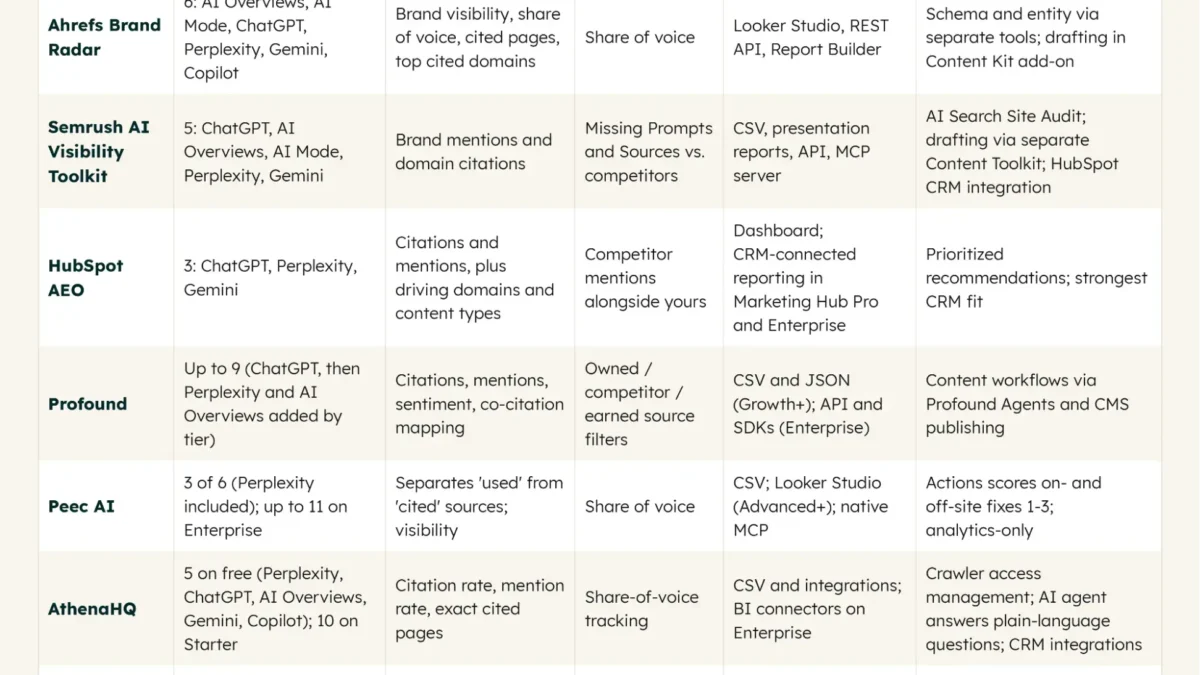
To address these scaling challenges, the software market has responded with a diverse ecosystem of AEO monitoring and optimization platforms. Industry analysts categorize these tools based on their specific strengths, ranging from AI Overview tracking to deep citation analysis and schema readiness evaluation. Platforms such as Ahrefs Brand Radar and Semrush AI Visibility Toolkit leverage expansive organic search indexes to flag keywords that trigger AI Overviews, enabling marketing teams to optimize near-inclusion pages. Meanwhile, dedicated citation detection tools like HubSpot AEO and Profound evaluate nuanced metrics, including sentiment scoring, uncited prompt flagging, and the precise breakdown of citations by source type—whether owned, earned, or competitor-driven. Other specialized utilities, such as Peec AI and AthenaHQ, offer targeted monitoring for conversational search engines like Perplexity, while technical platforms like Scrunch AI and Conductor focus on verifying whether web scrapers and AI crawlers can successfully render and parse corporate domains.
![AEO checker tools that measure answer engine visibility [2026]](https://53.fs1.hubspotusercontent-na1.net/hubfs/53/aeo-checker-2-20260903-852936.webp)
The financial and operational implications of this technological shift are forcing enterprises to reallocate marketing budgets toward specialized AEO workflows. Maintaining visibility in generative AI environments demands a rigorous focus on specific performance indicators. Key metrics now include the overall AI visibility score, citation frequency relative to top competitors, brand mention share in unlinked text, and zero-click influence proxies such as branded search lift and direct referral traffic from conversational platforms. Industry experts emphasize that these metrics must be evaluated as longitudinal trends rather than isolated snapshots, given the inherent volatility of large language model outputs.
Integrating these diagnostic tools into daily operations has also sparked innovation within enterprise software suites. While early AEO software primarily stopped at diagnosis—leaving marketing teams to export data, brief content writers, and manually update content management systems—newer solutions bridge the gap between measurement and execution. Advanced integrations, such as those introduced within comprehensive marketing ecosystems, connect AEO analytics directly to customer relationship management (CRM) data. By linking AI-referred traffic and brand citations to downstream pipeline generation, organizations can quantify the exact business value derived from their answer engine optimization efforts. Furthermore, automated content generation tools can now ingest AEO recommendations, utilizing structured brand guidelines to draft optimized articles designed specifically to satisfy the retrieval parameters of modern language models.
![AEO checker tools that measure answer engine visibility [2026]](https://53.fs1.hubspotusercontent-na1.net/hubfs/53/aeo-checker-3-20260903-8904553.webp)
Despite these technological advancements, digital marketing professionals face persistent strategic challenges. A primary limitation of current AEO measurement is the inability to directly track pipeline attribution for zero-click interactions. Because answer engines frequently resolve a user’s intent entirely within the chat interface without driving a physical web session, a vast amount of brand influence remains invisible to traditional analytics. Consequently, executives must interpret visibility scores and referral revenue as complementary yet distinct indicators of market presence.
Furthermore, industry consensus strongly emphasizes that AEO does not replace traditional SEO; rather, the two disciplines function as interdependent halves of a cohesive digital visibility strategy. Answer engines rely heavily on the foundational signals traditionally cultivated by SEO, including robust crawlability, technical site health, high-authority backlink profiles, and clear document structures. Without a strong organic foundation, web pages lack the credibility and parsability required for AI models to select them as authoritative primary sources. Therefore, modern digital strategies must run search engine optimization and answer engine optimization concurrently, ensuring technical excellence supports both human-facing search rankings and machine-driven synthesis.
![AEO checker tools that measure answer engine visibility [2026]](https://53.fs1.hubspotusercontent-na1.net/hubfs/53/aeo-checker-4-20260903-6212698.webp)
As conversational artificial intelligence continues to mature, the boundary between searching for information and receiving synthesized answers will continue to blur. Organizations that proactively adopt systematic AEO monitoring, refine their content architecture for machine comprehension, and adapt to the realities of zero-click discovery will secure a decisive competitive advantage. Conversely, brands that rely solely on legacy SEO methodologies risk fading into digital obscurity as consumer reliance on intelligent answer engines accelerates across global markets.