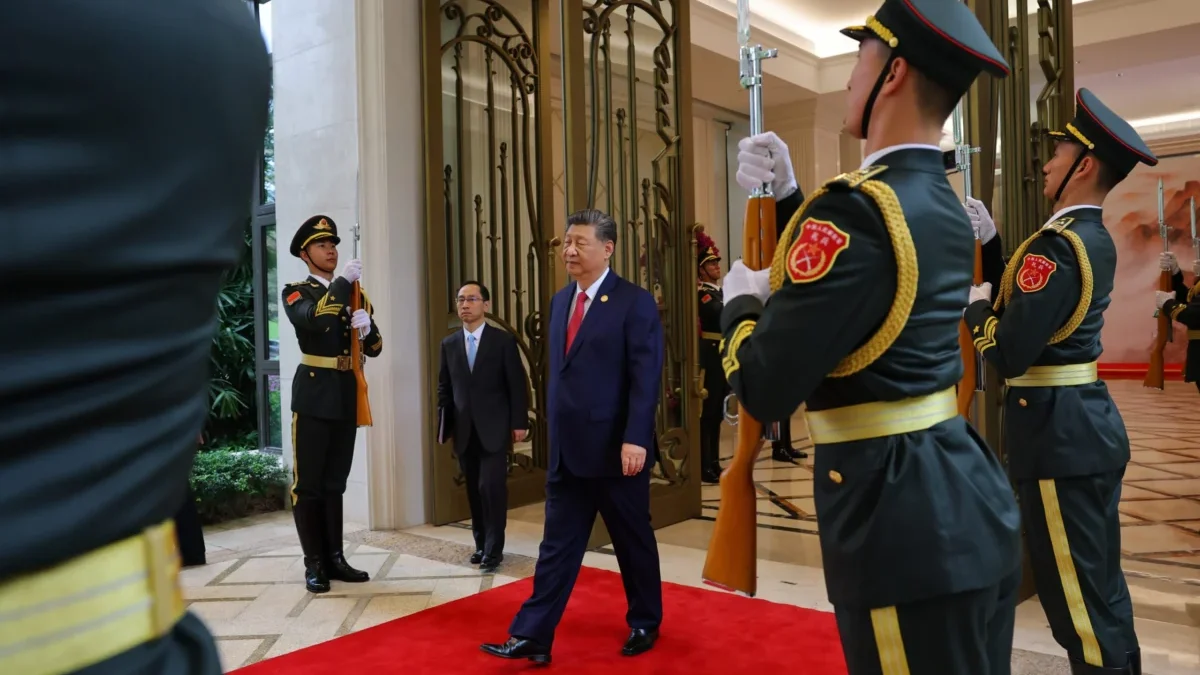
As U.S. investors grapple with the cooling fervor surrounding the artificial intelligence sector and broader market volatility, a more profound financial reckoning is unfolding within the borders of the People’s Republic of China. According to recent analysis from Yardeni Research, the speculative bubble that many feared in the West has not only popped in China but has triggered a systemic market collapse that jeopardizes the long-term economic vision of President Xi Jinping. This domestic crisis, characterized by a sharp decline in tech-heavy indices and a persistent erosion of consumer confidence, represents a significant hurdle for Beijing as it attempts to pivot from a property-led growth model to one driven by technological innovation and capital market expansion.
The Scale of the Contraction
The disparity between the American and Chinese market environments is stark. While the Nasdaq has retreated approximately 18% from its record highs—a correction that followed the most difficult trading week for U.S. equities since the onset of the COVID-19 pandemic—China’s STAR 50 index has experienced a far more aggressive downward trajectory. The index, which serves as a barometer for China’s high-tech aspirations, has plummeted 44% from its summer peak. This precipitous decline is not merely a reflection of global tech sentiment but a localized reaction to structural weaknesses that have long plagued the Chinese economy.
The crisis is particularly damaging to the central government’s strategic mandate to transform the nation’s savings habits. For decades, approximately 70% of Chinese household wealth was tethered to the real estate sector. As the housing market suffers from a prolonged, multi-year downturn—exemplified by a nearly 22% drop in property investment as of October—Beijing has struggled to redirect this idle capital into the stock market to fuel the "AI buildout." Instead of viewing the stock market as a legitimate engine for retirement growth, the Chinese public remains deeply skeptical, traumatized by the "financial PTSD" stemming from the 2015 stock market crash and subsequent regulatory crackdowns on the tech sector that began in 2020.
A Chronology of Economic Instability
The current volatility is the latest chapter in a long-standing struggle to modernize China’s financial architecture.
- 2007: The Shanghai Composite reaches its historic peak, a level it has failed to surpass in the nearly two decades since, even as the nation’s GDP grew by a factor of six.
- 2013: President Xi Jinping initiates a campaign to reform state-owned enterprises (SOEs), aiming to reduce their dominance and create space for a more dynamic private sector.
- 2015: A massive stock market bubble bursts, forcing the government to deploy the "national team"—a collection of state-backed financial institutions—to stabilize prices through massive liquidity injections.
- 2020: The government launches a sweeping regulatory crackdown on the tech sector, effectively curbing the influence of tech giants and leaving retail investors permanently wary of "political risk."
- 2024: A combination of cutthroat internal competition, rising energy costs, and the threat of international trade barriers leads to a collapse in tech-heavy stock valuations.
Structural Obstacles to the AI Pivot
Beijing’s reliance on high-tech manufacturing to compensate for the real estate slump is facing significant headwinds. With domestic consumption failing to recover, the government has resorted to aggressive export strategies, flooding global markets with low-cost goods. However, this strategy has invited scrutiny and potential retaliatory tariffs from key trading partners.
Yardeni Research notes that the integration of AI into the economy is now at a critical crossroads. "To keep AI funding flowing, Xi needs a buoyant stock market," the report states. If the market fails to recover, there is a distinct risk that AI development will be absorbed by the SOE universe. This outcome would be the antithesis of the 2013 reform goals, as it would effectively crowd out private innovation and cement state control over the very technologies intended to drive the next decade of growth.
Moreover, the market’s reputation as a "rigged casino" remains a formidable barrier. For the average Chinese investor, the stock market does not represent a vehicle for long-term wealth accumulation but rather a volatile environment where the odds are dictated by the Politburo. Without a fundamental restoration of trust, the dream of a "Chinese Wall Street" appears increasingly unattainable.
Official Responses and Regulatory Maneuvers
Recognizing the urgency of the situation, Premier Li Qiang has designated the stabilization of capital markets as the government’s top priority for the remainder of the year. During a recent State Council executive meeting, officials emphasized the need for decisive action to prevent further erosion of investor sentiment.
In response, securities regulators have implemented several supportive measures:
- Buyback Liberalization: Requirements for corporate share buybacks have been significantly eased to provide a floor for stock prices.
- IPO Throttling: Regulators have discouraged initial public offerings and large secondary share sales to mitigate the risk of share dilution, which has historically triggered retail panic-selling.
- State Intervention: The "national team" has been signaled to stand ready to provide liquidity should the market face another uncontrollable downdraft.
Despite these efforts, the structural risks remain high. The persistent deflationary pressures and the decline in business investment suggest that market-stabilization efforts are treating the symptoms rather than the root cause of the malaise.
The Geopolitical Dimension of Tech Curbs
Compounding the domestic market crisis is the intensifying geopolitical friction regarding technology access. The recent developments surrounding Nvidia—highlighted by leadership changes and increased scrutiny of advanced chip shipments—have heightened concerns among investors. The Trump administration’s move to tighten export controls on both hardware and, crucially, access to overseas cloud-based computing power, strikes at the heart of China’s AI ambitions.
Analysts at Capital Economics have warned that these new restrictions pose a "severe threat" to China’s ability to catch up with global AI benchmarks. By limiting access to the high-end computing capacity required to train sophisticated large language models, the U.S. is effectively imposing a ceiling on the speed of China’s AI rollout. This creates a feedback loop: lower technological progress leads to reduced investor interest, which in turn leads to lower valuations, further destabilizing the market.
Future Implications
The convergence of these factors—a domestic crisis of confidence, the failure of the property-to-stock-market transition, and the tightening of external technology access—presents a multifaceted challenge for the current administration.
If the government fails to reconcile the need for state control with the necessity of a vibrant, independent capital market, the economic stagnation currently observed in the real estate sector could well permeate the technology sector. The ultimate test for Beijing will be whether it can foster a market culture that rewards genuine innovation rather than one that operates on the whims of policy shifts and state-backed interventions.
As the year concludes, the focus remains on whether these regulatory patches will provide enough support to prevent a broader economic contagion. For investors, the takeaway is clear: the volatility in China is not merely a temporary fluctuation but a manifestation of a deeper structural pivot that remains incomplete, fragile, and increasingly susceptible to both internal and external pressures. The "Chinese Dream" of a global financial and technological hub now rests on the knife’s edge of market stability, with the next few quarters likely to determine the trajectory of the nation’s economic future.