In the modern digital economy, the frontline of customer engagement has fundamentally shifted from email inboxes and telephone call centers to the comment sections, direct messages, and brand mentions of social media platforms. As consumer expectations for instantaneous corporate responsiveness continue to rise, organizations across industries are grappling with a widening experience gap—the delta between the seamless service brands intend to deliver and the friction customers actually encounter. To bridge this divide, enterprises are increasingly adopting Social Customer Relationship Management (Social CRM), a strategic framework that integrates unstructured social media data with structured historical customer records to create a unified view of the modern consumer.

Traditional customer relationship management systems have long served as the backbone of corporate sales, marketing, and support operations. However, these legacy platforms were architected around historical, structured data points: past purchases, support ticket histories, logged phone calls, and email correspondence. They are inherently reactive systems built to track what a customer has already done. Conversely, Social CRM incorporates real-time, unstructured data—such as public complaints on X (formerly Twitter), product inquiries via Instagram direct messages, brand sentiments expressed in TikTok comments, and broader conversation trends captured by advanced listening tools. By melding these two data paradigms, customer-facing teams across marketing, sales, and support can access immediate contextual awareness precisely when an interaction occurs.
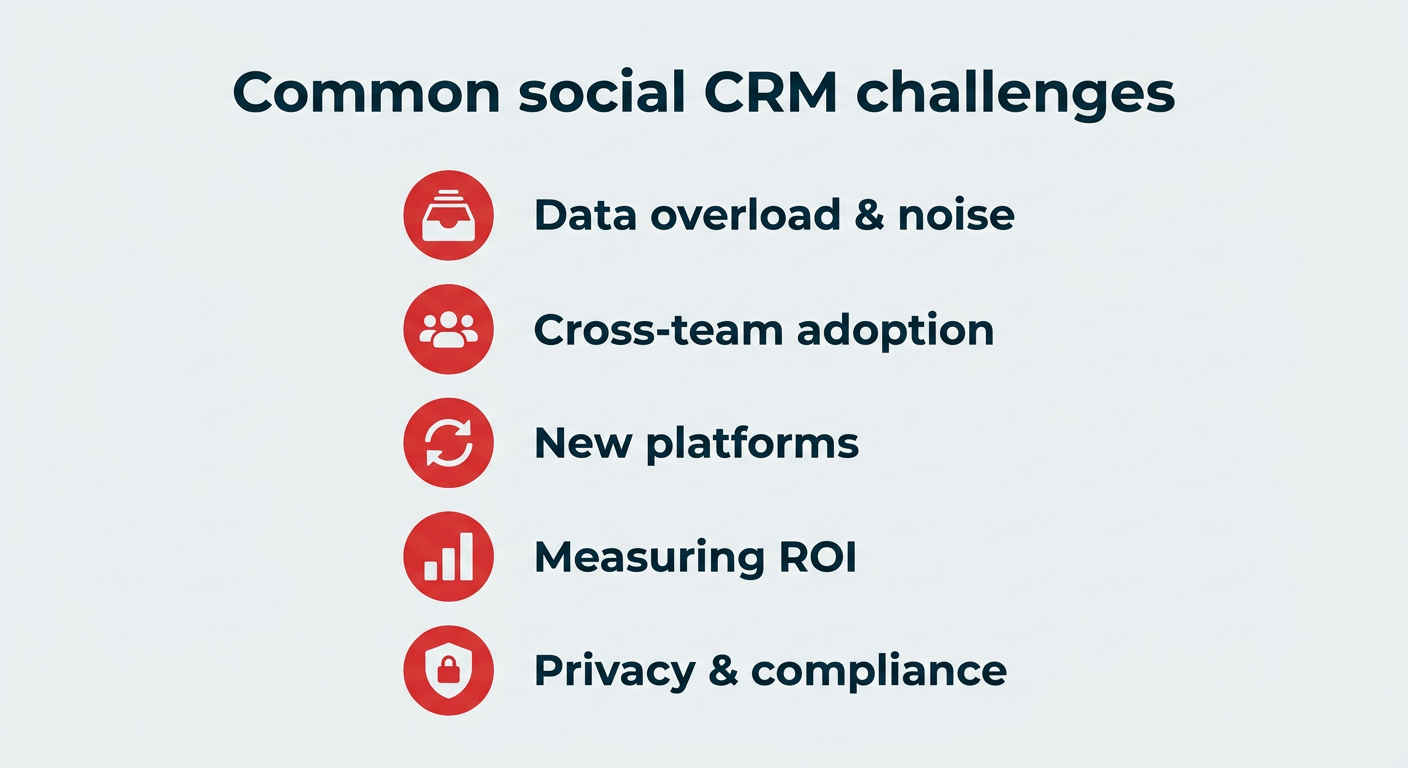
The imperative for this integration is underscored by contemporary consumer behavior studies. According to research highlighted in global customer experience indices, the operational friction points that damage brand loyalty most frequently manifest publicly on social networks. Data from leading consumer research indicates that a vast majority of users expect same-day or near-instantaneous responses to questions and complaints posted on social channels. When brands fail to interact or ignore negative commentary entirely, they face immediate attrition, with substantial percentages of consumers reporting that they will actively unfollow or abandon brands that display administrative silence. Consequently, the manual, siloed methods of copying and pasting social media notes into isolated CRM fields have broken down under the weight of modern digital volume, necessitating automated, enterprise-grade integration.
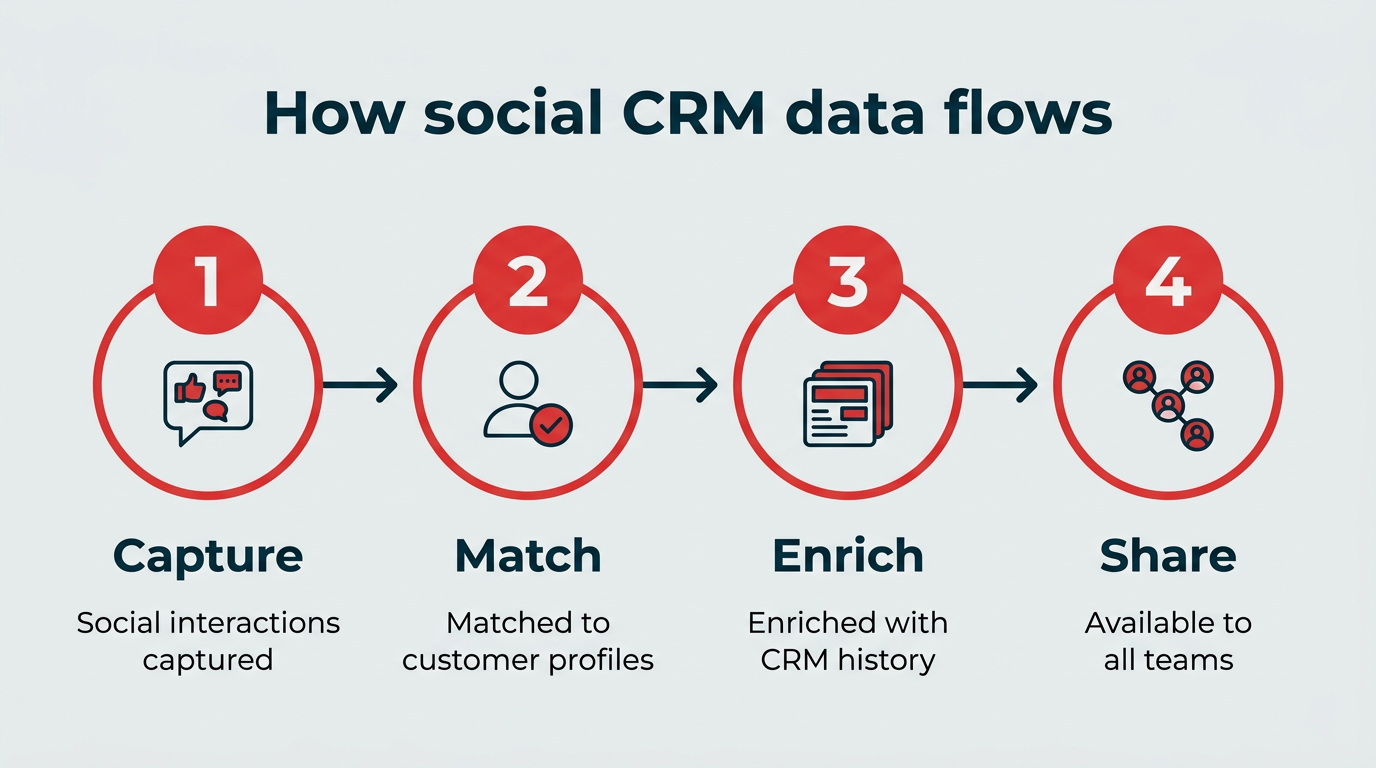
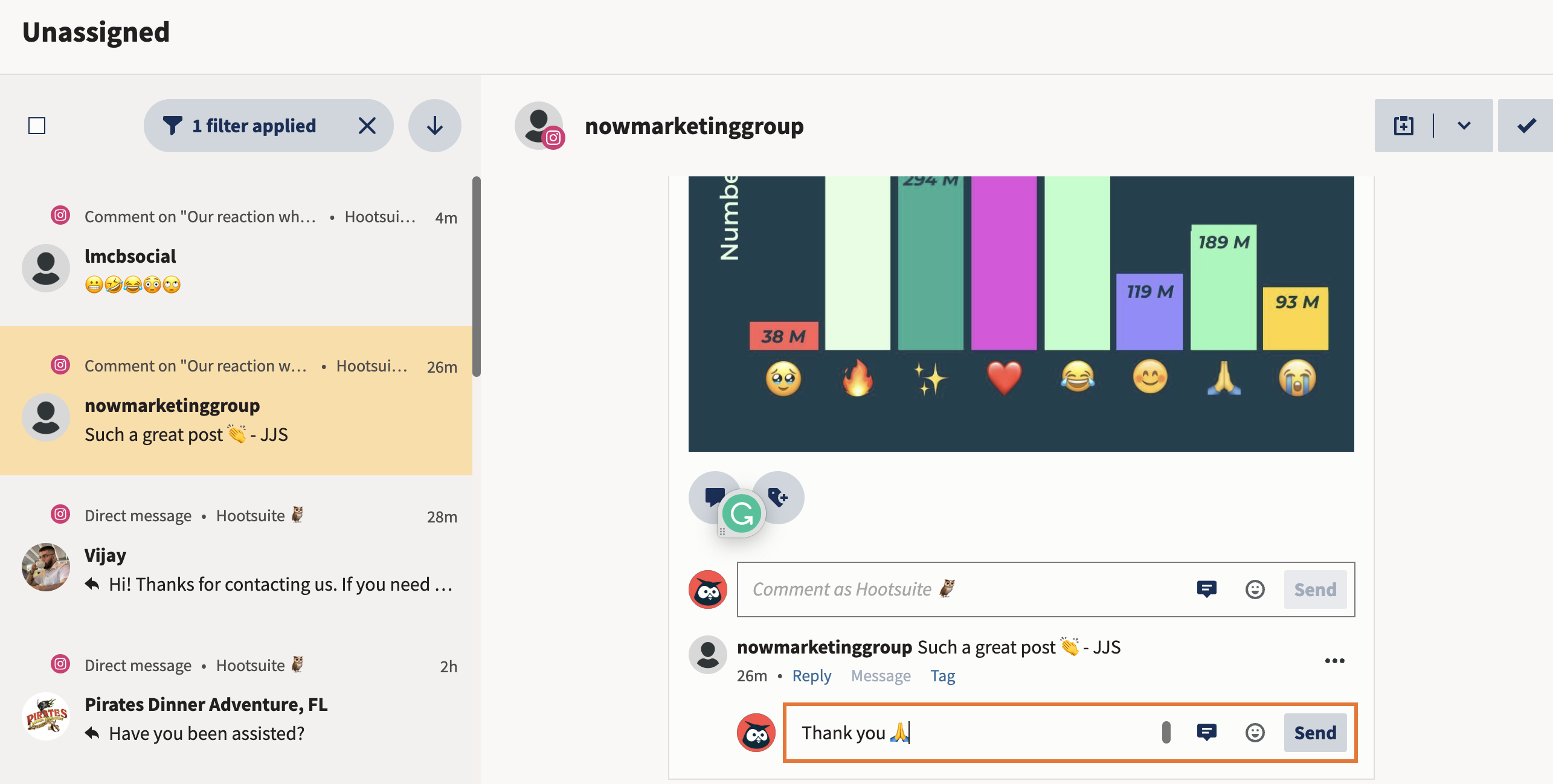
To understand how organizations operationalize this capability, it is helpful to examine the evolution of the software ecosystem supporting these strategies. Historically, businesses had to choose between standalone social media management tools that lacked deep sales pipeline tracking and traditional CRM suites that offered rudimentary, cumbersome social monitoring features. Today, a hybrid approach has emerged, characterized by advanced social operating systems. These platforms act as a bridge between native social engagement tools and heavy enterprise architectures like Salesforce, Microsoft Dynamics 365, and HubSpot. They capture interactions, enrich profiles with historical context, and automatically route high-priority messages to the appropriate internal departments without requiring employees to toggle between disparate applications.
The integration of artificial intelligence has further transformed the Social CRM landscape, redefining how organizations process incoming consumer data. In the past, support queues filled with hundreds of unmanaged messages required hours of manual sorting, increasing resolution times and frustrating customers. Modern AI-driven social CRM systems utilize machine learning models to perform automated sentiment analysis, intent recognition, and priority routing. Natural language processing tools can now parse unstructured conversations across multiple languages and regional markets simultaneously, identifying emerging customer frustrations before they escalate into global public relations crises.
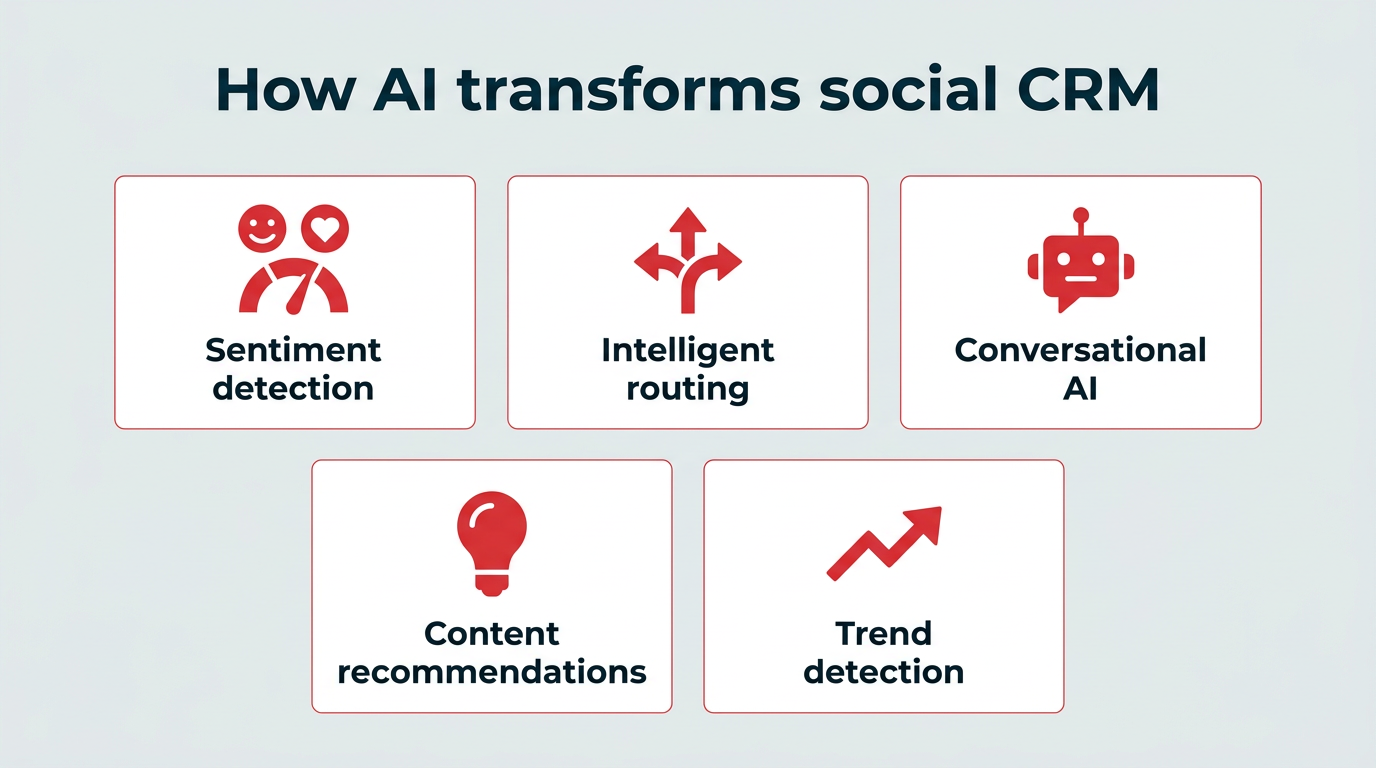
Furthermore, AI-powered social listening elevates the function of a CRM from a passive reporting archive to an active strategic engine. Instead of relying on manual keyword searches, automated listening systems detect sarcasm, emotional drivers, and nuanced topic clusters within digital conversations. These insights automatically enrich customer profiles, flagging accounts with shifting sentiment before contract renewals or surfacing trending topics that can directly inform upcoming marketing campaigns and product development roadmaps. Rather than removing the human element from customer relationship management, these intelligent layers ensure that human agents possess the requisite context before typing a single word of response.

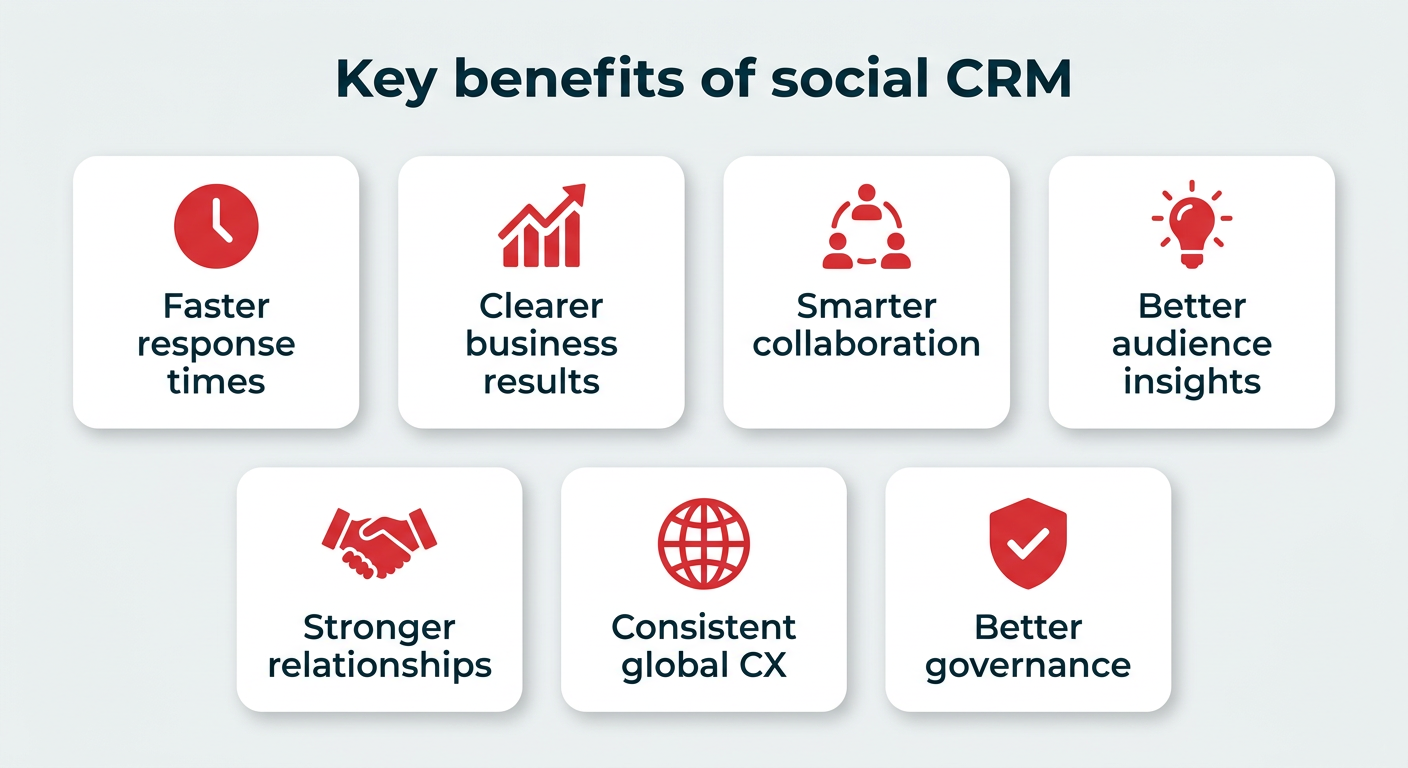
The operational benefits of this comprehensive approach span all primary customer-facing departments. For customer service teams, Social CRM eradicates the fragmented communication loops that force consumers to repeat their issues across multiple channels. Inbound requests are auto-routed based on sentiment and account history, ensuring that urgent escalations reach senior personnel immediately. For sales departments, social interactions provide invaluable intent signals. A prospect who repeatedly engages with educational content, saves product comparison media, and inquires about pricing via direct message exhibits a level of commercial intent that standard static contact lists cannot convey. When these social signals sit alongside CRM pipeline data, sales representatives can prioritize outreach based on demonstrated readiness rather than working blindly down an alphabetical list.
Marketing divisions likewise leverage Social CRM data to move away from speculative content creation and toward precision targeting. By analyzing the specific interests, pain points, and engagement patterns of their audience, marketing teams can design campaigns that resonate deeply with prospective buyers, thereby reducing churn caused by irrelevant messaging. Moreover, by linking social engagements directly to downstream outcomes such as purchases, subscriptions, and contract renewals, organizations can finally establish reliable attribution models for social media return on investment (ROI). This alignment addresses a persistent challenge for corporate leadership: proving the financial impact of social media initiatives in executive-level reporting.

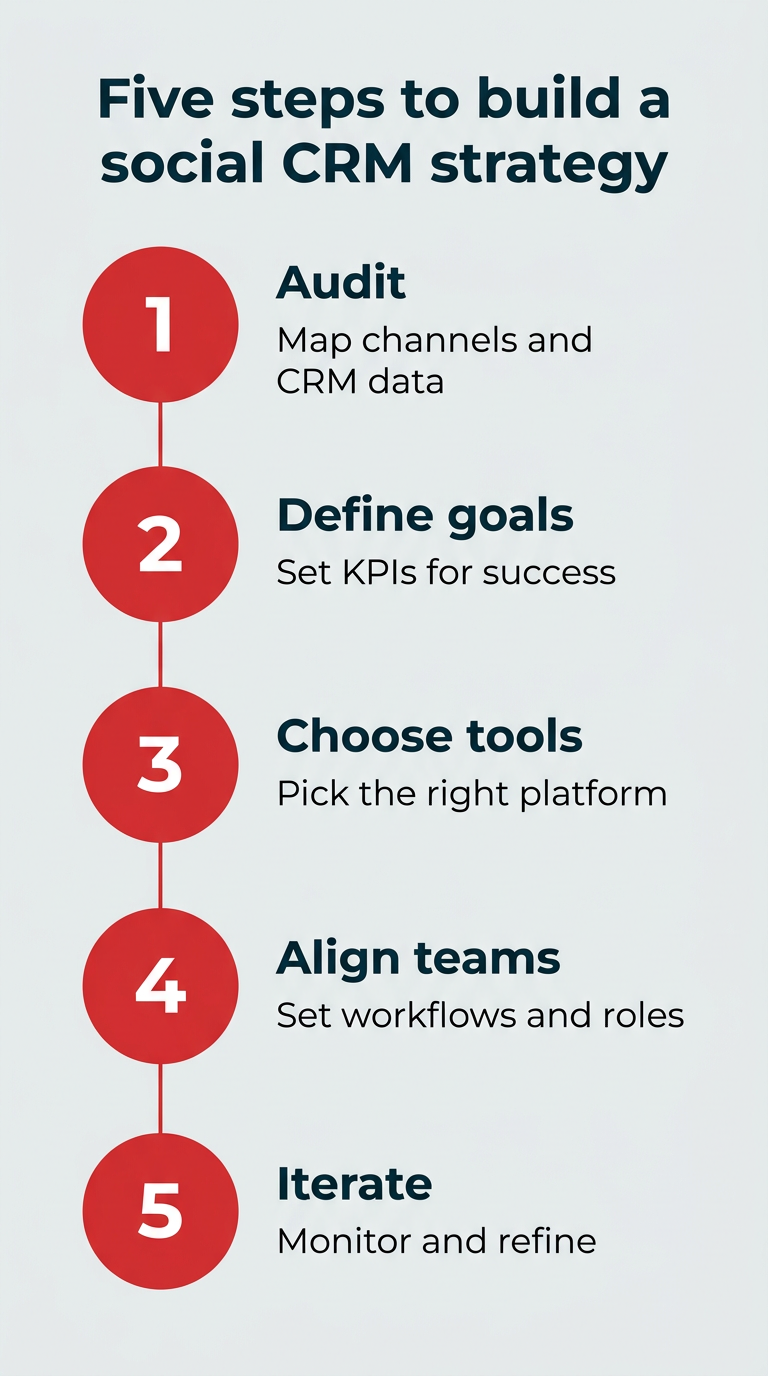
Implementing a successful Social CRM strategy requires a structured, multi-phase framework to ensure organizational alignment and technical cohesion. Industry experts recommend a five-step implementation process for enterprises looking to bridge the gap between social data and customer databases:
- Audit Current Infrastructure: Map out existing social channels currently utilized by customers and inventory the data structures currently residing within legacy CRM systems to identify operational blind spots.
- Define Strategic Goals and KPIs: Establish explicit objectives—such as decreasing first-response times, increasing qualified social lead generation, or improving customer sentiment scores—before deploying new technology.
- Select Scalable Tools and Integrations: Invest in platforms that offer robust, native connectors capable of synchronizing social interactions with enterprise CRMs with minimal manual data entry.
- Align Cross-Functional Workflows: Establish clear governance rules, response guidelines, and routing protocols between marketing, sales, and support teams to ensure accountability and consistency.
- Monitor, Measure, and Iterate: Continuously review key performance indicators against business outcomes, leveraging AI-driven insights to adapt rapidly to shifting market dynamics and customer preferences.
As the software market matures, several prominent platforms have established themselves as leaders in facilitating this integration. Hootsuite Social OS provides comprehensive social media management, advanced listening capabilities, and a unified, governed inbox that synchronizes seamlessly with major enterprise systems. HubSpot offers an intuitive, scalable Smart CRM designed to unify marketing, sales, and service functions for growing organizations. Salesforce brings enterprise-grade scalability and conversational AI assistants to complex sales processes, while Microsoft Dynamics 365 delivers modular, customizable CRM systems backed by predictive customer insights. SugarCRM rounds out the field with highly flexible solutions tailored for specific departmental focuses.
Ultimately, the convergence of social media data and customer relationship management is no longer an experimental strategy for forward-thinking enterprises; it is a fundamental requirement for business survival in a digitally native marketplace. By breaking down the traditional barriers between public social interactions and private customer records, organizations can cultivate deeper relationships, streamline cross-departmental collaboration, and transform everyday digital conversations into measurable business value.