World Records Shattered as Women Dominate the Lumberjack World Championships in Hayward Wisconsin

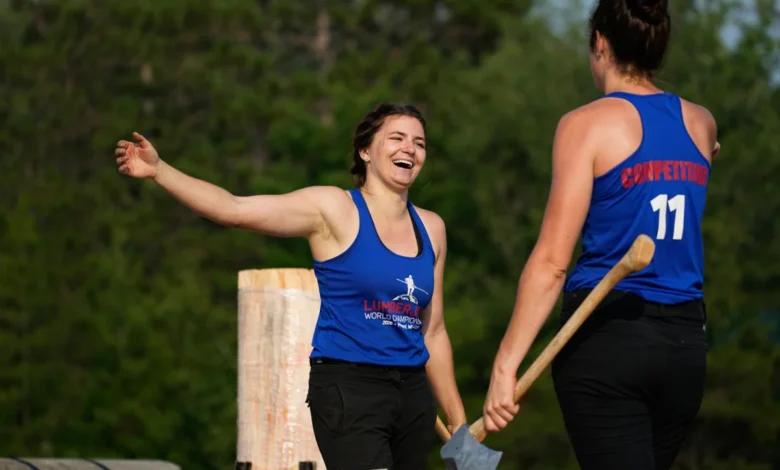
The quiet, lakeside community of Hayward, Wisconsin, recently served as the epicenter of the international timber sports world, hosting the 64th annual Lumberjack World Championships. Over three days of intense competition that concluded this past Saturday, the air was thick with the scent of freshly cut white pine and the roar of high-powered chainsaws, as 106 of the world’s most elite athletes gathered to test their strength, precision, and endurance. While the event has long been a staple of North American heritage sports, this year’s iteration was defined by a historic surge in women’s performance, culminating in three new world records that have redefined the ceiling of the sport.
The competition, held at the iconic Lumberjack Bowl, saw 66 men and 40 women representing 16 U.S. states and nine different countries. Despite the fierce rivalry inherent in a world-class championship, the atmosphere remained rooted in the traditional "Yo-Ho!" spirit, a nod to the logging heritage that built the American Midwest. The highlight of the weekend belonged to the women’s division, where athletes pushed the boundaries of physical possibility in events that were once considered the exclusive domain of men.
A Masterclass in Precision: Karolina Urbanová’s Historic Double
The standout performer of the weekend was Karolina Urbanová, an elite competitor from the Czech Republic, who demonstrated a level of technical mastery rarely seen in the history of the championships. Urbanová secured her place in the record books by setting world records in two of the most physically demanding disciplines: the Women’s Underhand Chop and the Women’s Standing Chop.
In the Underhand Chop, a discipline that requires the athlete to stand atop a horizontal log and swing an axe downward between their feet, Urbanová sliced through 11 inches of white pine in a staggering 21.28 seconds. The event is a grueling test of core strength and accuracy; a single misplaced swing can not only cost seconds but can result in catastrophic injury. Urbanová’s rhythm and power were unmatched, as she cleared the block with a efficiency that left the capacity crowd in awe.
Urbanová followed this performance by clinching the world record in the Women’s Standing Block Chop. This event simulates the felling of a tree, with the athlete swinging a razor-sharp axe at a vertical log. She completed the task, cutting through 9 inches of pine, in just 19.38 seconds. The dual records underscore the increasing professionalization of timber sports in Europe, where athletes like Urbanová undergo rigorous year-round training regimens to shave fractions of a second off their times.
Local Heroism and the Speed of the Boom Run
While the chopping events highlighted raw power and precision, the Women’s Boom Run showcased the extraordinary balance and agility required of modern "lumberjills." Meredith Ingbretson, a native of Hayward, delighted the local crowd by setting a new world record in the event.
The Boom Run requires competitors to sprint across a chain of eight floating red cedar logs—known as a "boom"—and then return to the starting dock. The logs are slick with water and inherently unstable, requiring a combination of high-speed sprinting and delicate weight distribution. Ingbretson navigated the treacherous course in 13.78 seconds, a feat that requires not only physical speed but an intuitive understanding of fluid dynamics and log buoyancy.
Ingbretson’s victory was particularly poignant for the Hayward community, as she represents the deep-seated local tradition of the sport. Growing up in the shadow of the Lumberjack Bowl, Ingbretson has transitioned from a local talent to a world-record holder, embodying the evolution of the championships from a regional festival to a global sporting phenomenon.
The Evolution of Women in Timber Sports
The record-breaking performances seen this year are the result of a decades-long expansion of women’s participation in the Lumberjack World Championships. When the competition was first inaugurated in 1960, women’s involvement was largely restricted to logrolling, a discipline that focuses on balance and footwork rather than the heavy-duty sawing and chopping that defined the men’s side.
However, the landscape began to shift as women pushed for inclusion in more technical and power-based events. Today, women compete in more than 20 different timber sports events, including the single buck saw, the springboard chop, and various chainsaw disciplines.
Nancy Zalewski, a veteran of the sport with 27 years of competitive experience, reflected on the dramatic changes she has witnessed during her career. Zalewski noted that in her early years, there were no dedicated women’s divisions for many of the chopping events, forcing her to compete directly against men. Her role has since evolved from competitor to mentor, as she now trains the next generation of athletes, including fellow participant Kate Witkowski. This lineage of mentorship has been vital in elevating the technical standards of the women’s division, leading directly to the record-shattering performances witnessed this weekend.
The Engineering and Economics of the Axe
Beyond the physical prowess of the athletes, the Lumberjack World Championships is a showcase of specialized engineering. The gear used in modern timber sports is a far cry from the standard tools found in a hardware store.
Competitors utilize custom-built chainsaws, often referred to as "Hot Saws," which are powered by modified snowmobile or motorcycle engines. These machines can weigh over 60 pounds and possess enough horsepower to cut through massive logs in seconds. Equally specialized are the axes, which are made from high-carbon steel and tempered to a specific hardness that allows them to hold a "razor’s edge" while striking frozen or knotted wood.
The financial investment required to compete at this level is significant. A single buck saw—a long, crosscut saw used by one person—can cost thousands of dollars to purchase, and the maintenance is equally steep. Competitors reported that professional sharpening for a single buck saw can cost upwards of $400. This level of investment highlights the transition of lumberjack sports from a hobbyist’s pastime into a professionalized circuit where equipment performance is as critical as athlete conditioning.
Historical Context: From the River to the Bowl
The tradition of lumberjack competitions dates back to the late 19th century, specifically the 1890s, when loggers would challenge one another to tests of skill in the logging camps of the Northwoods. These informal "rolios" were a way for workers to blow off steam and prove their worth in a dangerous and demanding industry.
The Hayward competition is held in the Lumberjack Bowl, a site with deep historical resonance. The area was once a holding pond for the massive log drives that moved timber down the Namekagon River to the sawmills. By repurposing this industrial site into a world-class stadium, the city of Hayward has ensured that its economic and cultural history remains a living part of the community.
The event today is a multi-sensory experience that extends beyond the competition ring. The surrounding grounds feature wood-carving demonstrations where artists turn stumps into intricate sculptures, logrolling clinics for children, and live music. The presence of children dressed in traditional lumberjack attire—flannels, suspenders, and wool socks—serves as a reminder that the sport is a generational bridge, connecting the digital age with the rugged manual labor of the past.
The Culture of a Niche Sport
One of the most striking aspects of the Lumberjack World Championships is the unique culture of camaraderie among competitors. Despite the high stakes and the international nature of the field, the community remains tight-knit.
Kate Witkowski, a protégé of Nancy Zalewski, noted that the niche nature of the sport fosters a level of mutual support rarely seen in professional athletics. Because the specialized gear is difficult to acquire and the technical knowledge is often passed down through word-of-mouth, competitors frequently share equipment and advice. "I don’t know any other sports where the athletes support each other like we do here," Witkowski said. "We’re all just trying to get better."
This sentiment was echoed by international participants, who often rely on local athletes for logistical support when traveling with heavy and dangerous equipment across borders. The shared passion for the "timber lifestyle" creates a bond that transcends national boundaries, making Hayward a global village for three days every July.
Broader Impact and the Future of Timber Sports
The success of the 2024 championships and the shattering of three world records suggest that timber sports are entering a new era of growth. The increasing visibility of women in the sport, combined with the high production value of the Hayward event, has attracted interest from major sponsors and media outlets.
From an analytical perspective, the records set by Urbanová and Ingbretson indicate a trend toward specialized athleticism. As the sport moves away from its "everyman" roots, we are seeing the emergence of athletes who train with the same intensity as Olympic sprinters or weightlifters. This shift is likely to lead to further record-breaking performances in the coming years, as training methodologies and equipment technology continue to advance.
Furthermore, the economic impact on the Hayward area is substantial. The influx of thousands of spectators, athletes, and support staff provides a significant seasonal boost to the local hospitality and tourism sectors. As the "Golf Capital of Wisconsin" continues to brand itself as a premier destination for outdoor heritage sports, the Lumberjack World Championships remain the crown jewel of its summer calendar.
As the cheers of "Yo-Ho!" fade and the sawdust settles, the 2024 championships will be remembered as the year the women of the timber world didn’t just compete—they rewrote the history books. With the bar now set higher than ever, the eyes of the sporting world remain on Hayward, waiting to see how much further these athletes can push the limits of steel and wood.