As Russia prepares to conduct its first parliamentary elections since the full-scale invasion of Ukraine in February 2022, the domestic political landscape exists in a state of carefully orchestrated inertia. For President Vladimir Putin, the electoral stakes are negligible; the nation’s solitary pro-peace political faction has been systematically barred from participating, and the legislative chamber itself holds no independent policymaking power. Yet, the timing of these elections presents an acute public relations challenge for the Kremlin. Over the past year, targeted Ukrainian drone strikes against domestic oil depots and critical infrastructure have breached the psychological distance of the conflict, compelling ordinary Russian citizens to confront the tangible consequences of a war that state television has labored to normalize or ignore.
This resurgence of public interest in war reporting has revitalized a high-stakes cat-and-mouse game between Moscow’s formidable censorship apparatus and an independent Russian press operating almost exclusively from overseas exile. Outlets driven out of the country are forced to navigate a precarious logistical labyrinth: extracting verified, ground-level information safely out of a tightening police state, and subsequently finding innovative digital pathways to bypass state firewalls and deliver that information back to domestic audiences.
The Systematic Eradication of Domestic Press Freedom
The marginalization of independent journalism in the Russian Federation is not a recent phenomenon, but rather a decades-long erosion that accelerated dramatically following Putin’s return to the presidency in 2012 and the subsequent annexation of Crimea in 2014. During the 2014 crisis, the Russian government empowered prosecutors to shutter any media entity deemed a threat to constitutional order—a sweeping legal category that ultimately encompassed virtually all independent major media organizations.
Simultaneously, the Kremlin weaponized financial regulations, forcing outlets that received foreign funding to register as “foreign agents,” thereby exposing them and their employees to invasive public audits and severe reputational damage. The February 2022 invasion of Ukraine served as the final catalyst for a total domestic information lockdown. Independent online news portals, foreign news bureaus, and major Western social media platforms were systematically blocked or banned under draconian wartime censorship laws that criminalized any deviation from the Ministry of Defense’s official narrative.
Fiona O’Brien, the regional director for Europe and Central Asia at the Committee to Protect Journalists (CPJ), underscores the severity of the ongoing crackdown. According to CPJ metrics, at least twenty-nine journalists remain imprisoned in Russia on charges related to their reporting or anti-censorship advocacy. The continuous wave of prosecutions demonstrates that the Kremlin views independent verification as an existential threat to its domestic stability.
Data Journalism in the Absence of On-the-Ground Reporting
The physical dangers of operating inside Russia have forced exiled newsrooms to completely reinvent investigative methodologies. When Ukrainian long-range drone strikes began hitting oil refineries and storage facilities near Moscow and regional hubs, international media coverage frequently relied on unverified social media posts and eyewitness accounts gathered from local gas stations.
Exiled outlets like Mediazona, mindful of the potential for psychological warfare and the amplification of unverified claims by adversarial actors, adopted a rigorous, data-driven approach. Alexander Borodikhin, a reporter and editor for Mediazona, noted that his team bypassed anecdotal reports entirely. Instead, journalists scraped publicly available financial registries, municipal transport logs, and digital bank transaction data from regional gas station networks to construct empirical maps tracking actual fuel availability and supply chain disruptions. This quantitative methodology allowed newsrooms to provide accurate reporting without exposing vulnerable local correspondents to immediate arrest.
Simultaneously, investigative outfits such as Meduza and iStories rely on decentralized networks of “proxy reporters”—undercover freelancers operating within Russia who utilize heavily encrypted communication channels and false identities. Roman Anin, the founder of iStories, acknowledges the profound personal risks assumed by these anonymous collaborators. The operational protocols mirror those of intelligence agencies, requiring absolute operational security to protect individuals whose freedom is perpetually at stake.
Bypassing the Firewall: The Technological Arms Race
Delivering news back into a heavily monitored digital environment requires constant technological adaptation. Over the past several years, exiled newsrooms have established sophisticated distribution networks designed to render blanket internet blocks ineffective. When the federal communications watchdog, Roskomnadzor, successfully blocks a primary website domain, newsrooms instantly deploy decentralized mirror sites or alternative distribution vectors.
Rather than relying solely on direct hyperlinks to banned domains, publications have begun embedding news content within standard HTML files hosted on globally trusted infrastructure providers, such as Google, which remain accessible within Russia. Furthermore, nearly all major exiled outlets have developed proprietary mobile applications equipped with native anti-censorship and anti-blocking protocols.
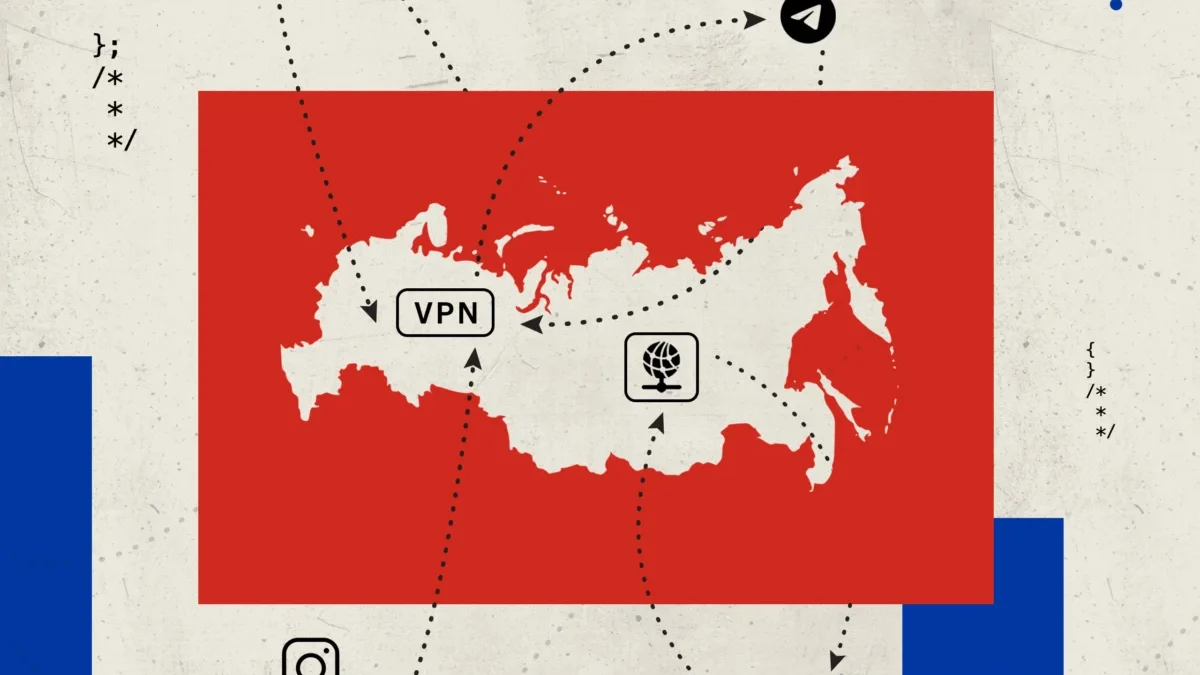
These technological workarounds have coincided with a significant rise in digital literacy among Russian consumers. Supported by comprehensive, step-by-step explainer guides published by exiled outlets, approximately half of all Russian internet users have become proficient in utilizing Virtual Private Networks (VPNs) and alternative routing tools. This digital proficiency enables citizens to bypass state-imposed blackouts and access restricted platforms like YouTube, Telegram, and Instagram, rendering total state control of the information ecosystem increasingly difficult to maintain.
The Breakdown of Kremlin Propaganda and the Politics of Apathy
The physical reality of the war—exemplified by high-profile strikes against critical infrastructure such as the Kapotnya oil refinery, which supplies a substantial portion of Moscow’s fuel, and the systematic bombardment of Wildberries logistics hubs—has strained the capabilities of state-controlled media. The traditional strategy of pro-Kremlin spin doctors has been one of calculated silence, routinely ignoring domestic drone strikes or reframing structural industrial accidents as localized technical malfunctions.
However, as these incidents multiply, pro-Kremlin media has grown increasingly reactive, steadily losing the initiative in the broader information war. According to Ivan Kolpakov, editor-in-chief of the Riga-based Meduza, the psychological impact on the civilian population has shifted. While periods of intense military escalation initially drove citizens to retreat into private lives and tune out the news entirely, the direct proximity of the conflict has forced a reluctant re-engagement with war coverage.
Yet, some analysts argue that the ultimate objective of modern Russian state propaganda is not necessarily to convince the public of a specific government narrative, but rather to cultivate systemic apathy. By flooding the public sphere with contradictory claims, the Kremlin seeks to instill a generalized distrust of all information sources, paralyzing civic action and political participation. Roman Anin of iStories notes that this engineered cynicism is designed to make citizens believe that no alternative exists, rendering collective dissent effectively impossible.
Implications and Future Outlook
Despite the controlled nature of the upcoming parliamentary elections, independent researchers suggest the vote could serve as an underlying barometer of public anxiety. Recent digital behavior analysis conducted by iStories revealed a notable spike in domestic Google search trends regarding real estate acquisition and relocation pathways to neighboring jurisdictions, such as Georgia.
The quiet migration of educated professionals and potential dissidents points to a lingering undercurrent of instability that standard electoral controls cannot entirely suppress. While the physical and digital battlegrounds remain heavily skewed in favor of the state apparatus, the persistence of exiled journalism ensures that an alternative historical record is continuously maintained, preserving the possibility of a different political future for Russian society.