The rapid evolution of digital discovery has forced enterprise marketing departments to rethink how brands build visibility, measure influence, and capture audience attention. As artificial intelligence transforms traditional search engines into conversational answer engines, optimizing for visibility within these systems has become a critical business imperative. This discipline, known as Answer Engine Optimization (AEO), is distinct from traditional Search Engine Optimization (SEO). While SEO focuses on climbing traditional search engine result pages, AEO measures and influences how brands appear within AI-generated responses across platforms like ChatGPT, Google Gemini, and Perplexity.
To navigate this landscape, modern marketing leaders are increasingly turning to dedicated AEO software platforms. Among the emerging frontrunners in this category are Profound and Bluefish AI. Both platforms help marketing teams evaluate brand presence, citation tracking, and competitive positioning within AI outputs, yet they diverge significantly in their underlying methodology, data capture mechanics, engine coverage, and reporting capabilities. Evaluating these differences is vital for organizations seeking to establish a resilient, data-driven AI discovery strategy.
The Paradigm Shift from Traditional Search to AI Discovery
The emergence of AI-driven answer engines represents one of the most fundamental shifts in consumer behavior and digital marketing history. Rather than presenting users with a list of blue links, modern AI models synthesize information from across the web, presenting direct answers that frequently include brand recommendations, product comparisons, and embedded citations.

This transformation makes measurement significantly more complex than tracking historical keyword rankings. A single prompt entered into an AI model can yield wildly divergent mentions, sentiment scores, and recommendations depending on geographic location, temporal factors, model updates, and underlying engine dynamics. Consequently, modern marketing operations require sophisticated tooling that can systematically monitor these fluctuations, establish reliable baselines, and provide actionable intelligence.
While traditional SEO software optimizes technical site performance and keyword indexing, AEO platforms specifically intercept the ecosystem of AI-generated content. Understanding this boundary is essential for marketing executives allocating budgets between traditional search tools and specialized AI visibility platforms.
Methodological Comparison: Model Coverage and Data Capture
A foundational point of divergence between Profound and Bluefish AI lies in how each platform collects, processes, and structures data from various artificial intelligence models.
Profound emphasizes granular configuration, allowing marketing teams to meticulously manage prompt volumes, regional parameters, and linguistic variables. Its primary data capture mechanism relies on observing consumer-facing answer-engine experiences directly. By capturing the exact interface responses that real-world users encounter, Profound aims to reflect authentic user journeys rather than theoretical API outputs. However, marketing teams utilizing Profound must carefully evaluate regional and platform availability across its various data sets to ensure alignment with their target demographics.

In contrast, Bluefish AI highlights monitoring capabilities spanning more than ten distinct models, incorporating commerce-focused AI systems and specialized shopping assistants alongside general-purpose conversational engines. Bluefish leverages static prompt sets and model-drift controls designed to maintain a consistent testing baseline over time. While Bluefish incorporates diverse data inputs—including panel data and provider signals—to establish its measurement framework, enterprise buyers must frequently validate precise capture methodologies during product demonstrations to understand how model updates impact longitudinal trend analysis.
Citation Fidelity and Actionable Feedback Loops
Tracking brand visibility is only valuable if the underlying data can be translated into strategic action. Both Profound and Bluefish AI provide capabilities that trace AI-generated responses back to specific source URLs, allowing communications and marketing teams to investigate weak or inaccurate brand representation.
Profound’s Answer Engine Insights incorporates a dedicated FactCheck analysis tool. This feature compares claims made by AI models about a brand against a customer-defined Knowledge Base. When discrepancies or inaccurate statements are identified, the platform links them directly to their citation URLs, providing a clear pathway for teams to update owned digital assets, produce targeted content, or execute digital PR outreach.
Bluefish AI similarly identifies citation URLs and evaluates brand claims against verified sources of truth. Furthermore, the platform introduces specialized metrics such as Impact Score and Influence Rank. These quantitative measures attempt to estimate how strongly a specific source URL influenced a given AI response. While these predictive metrics offer a useful hierarchy for prioritizing content optimization efforts, marketing analysts must interpret them cautiously, as they rely on proprietary algorithmic modeling rather than direct causal observation.

Case studies provided by Bluefish demonstrate effective diagnosis-to-action workflows—such as identifying low citation frequencies stemming from improper crawler access, modifying site configurations, and subsequently tracking recovery in citation rates. Nevertheless, independent validation remains crucial for confirming return on investment (ROI) claims associated with such attribution models.
Enterprise Reporting, Attribution, and CRM Integration
Connecting AEO visibility metrics to tangible business outcomes remains a central challenge for modern marketing organizations. Without a clear bridge between AI discovery and pipeline generation, AEO risks remaining an isolated vanity metric.
Profound addresses this challenge by supporting robust reporting infrastructure, including CSV data exports, an enterprise-grade API, and native integrations with prominent analytics suites. Notably, Profound’s integration with Google Analytics allows marketing teams to channel AI-originating referral traffic directly into core performance dashboards, evaluating micro-conversions, sign-ups, and purchases alongside visibility shifts.
Bluefish AI utilizes structured data collections to group URLs, topics, and product lines, establishing performance baselines that measure the impact of specific marketing tactics over time. While Bluefish promotes advanced closed-loop attribution capabilities, prospective enterprise buyers should conduct rigorous evaluations during product demonstrations to verify native integrations with established Customer Relationship Management (CRM) platforms and business intelligence (BI) software.

To effectively contextualize these tools, organizations often utilize an attribution ladder:
- AI visibility and brand mention frequency
- Identifiable referral traffic from AI sources
- User conversion events on owned digital properties
- Identification of known leads or contacts within the CRM
- Closed-won pipeline and revenue opportunities
Proving direct causation along this trajectory requires meticulous data governance and cross-channel tracking, ensuring that observed increases in pipeline are definitively linked to optimized AI discovery efforts rather than concurrent macroeconomic or traditional marketing campaigns.
Security, Governance, and Enterprise Compliance
As enterprise organizations increasingly entrust third-party software with proprietary brand strategies, prompt libraries, and customer data, rigorous security evaluations are mandatory. Both Profound and Bluefish AI have matured their compliance offerings to meet enterprise procurement standards.
Historically, platform certifications varied, but current documentation confirms that both Profound and Bluefish maintain robust security postures, including SOC 2 Type II compliance and single sign-on (SSO) capabilities. Bluefish additionally markets certain deployment configurations as HIPAA-ready, an essential consideration for organizations operating within highly regulated healthcare and financial sectors.

When conducting security reviews, procurement teams must analyze several critical vectors:
- Access Control: Granular role-based permissions and user provisioning workflows.
- Auditability: Comprehensive logging of administrative actions and data modifications.
- Data Handling: Encryption standards for data at rest and in transit, alongside clearly defined data retention policies.
- Integration Security: Evaluating what proprietary data traverses third-party APIs during automated prompt execution.
Onboarding, Resource Allocation, and Team Fit
The successful implementation of an AEO platform depends heavily on initial setup quality, team ownership, and ongoing operational support.
Profound typically champions a self-serve, highly configurable operational model. Documentation suggests initializing AEO monitoring with five to ten core strategic topics, expanding into structured prompt libraries organized by tags and metadata. However, platform administrators must exercise caution: altering tracked prompt structures frequently can disrupt historical data integrity, complicating period-over-period trend analysis.
Bluefish AI often leans into a more service-led implementation model. Its onboarding framework frequently incorporates dedicated platform training, custom workflow integrations, and strategic consulting services spanning executive briefings and change management. This approach is tailored for enterprise marketing teams seeking accelerated time-to-value through external partnership.

For organizations already embedded within the HubSpot ecosystem, alternative pathways exist. Integrating AEO functionality directly into Marketing Hub Professional or Enterprise enables marketing teams to leverage existing CRM context for intelligent prompt discovery, seamlessly connecting AEO insights with established content creation and nurturing workflows.
Strategic Checklist for Platform Evaluation
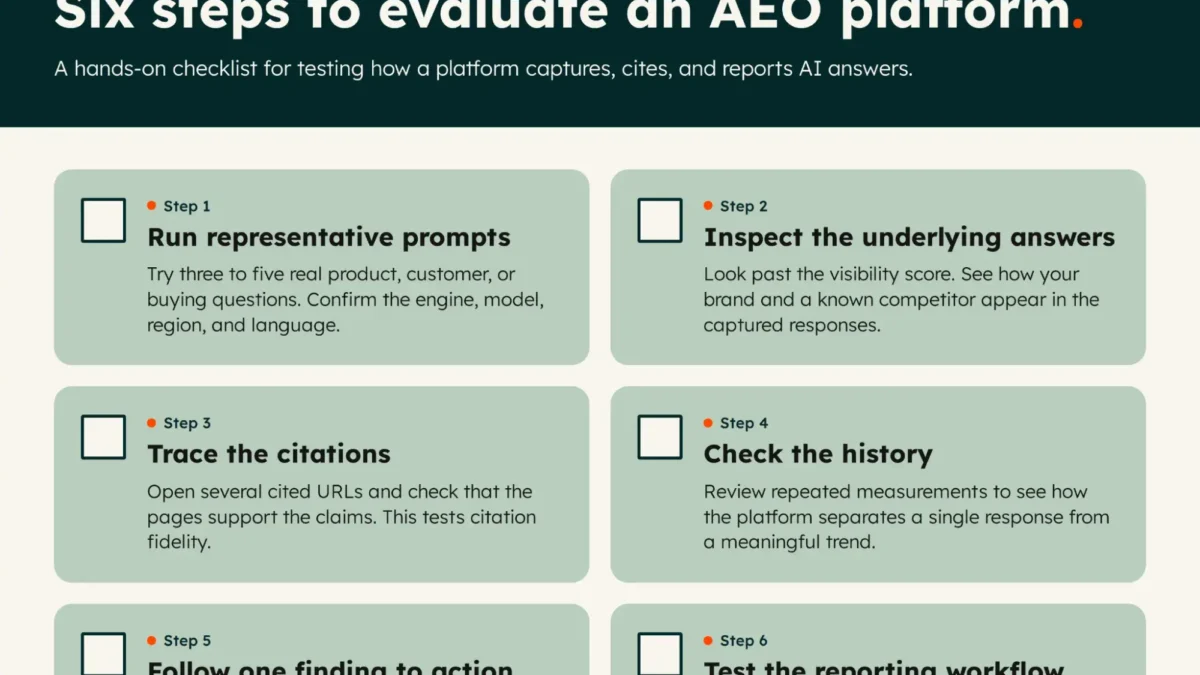
When selecting an AEO platform, marketing leaders should execute a standardized evaluation framework during vendor demonstrations. Utilizing a consistent set of prompts, competitor benchmarks, and source-verification tests ensures an objective comparison.
- Engine Coverage Validation: Confirm that the platform actively monitors the specific conversational engines utilized by your core audience within your target geographic markets and languages.
- Data Capture Transparency: Inquire whether responses are captured via direct consumer interface observation or provider APIs, and understand how interface modifications by AI developers are handled.
- Citation and Fact-Checking Mechanics: Test the platform’s ability to identify inaccurate brand assertions and trace them accurately to underlying citation URLs.
- Attribution and Analytics Integration: Evaluate the ease with which visibility data can be exported or synchronized with existing business intelligence and CRM systems.
- Governance and Permissions: Verify enterprise security credentials, SSO implementation, and role-based access controls to satisfy internal IT and compliance mandates.
Conclusion and Strategic Outlook
Choosing between Profound and Bluefish AI requires a clear understanding of an organization’s specific operational requirements and internal resources. Profound offers extensive technical control over prompt engineering, granular regional parameters, and robust integration with traditional web analytics. Bluefish AI combines multi-model coverage across diverse AI ecosystems with enterprise-grade consulting services, brand accuracy verification, and structured audience intelligence.
Ultimately, the strongest AEO platform is one that provides clear, verifiable evidentiary chains—connecting an initial user prompt to an AI-generated response, identifying the influential sources shaping that answer, guiding targeted optimization actions, and measuring the subsequent impact on business outcomes. By rigorously testing platforms against these criteria, marketing leaders can secure a sustainable competitive advantage in the burgeoning era of artificial intelligence discovery.