The modern web development landscape is currently defined by a significant migration trend: developers are increasingly abandoning JavaScript-heavy patterns in favor of powerful, native CSS features like container queries, the :has() relational pseudo-class, and native CSS nesting. While the primary goal of these migrations is to streamline codebases and improve performance, a growing body of evidence suggests that replacing JavaScript with CSS often trades local simplicity for hidden systemic complexity.
This shift, which has gained momentum throughout 2025 and 2026, presents a paradox. A developer can remove fifty lines of JavaScript, replace them with three lines of CSS, and submit a pull request that appears objectively superior. However, the resulting architecture often introduces unforeseen bugs, layout shifts, and performance bottlenecks that are significantly harder to debug than the original imperative code.
The Myth of the Simple Migration
The core of the issue lies in the misconception that CSS exists in a vacuum. In a typical production application, CSS functions as a "tenant" in a shared ecosystem alongside JavaScript, legacy layout structures, the CSS Cascade, and the browser’s rendering engine. When a developer introduces a new CSS feature without fully accounting for its interactions with existing code, the stability of the entire component suffers.
In April 2026, industry analyst Igor Roztropiński published a seminal essay, "Modern Frontend Complexity: Essential or Accidental?" which challenged the industry to reconsider the implications of this migration. Roztropiński argued that while browsers have evolved, the complexity of managing state across multiple layers has not necessarily decreased. His findings sparked a robust debate on platforms like Reddit, where developers debated whether "doing less" with code actually equates to "doing less" work for the browser and the maintenance team. The consensus among senior engineers is that native features only reduce complexity when they are integrated into a stable, well-documented system rather than being dropped into an existing, fragile environment.
Scenario 1: The Multi-Owner Behavior Trap
One of the most frequent points of failure occurs when a component has two "owners"—the legacy JavaScript and the new CSS. Consider a card element that switches to a two-column layout at a specific width. Traditionally, this required a ResizeObserver in JavaScript to toggle a class. Migrating this to CSS container queries is, in theory, a cleaner approach.

However, in practice, these migrations are rarely comprehensive. Developers often delete the class toggling logic but leave the observer active or fail to remove auxiliary CSS selectors that still rely on the now-defunct class. When a designer requests a breakpoint change, the developer updates the CSS container query, leaving the orphaned JavaScript observer to trigger conflicting styles. The result is a "limbo" state where the UI behaves unpredictably. Debugging this requires an intimate knowledge of both the CSS and the JavaScript, effectively doubling the cognitive load for future maintainers.
Scenario 2: Unintended Layout Side Effects
The introduction of container-type: inline-size represents a powerful tool for responsive design, but it carries heavy technical overhead. Declaring this property forces the browser to establish a new block formatting context (BFC) and applies size containment to the element. While this enables container queries, it also fundamentally alters how that element interacts with its surroundings.
Data from browser rendering engine audits shows that elements with container-type applied often stop collapsing their margins, change how they handle floats, and fail to calculate their size based on internal content if not explicitly defined. This can cause elements to "vanish" or collapse to zero height, particularly in flexbox or grid layouts. The lesson here is that a seemingly isolated CSS change can ripple through a page’s entire layout engine, causing regressions in components that appear completely unrelated to the change being made.
The Cascade and the Specificity War
The rise of the :has() selector and native CSS nesting has fundamentally changed how specificity is managed. While these features allow for more concise code, they can also cause selectors to be far more powerful—and "louder"—than intended.
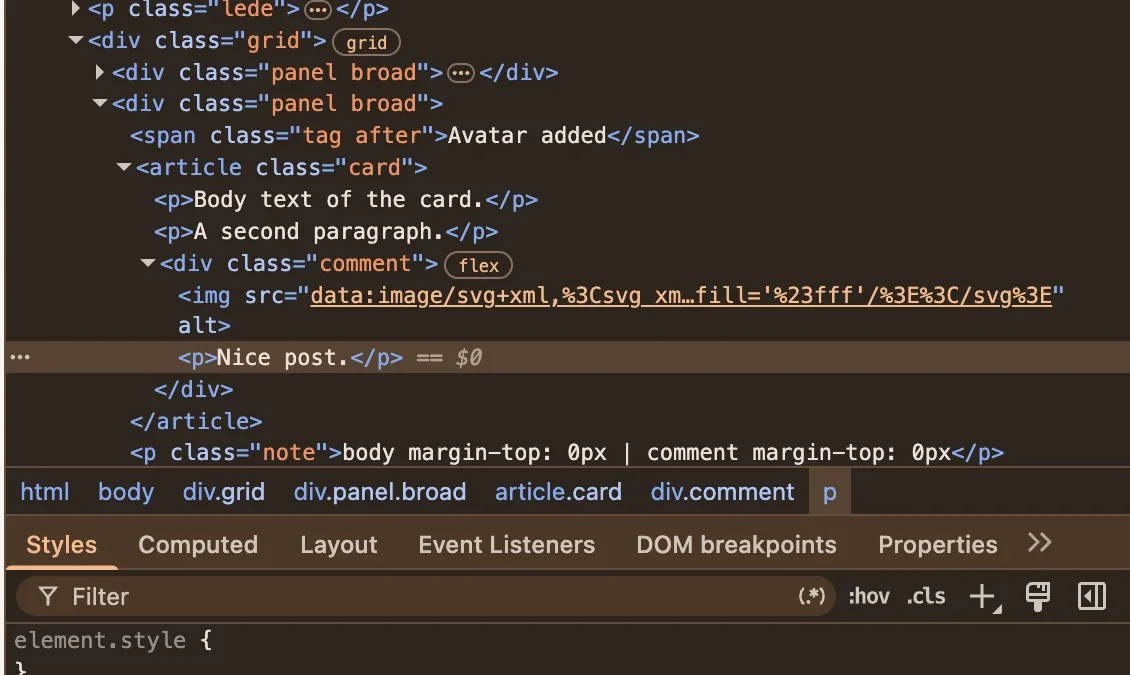
A common mistake is using a broad :has() selector to apply styles to children, such as card:has(img) p margin: 0; . This rule, intended only for cards with hero images, inadvertently strips margins from all paragraphs within the card, including those inside nested components like comment sections. Unless the developer explicitly uses child combinators (>), the selector reaches into deep component trees, triggering "spacing bugs" that are notoriously difficult to trace.
Similarly, native nesting inherits the highest specificity from its parent, mirroring the behavior of the :is() pseudo-class. This often leads to "specificity wars" where developers find themselves forced to add increasingly specific overrides or resort to the !important flag, effectively negating the benefits of the original clean code.

Performance and the Browser’s Rendering Engine
There is a prevailing belief that "CSS is always faster than JavaScript." While this is often true for simple UI tasks, it is not a universal rule. Performance traces using modern browser devtools reveal that complex CSS selectors—particularly those involving :has()—can impose significant costs on the browser’s style and layout recalculation phases.
In a controlled test involving 5,000 DOM elements, researchers found that while a single :has() rule was performant, the combination of multiple "harmless" rules resulted in a multiplicative performance hit. When two unrelated CSS rules interact, the browser may be forced to restyle thousands of elements on every toggle, creating a "performance footgun" that is invisible during code review but catastrophic in production.
A Framework for Future Migrations
To manage these risks, engineering teams are adopting more rigorous checklists for CSS migrations. Before any JavaScript is replaced, the following questions must be answered:
- Ownership: Does the new CSS rule completely replace the JavaScript, or will they continue to coexist?
- Side Effects: Does the new CSS property (like
container-type) change the element’s block formatting context? - Specificity: Have the selectors been constrained with child combinators to prevent them from reaching into nested components?
- Performance: Has the impact of the new selectors been measured across a realistic scale of DOM elements?
- Orphaned Code: Is there a documented plan to delete all associated JavaScript, classes, and legacy CSS?
- Regression Testing: Does the migration include a visual regression test that covers the component’s behavior within a real-world layout?
Conclusion: Moving Beyond the Greenfield Perspective
Most of the documentation surrounding new CSS features is written from a "greenfield" perspective—a perfect, empty environment where the new feature can shine. However, real-world development is defined by "brownfield" migrations—the messy, interdependent reality of existing codebases.
The transition to modern CSS is a positive evolution for web development, offering capabilities that were once impossible. However, the industry must move away from the assumption that these features are inherently "simpler." True simplicity is not found in the line count of a pull request, but in the maintainability, predictability, and performance of the system as a whole. By shifting the focus from the code itself to the systemic interactions it creates, developers can harness the power of modern CSS without falling into the traps of accidental complexity. The goal of a successful migration is not just to rewrite the code, but to ensure the new "tenant" respects the rules of the house.