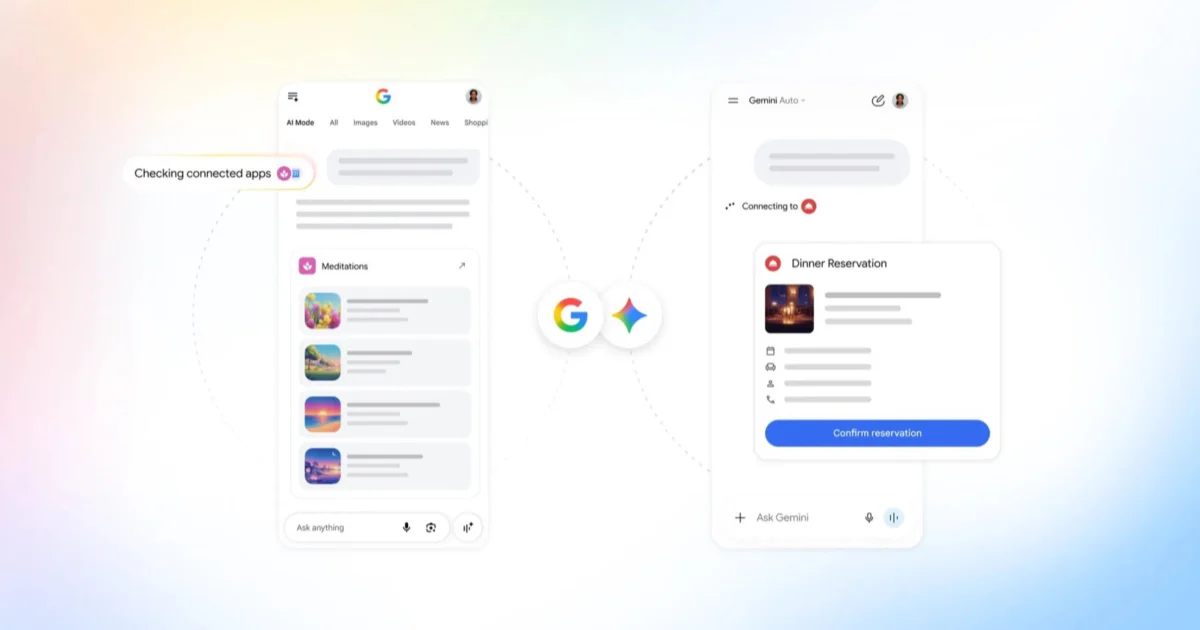
Google has officially transitioned its Connected Apps Platform into a public preview, marking a significant evolution in how generative AI interacts with the broader software ecosystem. Following an initial announcement on October 28, 2024, the tech giant is now inviting third-party developers to submit applications for integration, enabling their services to function directly within AI Mode in Google Search and the Gemini application. This move represents the formalization of a process that was previously opaque, providing a clear, policy-driven roadmap for developers to connect their tools with Google’s increasingly powerful AI models.
The Evolution of AI-Driven Utility
The integration of third-party applications into Google’s search experience is not a sudden pivot but rather the culmination of a deliberate, phased strategy. In July 2024, Google began testing "connected apps" within AI Mode, allowing users to perform tasks like meal planning via Instacart or music discovery through YouTube Music without leaving the search interface. At that time, however, the mechanism for inclusion was invitation-only, leaving the developer community without a standardized path for participation.
By opening the public preview, Google has provided the necessary technical documentation and infrastructure—specifically the Model Context Protocol (MCP) and Android MCP—to allow developers to build bridges between their own software and Google’s AI agents. Robby Stein, Vice President of Product for Google Search, confirmed the milestone via social media, signaling that the platform is ready for broader adoption. This expansion is designed to turn Google Search from a traditional information retrieval engine into a proactive agentic platform capable of executing complex, multi-step workflows.
Technical Architecture: How the Integration Works
For developers, the integration process is rooted in the Model Context Protocol (MCP). MCP acts as the standardized language that allows AI models to communicate with external tools, ensuring that the model understands precisely when and how to delegate a user’s request to a specific application. Google has outlined two primary pathways for integration:
- Remote MCP Servers: This is the primary method for web, Android, and iOS accessibility. Developers host a server that translates AI intents into actionable commands for their specific application.
- AppFunctions (Android MCP): Designed specifically for the Android ecosystem, this pathway allows deeper, native integration for Gemini users on mobile devices.
The registration process is facilitated through the Google Connected Console. Upon registration, developers must categorize their applications, a choice that dictates the minimum functional requirements and, crucially, cannot be modified after the application is live. Developers are also required to define a minimum of three distinct capabilities, which are then surfaced to users as a way to contextualize the app’s utility.
To maintain platform integrity, Google has implemented a rigorous review process. Developers are required to submit functional test accounts with representative sample data. If an application fails to demonstrate its described capabilities or presents technical friction that prevents Google’s review team from validating its performance, the submission is subject to rejection.
The Policy Framework and Guardrails
A significant portion of the platform’s documentation is dedicated to a strict developer policy aimed at preventing "model gaming." As AI agents become more prevalent, there is a risk that developers might attempt to manipulate the model’s decision-making process to ensure their app is selected over a competitor’s.
Google’s policy explicitly forbids any behavior that would "deceive or influence the model into performing an adverse action." This includes the use of overly broad, misleading, or promotional language in an app’s capability description. The policy also mandates that connected apps remain free of third-party advertisements or promotional materials from other companies. Failure to adhere to these guidelines can result in the immediate removal of the app from the platform or the suspension of the developer’s account.
This focus on transparency is a strategic attempt to ensure that user trust remains high. If the AI model consistently suggests irrelevant or deceptive apps, the utility of the AI-enhanced search experience would diminish rapidly. By enforcing strict instruction-based routing, Google aims to ensure that the model chooses the right tool for the right task based on objective capability mapping rather than marketing noise.
User Experience and the Current Landscape
On the consumer side, the interface is designed to balance automation with user control. When a user queries Google, the AI model may default to an application that the user has previously interacted with to complete a similar task. However, users retain the ability to override these suggestions, manually selecting from a list of available integrations or specifying a preferred app within their prompt.
Currently, the ecosystem is in its infancy, with over 50 applications live across Search and Gemini. The initial roster includes major consumer-facing brands such as Instacart, Canva, YouTube Music, Yahoo Fantasy Football, and Sleeper. For these companies, the integration provides a direct pipeline to users at the exact moment they are looking to solve a problem—such as finding a recipe and ordering groceries in one continuous flow.
Once an application is live, developers gain access to a dashboard providing analytics on traffic, latency, and error rates. This data is critical for refining the app’s performance, as the speed and reliability of the connection directly correlate to how often the AI model will choose that specific tool for a task.
Strategic Implications and Industry Outlook
The opening of this platform marks a turning point in the competitive landscape of generative AI. By creating a standardized way for third-party apps to integrate into its AI core, Google is effectively building a "super-app" architecture. This strategy creates a symbiotic relationship: developers gain unprecedented visibility and usage, while Google’s search experience becomes indispensable, shifting from a destination for links to a destination for outcomes.
Market analysts suggest that this model could challenge the traditional app store paradigm. If users can interact with software through a conversational interface, the need to download and manage dozens of individual apps may decrease, shifting the power dynamic toward the platform that controls the AI interface.
However, the rollout remains cautious. Google Search Advocate John Mueller noted that while the development is promising, the platform is "still extremely early." The gradual expansion, which includes plans to integrate apps from partners like Adobe, Experian, Localiza, Peloton, and Calm, suggests that Google is prioritizing quality and stability over rapid, uncontrolled scaling.
Looking Toward the Future
The next few months will be a period of significant testing for both Google and the developer community. As Google moves toward expanding the platform to more geographic markets and additional product integrations, the primary challenge will be maintaining the balance between a personalized, efficient experience and an open, competitive marketplace.
The upcoming integration of wellness app Calm into both Search and Gemini serves as a test case for how non-transactional services can exist within an AI-driven environment. As the technology matures, the ability of AI to accurately parse complex, multi-layered queries and route them to the appropriate third-party server will determine the success of the platform.
For now, the focus remains on building the foundation. By providing a clear, regulated, and technical framework for developers, Google is attempting to ensure that the future of search is not just about finding the right page, but about connecting users to the right software at the exact moment they need it. The success of this endeavor will depend on how effectively developers can translate their services into the language of AI, and how well Google can govern a space that is becoming increasingly automated and agent-driven. As the industry watches, the "Connected Apps" experiment will likely serve as a benchmark for how other major technology firms approach the integration of third-party software into their AI-driven future.