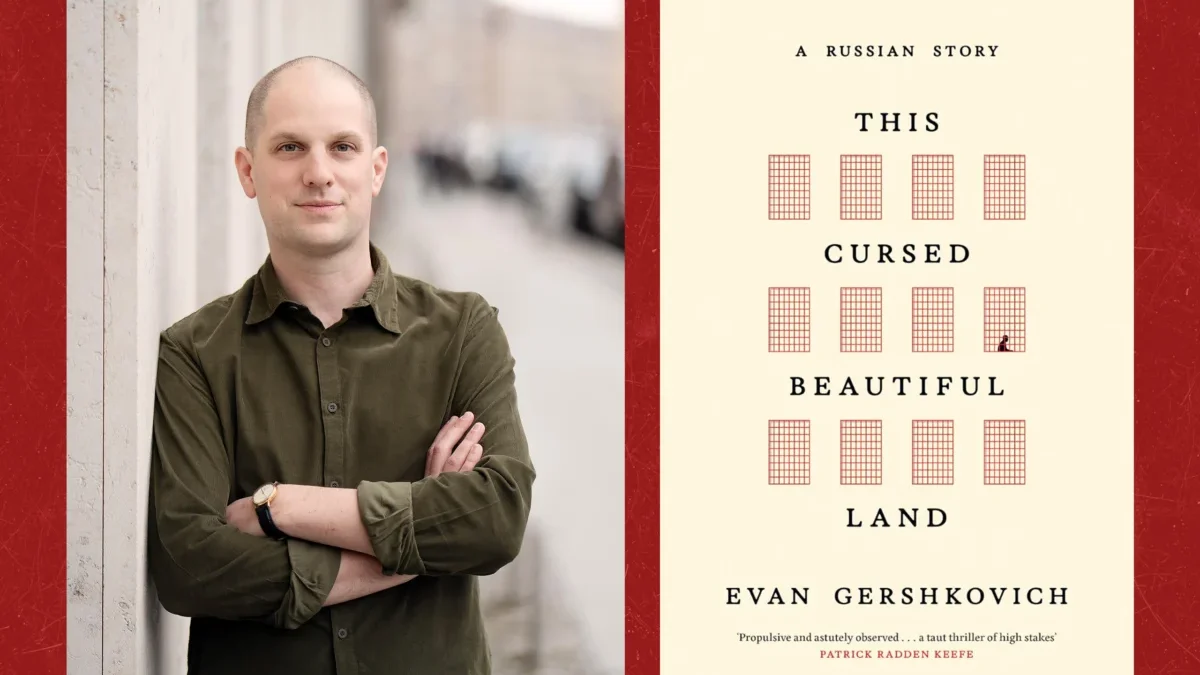
Evan Gershkovich’s new book, This Cursed Beautiful Land, opens in March 2023, more than a year after the escalation of the Russian invasion of Ukraine. Traveling to the industrial city of Yekaterinburg to report on Russia’s burgeoning arms industry, Gershkovich met a confidential source in a local steakhouse who handed over documents detailing Russian tank production. Before he could fully process the intelligence, the heavy thud of military boots echoed through the room. Federal Security Service (FSB) agents swarmed the table, slapped handcuffs on his wrists, pulled a sack over his head, and bundled him into a waiting van.
Inside the vehicle, he was pummeled with fists and interrogated about his employers. When Gershkovich blurted out that he worked for The Wall Street Journal, it was not the answer his captors wanted to hear. Charged with espionage, Gershkovich was transferred to Moscow’s notorious Lefortovo Prison. Two FSB agents who escorted him there joked sardonically that they worked for the Russian postal service, with one quipping that Gershkovich could easily start his future memoir with the dark joke.
A Familiar Genre with Unique Stakes
This Cursed Beautiful Land fits squarely into the sobering, densely populated literary genre of the journalist hostage memoir. Following a dramatic, high-stakes opening, the book details Gershkovich’s upbringing as the son of Russian-speaking immigrants in Princeton, New Jersey, his relocation to Moscow, and his early journalism career with the English-language Moscow Times. The memoir chronologically tracks his arrest, his harrowing months inside a maximum-security Russian prison, his eventual release, and his painstaking psychological recovery.
Yet, Gershkovich’s ordeal occupies a distinct historical and geopolitical space. He was the first American journalist imprisoned on espionage charges in Russia in nearly fifty years, a grim milestone that harkens back to the height of the Cold War. Despite the oppressive environment, his professional instincts remained intact. "I get to see the system from the inside," Gershkovich writes. "I’m a reporter after all—a voyeur—and this is the ultimate voyeurism."
The book transcends a standard survival narrative by using unprecedented access to examine the machinery of the modern Russian state. Gershkovich documents interactions with prison guards, intelligence officers, and inmates alike, offering a sociological view of individuals constrained by an autocratic regime. "It’s a captivity memoir," Gershkovich noted in an interview. "लेकिन it’s also about memorializing another autocratic turn in Russian history."
Daily Life in Lefortovo and the Craft of Survival
Inside his cell, Gershkovich forged a complex relationship with his surroundings. He bonded briefly with an FSB agent over a shared passion for soccer, though the guard laughed off inquiries about the official FSB league team. His primary cellmate, Seryoga, an inmate who had pleaded guilty to producing illegal weapons, schooled the American reporter on the unwritten codes of Russian prison life, including sanitation protocols and cell etiquette.
When Seryoga’s mother passed away, Gershkovich offered a compassionate embrace and encouraged him to weep—an offer the hardened inmate declined. Gershkovich adopted a similar emotional armor for himself. "I hadn’t allowed myself to cry," he writes, noting that surrendering to grief felt like a threat to his psychological survival. "I felt that if I did, I would break down, so I had to stay tough, keeping all my emotions pent up."
Gershkovich maintained his sanity through rigorous intellectual labor. Filling three dense journals, he consumed historical texts, studies of the Russian penal system, and political analyses acquired from the prison’s surprisingly uncensored library, supplemented by books smuggled in by friends. He scoured daily newspapers and drafted clandestine messages on blank sheets of paper destined for his legal counsel. His bunk transformed into a makeshift newsroom, anchored by a heavy Russian-English dictionary serving as his desk.
Compared to other modern political prisoners, Gershkovich acknowledged his treatment was deliberately preserved for diplomatic leverage. Reflecting on the fate of Viktoriia Roshchyna, a Ukrainian journalist allegedly tortured to death in captivity, Gershkovich observed, "I was taken specifically for a swap as a valuable hostage to be kept pristine." Aside from the violence of his initial arrest, he received regular meals, baseline medical care, and daily outdoor exercise access.
High-Stakes Diplomacy and the Prisoner Swap
Gershkovich’s imprisonment ended through a complex, multi-nation diplomatic exchange orchestrated by the United States, European allies, and Russia. The August 2024 swap freed Gershkovich alongside fellow American Paul Whelan and several prominent Russian dissidents. In exchange, Western nations released eight Russian intelligence operatives and assassins held across multiple countries. Among them was Vadim Krasikov, a high-ranking FSB hitman serving a life sentence in Germany for the targeted assassination of a Chechen-Georgian dissident in Berlin.
Despite his release, Gershkovich remained haunted by a lingering question: Did the operatives who orchestrated his entrapment genuinely believe he was a spy?
The final chapters of This Cursed Beautiful Land return to investigative reporting. Gershkovich uncovers evidence that the FSB meticulously constructed his arrest to create high-value barter material, convincing President Vladimir Putin of his guilt. This narrative was repeated by Putin himself during an interview with American television host Tucker Carlson in February 2024. Ultimately, Gershkovich’s captors—from low-level guards to high-ranking officials—viewed him as a pawn, though personal animosity was notably absent.
The Evolution of Hostage Diplomacy and Journalist Memoirs
The modern history of journalist captivity memoirs traces back to the Cold War and geopolitical flashpoints of the late 20th century. In 1981, Jacobo Timerman published Prisoner Without a Name, Cell Without a Number, detailing his forced disappearance and torture by the military junta in Argentina. Timerman’s work exposed the brutal repression of a fascist regime and catalyzed the modern international human rights movement.
In 1985, Associated Press correspondent Terry Anderson was kidnapped by Hezbollah in Lebanon and held for nearly seven years. His 1993 bestselling memoir, Den of Lions, generated immense international fallout, effectively forcing militant groups to reconsider the tactical viability of holding Western journalists hostage.
However, the post-9/11 security landscape upended those calculations. The 2002 kidnapping and murder of Wall Street Journal reporter Daniel Pearl by Al Qaeda militants in Pakistan introduced a grim precedent: Western journalists were increasingly targeted for ideological terror and public execution. This era saw a wave of abductions in Iraq, Afghanistan, and Somalia, inspiring harrowing accounts such as A Rope and a Prayer by former New York Times reporter David Rohde, who escaped Taliban captivity in 2008.
As traditional terrorist networks fractured over the past decade, the threat landscape shifted dramatically toward state-sponsored hostage-taking, often dubbed "hostage diplomacy." Authoritarian governments in nations like Iran increasingly relied on the wrongful detention of foreign nationals to extract financial and political concessions from Western democracies.
Among the notable narratives of this era is that of Jason Rezaian, former Tehran bureau chief for The Washington Post, who was detained by Iranian authorities alongside his wife in 2014. Rezaian’s memoir, Prisoner, chronicled 544 days of isolation, culminating in a diplomatic release engineered during the Obama administration. Because Iranian captors denied Rezaian writing materials, he relied entirely on post-release reporting to reconstruct his experience, aiming to reclaim his own narrative from media speculation.
Similarly, Michael Scott Moore spent nearly three years in captivity after being abducted by Somali pirates in 2012, an ordeal chronicled in The Desert and the Sea. Discussing the psychological toll of recovery with Gershkovich in Berlin in 2025, Moore emphasized that healing requires active cultivation of joy and human connection to counteract trauma.
Returning to the Newsroom
Months after returning to freedom, Gershkovich confronted the raw materials of his confinement. Settled in Berlin with his partner, Masha, he opened his smuggled journals for the first time. The notebooks induced a trancelike state of heavy weeping, unlocking years of pent-up emotion. "I’m forcing myself to read them," he reflected. "Then I’m forcing myself to write. And with time, it gets easier."
Modeled stylistically after George Orwell’s Homage to Catalonia, Gershkovich’s book aims to stand as a historical document rather than a conventional trauma narrative. By contextualizing his detention within the broader arc of Russian autocracy, he seeks to contribute a rigorous journalistic analysis of state-sponsored repression.
With the manuscript completed, Gershkovich has turned the page on his captivity. Rather than stepping away from the spotlight, he has returned to active reporting for The Wall Street Journal, maintaining that public figures at the center of major historical events have a duty to remain accessible.
"I believe that it’s important for people who are at the center of big news events to answer questions and be available," Gershkovich said. For him, publishing the book marks the final chapter of a dark interruption—paving the way for a return to ordinary journalistic life.