Artificial intelligence has rapidly evolved from an experimental novelty into an indispensable utility for corporate marketing divisions. Recent industry data indicates that approximately 98 percent of marketing teams currently integrate some form of AI into their daily workflows, utilizing machine learning to streamline operations ranging from social media scheduling to rigorous campaign analysis. Despite this widespread adoption, a persistent challenge has remained: large language models (LLMs) traditionally operate in a vacuum, lacking direct visibility into enterprise customer relationship management (CRM) systems. To bridge this operational gap, technology platforms have increasingly turned to specialized integrations that unite advanced language models with unified customer databases.
The integration between Anthropic’s Claude AI and the HubSpot Smart CRM represents a significant milestone in this technological convergence. By embedding real-time CRM data directly into conversational AI sessions, the HubSpot connector for Claude allows marketers to transition from manual data extraction to dynamic, data-driven automation. This development addresses a fundamental limitation of standard generative AI tools: their historical reliance on static, manually copied datasets that quickly become outdated.
Background and Technological Evolution

The integration of generative AI into marketing historically required tedious workarounds, such as exporting customer metrics into spreadsheets, manually scrubbing sensitive information, and pasting text blocks into external chat interfaces. While effective for isolated drafting tasks, these disconnected workflows inherently limited the analytical scope of AI assistants. Marketers could not query an AI about proprietary conversion pipelines or customer support ticket trends without manually assembling the underlying data first.
The introduction of native connectors fundamentally alters this dynamic by establishing secure, bidirectional communication channels between AI platforms and unified CRMs. Operating beneath core enterprise modules like Marketing Hub and Sales Hub, the HubSpot Smart CRM acts as a centralized repository for customer interactions, deal stages, and campaign attribution metrics. When linked with Claude, the AI assistant gains read and write capabilities mapped directly to an individual user’s specific access rights and permissions.
Functionality and Setup Protocols
Implementing the HubSpot connector for Claude requires a structured administrative workflow designed to maintain data security and regulatory compliance. The integration is accessible to users with active HubSpot accounts—ranging from free tiers to enterprise editions—coupled with a paid Claude subscription plan, such as Pro, Team, or Enterprise.

Administrative governance is built directly into the deployment process. While super administrators and individuals with specific App Marketplace permissions can establish the connection immediately, standard users require formal authorization before accessing CRM data through the AI interface. Furthermore, security protocols dictate that write operations within HubSpot—such as updating deal stages or creating follow-up tasks—should be configured to require explicit user approval. Every automated action executed by the AI is meticulously logged within HubSpot’s centralized audit trail, ensuring full transparency and accountability for team leads.
Once activated, the connector enables marketers to execute complex, multi-step operations via simple conversational prompts. Rather than navigating multiple dashboards to aggregate performance statistics, a user can instruct Claude to evaluate campaign metrics, analyze customer feedback, or draft personalized follow-up sequences using live account data.
Practical Applications in Modern Marketing Workflows
The convergence of Claude AI and HubSpot data impacts four primary pillars of modern marketing operations: campaign analysis, content creation, audience personalization, and administrative task management.

In the realm of campaign and performance analysis, the integration allows marketers to evaluate high-level strategic outcomes alongside granular engagement metrics. Instead of reviewing vanity metrics in isolation, teams can prompt Claude to correlate email open rates and click-through statistics with actual attributed revenue and closed-won deals. The AI can process these requests to generate structured summaries, comparative tables, and even visual charts that highlight behavioral trends within specific customer segments.
Content generation also benefits significantly from contextual CRM awareness. When drafting landing pages, website copy, or email sequences, Claude can analyze historical top-performing assets to replicate successful tonal patterns and messaging structures. Additionally, by reviewing recent interactions logged in help desk queues and chat transcripts, the AI can synthesize recurring customer pain points and objections in the buyer’s own vocabulary. This qualitative data can then be leveraged to ideate targeted blog headlines, SEO-optimized meta descriptions, and conversion-focused email campaigns.
Implications and Strategic Governance
While the efficiency gains associated with connected AI workflows are substantial, industry analysts emphasize the necessity of rigorous internal governance. Because generative AI models are inherently probabilistic, their outputs can occasionally contain inaccuracies or misinterpret complex data sets. Consequently, leading marketing organizations are establishing standardized review protocols before publishing AI-generated content or executing automated CRM updates.

Effective governance frameworks typically incorporate four key controls:
- Mandatory peer or managerial reviews for shared AI prompts and custom skills.
- Strict terminology standards to ensure brand consistency and regulatory compliance across all generated collateral.
- Granular access controls that limit connector permissions based on employee roles and data sensitivity requirements.
- Continuous measurement of operational efficiency metrics alongside traditional pipeline contribution indicators.
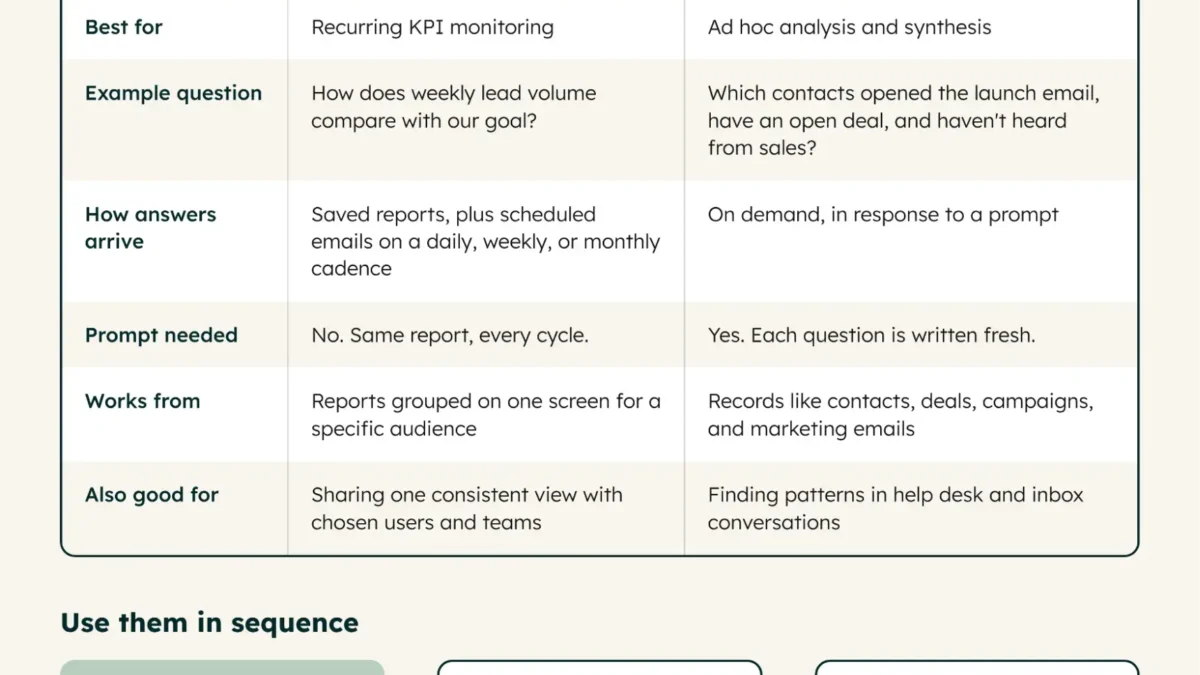
Furthermore, digital strategists emphasize that conversational AI is not a universal replacement for structured business intelligence tools. While Claude excels at handling ad-hoc, multi-condition queries and unstructured text analysis, fixed-cadence key performance indicator (KPI) monitoring remains best suited for traditional dashboards and automated reporting suites. Dashboards provide a reliable, prompt-free mechanism for tracking recurring metrics such as weekly lead volume and monthly pipeline generation, ensuring that baseline performance data remains immediately accessible to executive stakeholders.
Broader Market Impact
The widespread deployment of integrated AI-CRM architectures signals a broader maturation of enterprise technology. As businesses accumulate vast quantities of customer data, the primary competitive advantage no longer lies merely in data collection, but in the speed and intelligence with which that data can be operationalized.

By combining the natural language processing capabilities of advanced models like Claude with the structured relational architecture of platforms like HubSpot, organizations are steadily moving toward a more agile, agentic operational model. As these integrations continue to evolve, marketing teams are expected to increasingly rely on automated workflows that harmonize human strategic oversight with machine-driven execution, ultimately transforming how brands engage with their target audiences in an increasingly competitive global marketplace.