Alphabet’s third-quarter financial results for 2026 paint a portrait of a maturing digital video titan that is successfully diversifying its revenue streams even as traditional advertising growth experiences a slight cooling phase. According to official reports released by parent company Alphabet, YouTube generated $11.2 billion in advertising revenue for the third quarter. While this figure reflects a healthy and massive commercial footprint, the year-over-year growth rate settled at 9%, down from the 13% growth clip reported in the second quarter of the year.
Despite the moderate deceleration in pure ad intake, YouTube’s overarching financial ecosystem is expanding rapidly. The platform is experiencing a dramatic upswing in subscription revenue, bolstered by massive migration patterns from traditional linear television to connected living rooms. Furthermore, aggressive integration of generative artificial intelligence tools within YouTube Studio and a sprawling new e-commerce partnership with retail giant Amazon are redefining how creators monetize content. Industry analysts are closely monitoring these shifts, recognizing that YouTube’s strategic pivot toward subscriptions and commerce could insulate the platform from broader macroeconomic advertising fluctuations.
The Financial Trajectory: Q3 2026 Ad Performance in Context
To fully understand YouTube’s Q3 2026 performance, market observers must look at the broader trajectory of the digital advertising economy. For years, YouTube served as the undisputed engine of hyper-growth within Alphabet’s portfolio. However, as the digital video market reaches saturation points in core Western demographics, quarter-over-quarter percentage growth naturally encounters a law of large numbers.
The 9% year-over-year increase, bringing the quarterly ad total to $11.2 billion, is indicative of a stable yet tempering market. Advertising industry experts note that while brand spending remains robust—particularly among small and medium-sized businesses (SMBs) utilizing Google’s Demand Gen products—advertisers are increasingly demanding hyper-targeted efficiency. In response, YouTube has leaned heavily into advanced machine learning algorithms and AI-driven ad placement tools to maximize return on investment for brands.
The slight cooling in ad revenue growth is not viewed as a structural weakness, but rather as a transition period. As ad growth settles into a sustainable rhythm, YouTube’s non-advertising pillars—specifically paid subscriptions and transaction-based creator tools—are picking up the slack and driving overall enterprise valuation higher.
Chronology of Growth: From 100 Million to 150 Million Subscribers
The crown jewel of YouTube’s non-advertising expansion is its subscription business, which encompasses YouTube Music and YouTube Premium. Alphabet’s Q3 data revealed that combined subscribers for these services have officially crossed the 150 million mark, a monumental milestone that directly contributed to an 11% increase in Google’s overall subscription revenue for the period.
This milestone represents a blistering pace of customer acquisition. In early 2024, YouTube proudly announced that its paid subscription tiers had cleared the 100 million threshold. Scaling from 100 million to 150 million paying users in roughly two and a half years underscores the platform’s ability to convert ad-weary free viewers into loyal, paying subscribers.
Market researchers attribute this surge to a concerted push into bundled offerings, localized pricing strategies, and an aggressive crackdown on ad-blockers that encouraged users to cross the paywall for an uninterrupted viewing experience. As streaming fatigue sets in across the broader media landscape—with consumers growing weary of managing dozens of disparate subscription services—YouTube’s dual-value proposition of music streaming combined with ad-free long-form video has established itself as an essential digital utility.
The Living Room Revolution and Connected TV Dominance
Much of the fuel driving both subscription sign-ups and advertising resilience can be traced to the living room. During Alphabet’s second-quarter earnings call in July, executives highlighted a profound behavioral shift: an accelerating migration of viewers watching YouTube content on connected TV (CTV) devices as a direct, superior alternative to traditional cable and broadcast television.
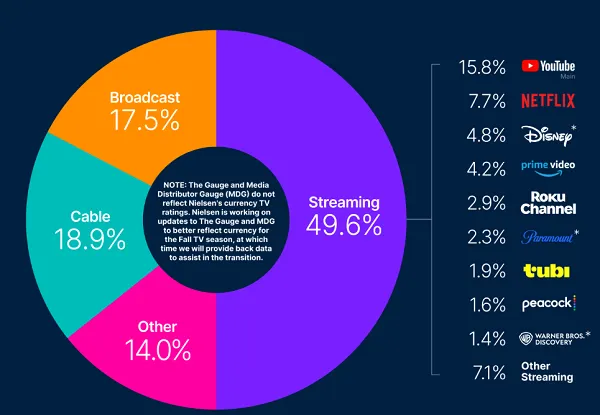
This trend was quantitatively validated by Nielsen’s authoritative "The Gauge" report for August 2026, which cemented YouTube’s position as the absolute top streaming television platform in the United States. No longer confined to mobile phones and desktop computers, YouTube has successfully captured the premier real estate in the American household: the living room television screen.
During the subsequent Q3 earnings call, Google Chief Business Officer Philipp Schindler elaborated on the commercial significance of this shift. Schindler revealed that the "Living Room" connected TV experience has transcended mere viewership to become a primary financial driver, accounting for more than one-third of YouTube’s total advertising revenue.

Because connected TV ads command higher CPMs (cost per thousand impressions) similar to traditional television upfronts, this shift allows YouTube to capture premium brand budgets that historically went to terrestrial networks. Furthermore, executives noted a sharp spike in Premium subscription sign-ups originating directly from connected TV interfaces, proving that the living room audience is uniquely willing to pay to eliminate commercial interruptions on the big screen.
Empowering the Creator Economy: E-Commerce and the Amazon Partnership
Beyond subscriptions and living room ads, YouTube is aggressively widening the aperture for creator monetization, transforming its platform from a passive media repository into a dynamic commercial marketplace.
Alphabet reported that YouTube’s Partner Program now encompasses more than three million creators worldwide. To keep this massive workforce engaged and financially viable, the platform is doubling down on e-commerce integrations. More than 1.3 million channels are currently enrolled in YouTube’s shopping program, allowing creators to seamlessly tag products featured in their videos, Shorts, and live streams.
The most consequential development in this strategy is YouTube’s newly minted affiliate partnership with Amazon. Rolled out to U.S.-based creators, this landmark agreement allows channels to directly tag and link Amazon products within their content. By bridging the gap between YouTube’s vast audience and Amazon’s unparalleled e-commerce fulfillment infrastructure, the partnership drastically reduces friction for impulse purchases. Viewers can now seamlessly buy items recommended by their favorite creators without leaving the viewing ecosystem, opening up lucrative new affiliate revenue streams for mid-tier and macro-creators alike.
Generative AI Integration: Revolutionizing Content Creation at Scale
As YouTube scales its commercial operations, it is simultaneously overhauling its technological backend using generative artificial intelligence. With over 20 million videos uploaded to the platform every single day, managing moderation, creative output, and ad targeting requires unprecedented computational power.
During the Q3 earnings disclosures, Philipp Schindler emphasized the transformative role AI is playing in lowering the barrier to entry for content creators. "We’re making creation easier with new generative AI tools in YouTube Studio, plus a conversational editing assistant in Shorts and YouTube Create," Schindler stated.
This rollout builds upon a series of aggressive AI product deployments throughout the year. In March, YouTube introduced an AI-powered "reimagine" option for Shorts, enabling viewers to generate entirely alternative video clips based on existing creator content. This was followed by testing of an "Extend with AI" feature, which allows creators to synthesize alternative video endings seamlessly.
These features are rapidly shifting from novelty experiments to core creation habits. A comprehensive report published by YouTube last week revealed that 61% of individuals who have published videos on the app over the past 12 months expressed active interest in utilizing AI tools to manipulate or insert themselves into video content. While digital watchdogs frequently express concern over the proliferation of low-quality "AI slop," YouTube’s internal metrics indicate that user-facing generative tools are overwhelmingly welcomed by the creator community as legitimate productivity multipliers.
Broader Implications and Market Outlook
The financial and operational disclosures from Alphabet’s Q3 2026 report signal a critical evolutionary phase for YouTube. The platform is successfully navigating the transition from a pure-play digital video site into a diversified media conglomerate encompassing subscription services, connected television dominance, social commerce, and artificial intelligence infrastructure.
While the 9% growth rate in ad revenue indicates that the era of explosive, unchecked digital advertising expansion has leveled off into a mature phase, the counterbalancing momentum in subscriptions and living room monetization proves that YouTube’s business model is remarkably resilient. By securing a dominant foothold in the American household television market, aligning with e-commerce giants like Amazon, and democratizing sophisticated production tools via generative AI, YouTube has fortified its competitive moat against emerging short-form competitors.
As Alphabet looks toward the final quarter of 2026 and into the future, the company’s ability to harmonize automated ad targeting with creator-friendly commerce will dictate its financial ceiling. For now, the data confirms that YouTube is not merely surviving the shifting media landscape—it is actively orchestrating it.