The U.S. economy currently stands as the defining issue for voters heading into the midterm elections, with the fiscal strain of energy costs weighing heavily on the American electorate. According to a comprehensive survey conducted by the Pew Research Center, nearly three-quarters of U.S. adults (74%) report being "very concerned" about the price of gasoline and energy. This figure represents a significant escalation in public anxiety, rising from 60% in July and a more moderate 43% in January. As voters prepare to cast their ballots, the volatility of fuel markets has transformed into a critical political barometer.
This economic climate is not occurring in a vacuum. The current trajectory of gasoline and diesel prices is intrinsically linked to the ongoing U.S.-Iran military conflict, which has introduced significant supply-chain risks and geopolitical uncertainty into global oil markets. To understand the depth of this impact, one must look at the data provided by the U.S. Energy Information Administration (EIA), which tracks the national average price for regular unleaded gasoline.
In late February 2026, on the precipice of the initial military engagements, the national average for a gallon of regular unleaded gasoline hovered around $2.80. As the conflict intensified, global oil benchmarks surged, causing domestic prices to follow a sharp upward trend. By mid-May, the price had reached a painful peak of approximately $4.35 per gallon. While the market has seen minor fluctuations since, the price as of October 26, 2026, remained elevated at $4.12 per gallon—a staggering 47.4% increase from the February baseline. The impact on the transportation and logistics sectors has been even more severe. Highway diesel fuel, the lifeblood of the nation’s trucking and freight industries, saw an even more dramatic spike, rising from $3.81 in late February to $6.35 by late October, representing a 66.8% increase.
Historical Context and the Inflation Factor
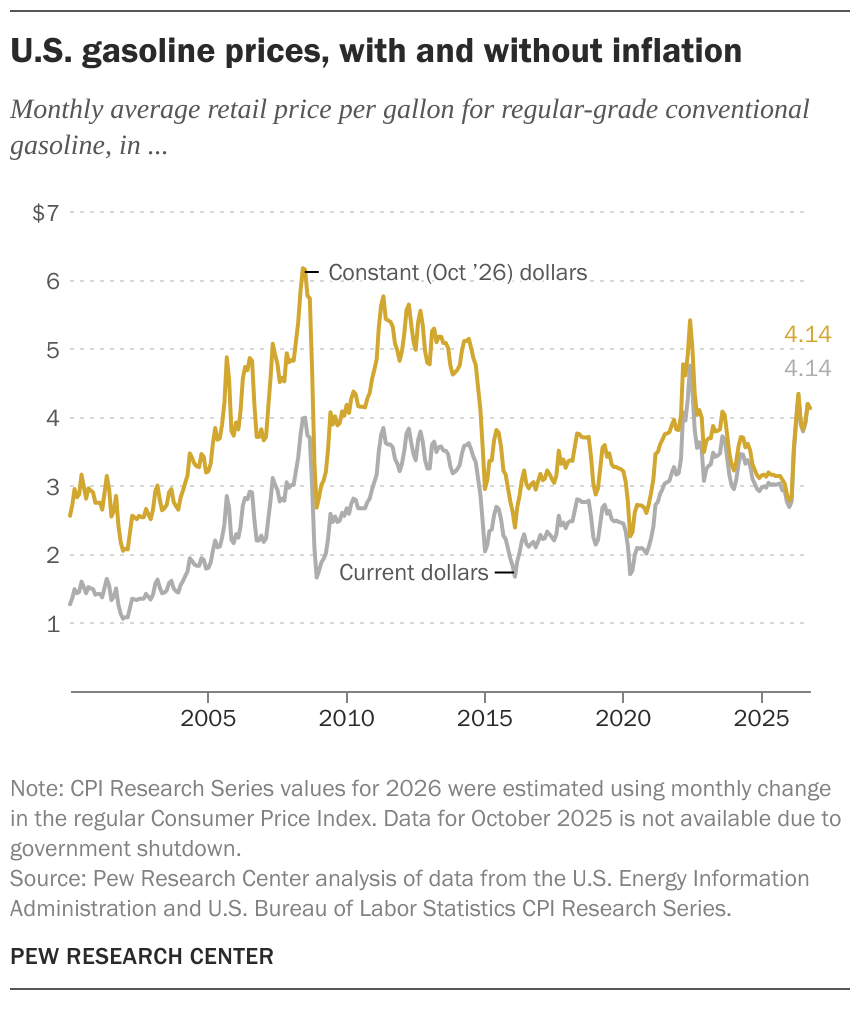
While these figures are undeniably high, a long-term analysis provides a necessary, if sobering, perspective. When adjusting for inflation—converting past prices into constant 2026 dollars—the current price hikes appear less historically unprecedented than they feel at the pump today.

Pew Research Center’s longitudinal analysis of data from the U.S. Energy Information Administration and the Bureau of Labor Statistics (using the Consumer Price Index Retroactive Series) indicates that the absolute peak of gasoline prices occurred in June 2008. In that month, the inflation-adjusted national average reached an equivalent of $6.18 per gallon. Similarly, diesel prices at that time hit a record high of $7.26 per gallon. That period was defined by the onset of the global financial crisis, which ultimately triggered a deep recession and a subsequent, rapid collapse in energy demand.
The current economic environment differs from 2008 in its causes, but the psychological and financial impact on the average household remains similar. The volatility seen in 2026 serves as a reminder of how susceptible the U.S. consumer is to global geopolitical shocks, regardless of domestic production capacities.
The Labor Cost of Fuel
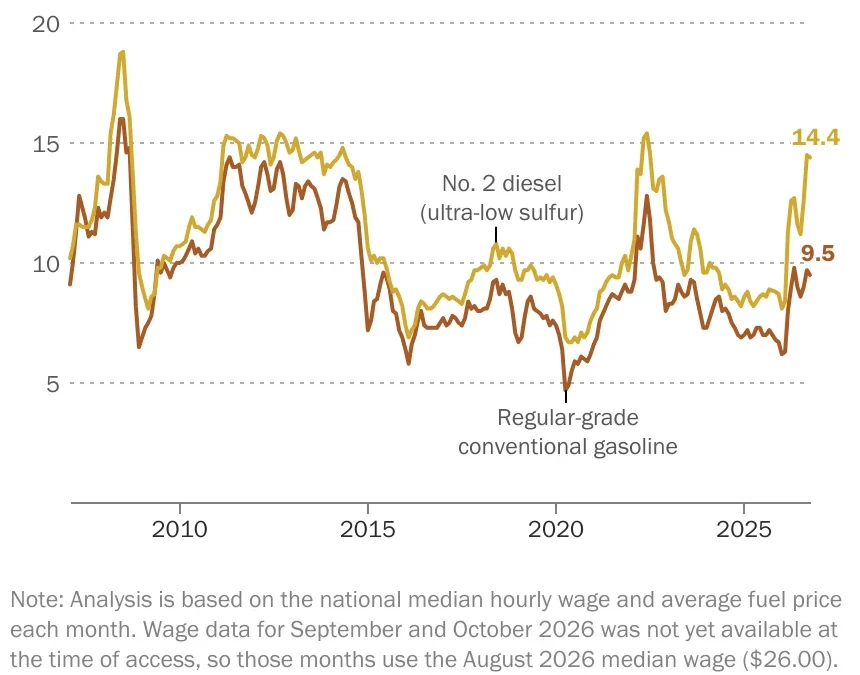
A more precise metric for understanding the burden of these costs is the amount of labor required to purchase fuel. By calculating the number of minutes an average American must work at the median hourly wage to afford one gallon of gasoline, economists can strip away the distortion of raw dollar figures.
In October 2026, an average worker needed to clock approximately 9.5 minutes of labor to earn enough to buy one gallon of regular-grade, conventional gasoline, based on a national median wage of $26 per hour. This is a sharp rise from February 2026, when only 6.3 minutes of work were required. However, this is still below the record set in July 2008, when the typical American had to work for 16 minutes to afford the same volume of fuel.
The lowest point in this labor-cost metric occurred in April 2020. During the depths of the COVID-19 pandemic, when global lockdowns effectively brought travel and commerce to a standstill, the precipitous drop in demand resulted in prices so low that a gallon of gas could be earned with just 4.7 minutes of work. This extreme fluctuation illustrates how drastically exogenous events—from global pandemics to international conflicts—can alter the accessibility of essential energy resources.
The Disparity of Regional Pricing
While the national average provides a broad overview, it masks the extreme regional disparities that define the American fuel market. The United States is not a single, monolithic market; rather, it is a collection of regional hubs governed by localized infrastructure, environmental regulations, and distribution costs.
The Gulf Coast, which serves as the epicenter of U.S. petroleum refining and storage, consistently enjoys the lowest prices in the nation. In October 2026, residents in the Gulf region saw prices average roughly $3.86 per gallon. In stark contrast, the West Coast—and California in particular—consistently faces the highest costs. By late October 2026, the average price in California reached nearly $5.89 per gallon.
The California Energy Commission identifies several key drivers for this persistent premium:
- Environmental Standards: California maintains the most stringent fuel emission standards in the country, necessitating the production of specific "reformulated" gasoline blends that are more expensive to manufacture than those used in other states.
- Geographic Isolation: The state’s relative geographic isolation from major mid-continent pipelines forces it to rely on local refineries or expensive imports.
- Taxation: High state-level excise taxes on motor fuel contribute significantly to the total cost per gallon at the pump.
The Widening Gap Between Fuel Varieties
The market for gasoline is further complicated by the divergence in pricing between different grades and formulations. Historically, the price difference between regular, midgrade, and premium gasoline was relatively stable. Since 1994, the gap between regular and premium has widened significantly, particularly following 2007. By October 2026, the average cost of premium fuel was nearly 92 cents higher than regular-grade gasoline.
Furthermore, the implementation of "reformulated" gasoline, designed to reduce smog and volatile organic compound emissions in major urban areas, has created another layer of price disparity. These blends are mandated in regions such as the Northeastern seaboard and California. The price gap between conventional and reformulated gasoline has expanded rapidly over the last three decades. In 1996, the difference was a mere 3 cents per gallon. By 2026, that spread had grown to 62.6 cents, reflecting the rising costs of environmental compliance and refined production technologies.

Implications for the Future
The current economic landscape presents a challenging environment for policymakers. The interplay between the U.S.-Iran conflict and energy prices demonstrates the precarious nature of the global oil supply chain. For the administration and energy regulators, the challenge lies in balancing the immediate need for lower prices to ease voter anxiety with the long-term goals of energy security and environmental sustainability.
The data suggests that while we are not currently at the record-high inflation-adjusted costs seen in 2008, the velocity of the price increase in 2026 has been jarring for the average American household. The economic implications are far-reaching: higher fuel costs permeate the entire supply chain, contributing to broader inflationary pressures on food, shipping, and consumer goods. As the midterm elections approach, the ability of candidates to address these systemic energy issues will likely determine the outcome in many districts.
Ultimately, the 2026 fuel crisis highlights the vulnerability of the modern economy to international instability. Whether these prices will subside as the geopolitical situation potentially stabilizes, or whether they represent a new floor for energy costs, remains the subject of intense debate among market analysts and federal policymakers alike. As the year draws to a close, the focus for many Americans remains fixed on the pump, where the intersection of global politics and household economics is felt most acutely.