The digital public square has officially become the primary newsroom for a majority of the United States. According to a comprehensive report published by Pew Research Center, more than half of all American adults now turn to social media platforms as a core source of news and current events. This milestone underscores a profound transformation in how society consumes journalism, engages with civic discourse, and stays informed about matters of national and global importance.
However, this reliance brings to the forefront a complex web of challenges. As social networks exert unprecedented influence over the flow of information, they have also become ground zero in high-stakes battles over content moderation, government oversight, corporate responsibility, and the fundamental definition of free speech in a digital age.
The Rising Dominance of Social Media in Daily News Consumption
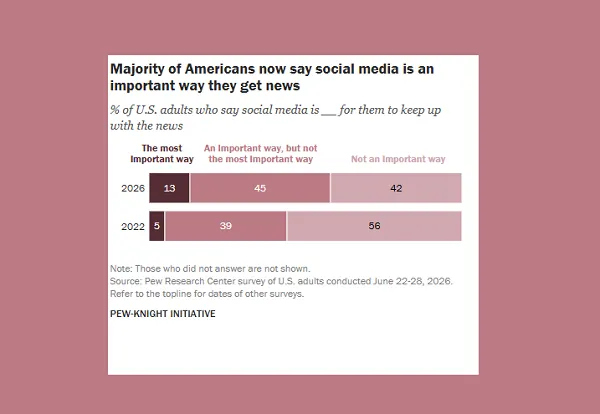
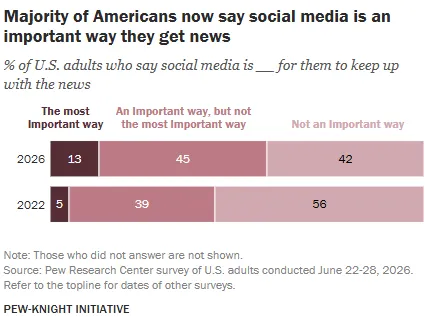
The Pew Research Center report, based on a nationwide survey of more than 3,500 U.S. adults conducted earlier in the year, highlights a sharp upward trajectory in digital news habits. Data indicates that 58% of Americans currently view social media as an important connector to current events. Within that group, 13% of respondents identify social media applications as their single most important source of news and information.
When applied to the broader U.S. adult population—estimated by the Annie E. Casey Foundation to be approximately 270 million people—these percentages reveal that roughly 35 million Americans rely on social platforms as their primary gateway to understanding the world. This represents a substantial increase from a similar Pew study conducted in 2022. At that time, only 43% of U.S. adults considered social media an important news source, and merely 5% named it their primary resource.
This rapid shift indicates that traditional boundaries between interpersonal communication tools and institutional journalism have effectively dissolved. For millions of citizens, breaking news is no longer encountered first on the front page of a newspaper or during a nightly television broadcast, but rather through algorithmic feeds populated by a mix of professional journalists, independent creators, influencers, and peers.
A Timeline of Moderation, Oversight, and Ideological Shifts
The debate over how social media platforms police content—or fail to do so—has evolved dramatically over the past several years, driven by shifting corporate strategies and intense political scrutiny.
- 2021: Meta founder Mark Zuckerberg publicly acknowledged the inherent structural flaws of social media algorithms. In an extensive public statement, he noted that unmonitored platforms naturally incentivize sensationalist and provocative content, drawing parallels to tabloid journalism and warning that such engagement patterns risk polarizing public discourse.
- 2022: Billionaire entrepreneur Elon Musk acquired Twitter (subsequently rebranded as X), citing deep concerns that previous management teams had actively manipulated platform visibility to suppress specific political viewpoints and interfere with democratic processes. That same year, Pew Research established a baseline showing 43% of Americans relying on social apps for news.
- December 2025: U.S. Secretary of State Marco Rubio announced formal State Department actions targeting what the administration termed the "censorship-industrial complex." The initiative took aim at coordinated networks of activists and non-governmental entities accused of pressuring tech companies to demonetize, suppress, and censor conservative or dissenting American viewpoints.
- January 2026: In a significant reversal of his previous stance, Meta’s Mark Zuckerberg published a corporate update outlining a strategic pivot away from traditional third-party fact-checking. Announcing that Meta would embrace a philosophy of "more speech, fewer mistakes," the company deliberately relaxed several of its long-standing restrictions on controversial topics such as immigration, gender identity, and political discourse.
- October 2026: Pew Research published its landmark report proving that social media reliance had surged to 58%, cementing the platform’s role as an inescapable force in civic life just as major tech firms were loosening their grip on content curation.
The Mechanics of Engagement: Algorithms Versus Public Discourse
The core tension governing social media news consumption lies in the fundamental architecture of platform algorithms. Modern social networks are commercially engineered to maximize user engagement. Because human psychology consistently demonstrates a higher propensity to interact with emotionally charged, provocative, or controversial material, algorithms naturally reward these dynamics with greater visibility.
This phenomenon creates a dual-edged sword. On one hand, decentralized networks democratize information, allowing grassroots movements, marginalized voices, and breaking eyewitness accounts to bypass traditional media gatekeepers. On the other hand, the same mechanisms facilitate the rapid amplification of unverified claims, conspiracy theories, and polarizing rhetoric.
For years, technology executives wrestled with this paradox by implementing robust trust-and-safety teams, partnering with independent fact-checkers, and deploying automated filters to suppress borderline content. However, these efforts frequently drew fierce criticism from political figures and free-speech advocates who argued that content moderation had morphed into partisan censorship, disproportionately silencing mainstream or alternative viewpoints under the guise of public safety.
Government Intervention and the "Censorship-Industrial Complex"
As social media evolved into the de facto infrastructure for political communication, governments around the world recognized the immense geopolitical and domestic stakes involved. In the United States, concerns over alleged collusion between federal agencies and technology corporations coalesced into a powerful political narrative opposing government-influenced censorship.
The launch of the State Department’s initiative under Secretary of State Marco Rubio marked a watershed moment in official U.S. policy regarding digital platforms. By officially moving to combat what the administration defined as organized efforts to coerce private companies into silencing citizens, the federal government signaled that protecting open access to diverse viewpoints is a matter of national security and constitutional integrity.
Yet, this regulatory and ideological pushback leaves platforms in an unenviable position. If governments mandate absolute non-interference to protect free speech, platforms risk becoming vectors for unchecked disinformation that can destabilize elections and public health initiatives. Conversely, if tech companies aggressively moderate content to protect users from falsehoods, they risk accusations of bias, authoritarian overreach, and election interference.
The Strategic Pivot: Why Tech Leaders Changed Course
The recent decision by industry leaders—exemplified by Meta’s transition toward fewer content restrictions and a deprioritization of traditional fact-checking—reflects a broader philosophical retreat from corporate arbitration of truth.
Earlier in the decade, industry leaders like Zuckerberg warned that unmitigated sensationalism would inevitably degrade the quality of public life. However, mounting legal pressures, shifting political landscapes, antitrust scrutiny, and intense cultural pushback against corporate "paternalism" have forced a recalculation. By stepping back from active gatekeeping, major tech companies are effectively transferring the responsibility of discernment back to the individual user.
This shift creates a paradox identified by media analysts and sociologists alike. By Zuckerberg’s own previously established logic, relaxing content guardrails on sensitive and divisive topics will almost certainly amplify polarization and societal friction. Yet, platforms have chosen to accept this trade-off in exchange for operational neutrality and protection from allegations of ideological bias.
Broader Implications for the Future of News and Democracy
The reality that 35 million Americans—and a clear majority of the adult population—depend on social media for vital news carries profound implications for the future of democratic institutions and the journalism industry.
- Economic Pressures on Traditional Journalism: As social platforms capture an increasingly dominant share of audience attention, advertising revenue continues to migrate away from legacy print and broadcast organizations. This trend diminishes the financial sustainability of investigative journalism, which requires significant resources to verify facts and hold power to account.
- The Acceleration of Echo Chambers: Algorithmic curation ensures that users are frequently fed content that aligns with their pre-existing beliefs, reinforcing ideological silos and reducing exposure to nuanced, balanced reporting.
- Vulnerability to Foreign and Domestic Manipulation: Decentralized, lightly moderated platforms remain prime targets for state-sponsored actors and bad-faith domestic groups looking to sow discord, manipulate election outcomes, and erode trust in public institutions.
- The Burden of Media Literacy: With tech companies abdicating the role of primary arbiter of truth, the burden of verification shifts entirely to the consumer. Society faces an urgent educational imperative to improve digital and media literacy across all age demographics to ensure citizens possess the critical thinking skills needed to navigate an uncurated information ecosystem.
As social media solidifies its status as the backbone of modern communication, the fundamental question facing society is no longer whether digital platforms will shape the news, but rather how democratic societies can preserve the vital benefits of open expression without succumbing to the corrosive effects of unmanaged polarization. The path forward will require a delicate balance between safeguarding liberty and maintaining the shared baseline of truth required for a functioning republic.