The evolution of generative AI in software development has reached a critical juncture, as evidenced by the October 26 update to Google’s Android Bench. This standardized assessment, designed to evaluate the proficiency of large language models (LLMs) in the specific, nuanced domain of Android application development, has provided a stark look at the competitive hierarchy of current AI models. While developers have increasingly turned to AI to accelerate workflows and debug complex mobile architectures, the latest data suggests that not all models are created equal, with Google’s own flagship offering, Gemini 4 Argon, falling behind its primary competitors from OpenAI and Anthropic.
Understanding the Android Bench Framework
Introduced earlier this year, the Android Bench serves as a specialized barometer for the developer ecosystem. Unlike generic coding benchmarks that test general-purpose programming logic, Android Bench focuses on the unique constraints and best practices of the Android operating system. This includes adherence to modern Jetpack Compose standards, efficient memory management within the Android runtime, and the correct implementation of Material Design principles.
By incorporating specific Android-centric tasks—such as implementing lifecycle-aware components or integrating asynchronous Kotlin Coroutines—the benchmark offers a realistic simulation of the day-to-day challenges faced by mobile engineers. Google’s decision to include "average cost" as a key performance indicator in this latest update reflects a broader shift toward utility-focused development, where developers must weigh raw coding capability against the financial overhead of API consumption.
A New Hierarchy of AI Performance
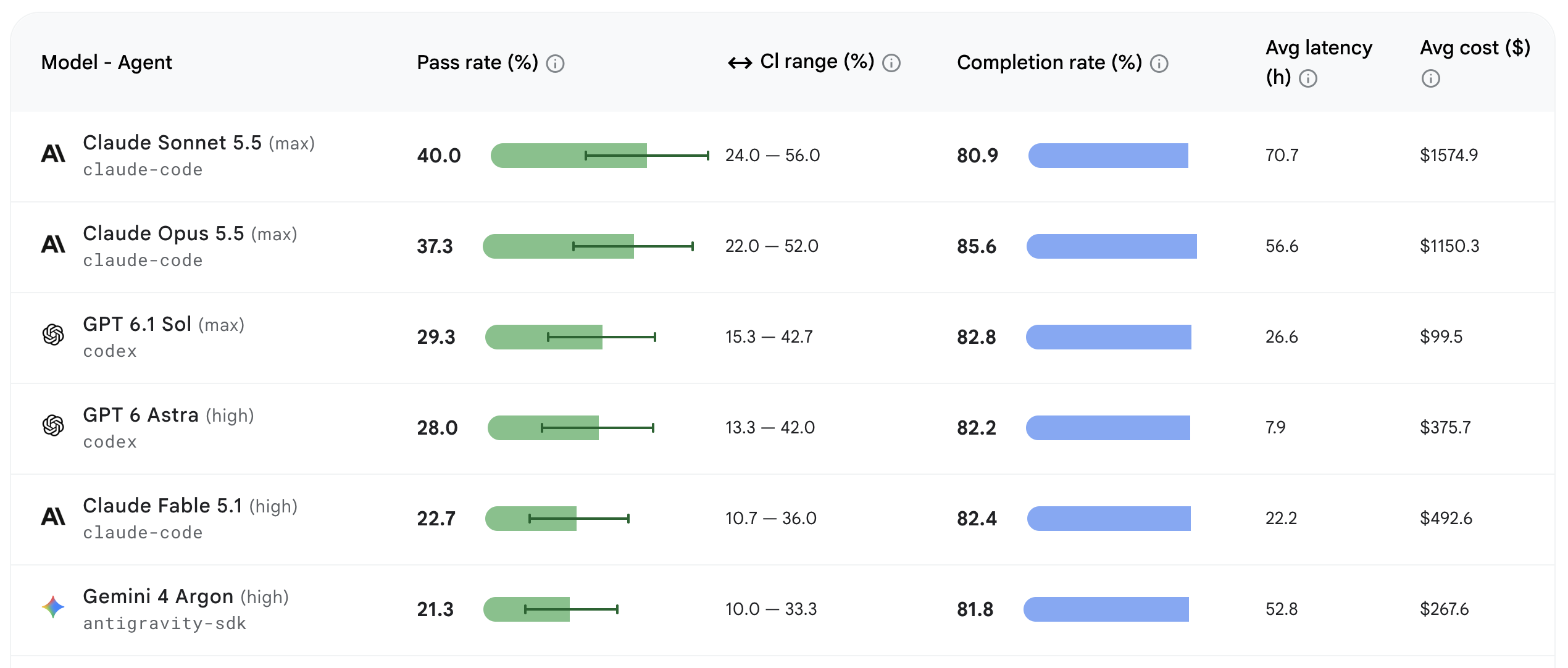
The October 26 update has significantly expanded the leaderboard, introducing several high-performing models that redefine current expectations. At the top of the performance chart sits Anthropic’s Claude Sonnet 5.5, which has secured a leading 40% pass rate. This metric indicates that the model successfully solves complex coding prompts without requiring human intervention in nearly half of all test cases, while simultaneously maintaining an impressive 80.9% completion rate.
Claude Opus 5.5, also from Anthropic and introduced earlier in October, holds the second position, solidifying the company’s current dominance in specialized coding tasks. However, the most significant disruption in the latest update comes from OpenAI’s GPT-6.1 Sol. While its 29.3% pass rate is lower than that of the leading Claude models, its completion rate of 82.8% is notably high. More importantly, its cost profile is dramatically lower. With an average operating cost of $99.50 per task compared to the $1,574.90 associated with the top-tier Claude performance, GPT-6.1 Sol presents a compelling value proposition for enterprise-scale development teams looking to optimize their operational budgets.
The Underwhelming Debut of Gemini 4 Argon
Perhaps the most scrutinized element of the latest update is the performance of Google’s own Gemini 4 Argon. Positioned as a premier model for the developer community, the model has debuted in fifth place, trailing behind Claude Fable 5.1. With a pass rate of just 21.3% and a completion rate of 81.8%, the model’s performance has raised questions regarding its readiness for professional-grade Android development.
The cost analysis further complicates the picture for Gemini 4 Argon. At an average cost of $267.70, the model occupies a difficult middle ground; it is significantly more expensive than the high-performing, cost-efficient GPT-6.1 Sol, yet it lacks the pass rate accuracy of the leading Claude models. This positioning has led to skepticism among industry analysts who expected Google to leverage its intimate knowledge of the Android codebase to produce a superior, vertically integrated tool.
Historical Context and Internal Challenges
The release of Gemini 4 Argon followed months of anticipation, yet it was shadowed by reports suggesting internal friction regarding the model’s capabilities. Shortly after the initial announcement of the Gemini 4 series in late September, anonymous internal sources indicated that the model faced difficulties in managing specific, high-complexity coding tasks. While Google leadership publicly maintained confidence in the model’s architecture, the empirical data provided by the Android Bench appears to align with these earlier reports of technical bottlenecks.
This timeline suggests a period of intense pressure within Google’s AI division to catch up to the rapid iteration cycles of competitors. Throughout 2026, the company has had to balance the need for public-facing innovation with the rigorous stability requirements of the Android platform, a balancing act that seems to have impacted the final output of the Argon iteration.
Implications for the Android Developer Ecosystem
The findings from the Android Bench have profound implications for how developers will approach AI-assisted coding in the coming year. As the gap between model performance and cost becomes more transparent, professional developers are likely to move away from "one-size-fits-all" AI tools. Instead, we can expect a bifurcated market:
- High-Accuracy Requirements: For mission-critical infrastructure, security-sensitive applications, and complex refactoring tasks, developers are gravitating toward the high-pass-rate models like Claude Sonnet 5.5, where the reduction in human debugging time justifies the higher financial cost.
- High-Volume/Low-Complexity Tasks: For routine boilerplate code generation, UI layout prototyping, and documentation drafting, the cost-efficiency of models like GPT-6.1 Sol becomes the primary driver for adoption.
The underperformance of Gemini 4 Argon also suggests that Google may need to pivot its strategy toward "reasoning levels"—a new metric added in the October update. This metric measures the model’s ability to perform multi-step logical planning before writing code. If Google can refine the reasoning capabilities of future Gemini iterations, it may be able to bridge the current performance gap. However, the current data serves as a clear signal that branding and integration alone are insufficient to command loyalty in a market that is increasingly dictated by measurable, reproducible output.

The Road Ahead for AI Benchmarking
Looking forward, the industry is closely watching how these models evolve. The inclusion of "reasoning level" data in the Android Bench is a sophisticated addition that acknowledges the complexity of modern software architecture. It suggests that future benchmarks will focus less on simple completion rates—which can often be achieved through basic syntax suggestions—and more on the ability of the model to maintain architectural integrity across large, multi-file projects.
As of late October 2026, the competitive landscape remains highly fluid. OpenAI and Anthropic continue to push the boundaries of performance, forcing Google to reconcile its role as both the steward of the Android ecosystem and a participant in the generative AI race. For the individual Android developer, the takeaway is clear: the utility of AI in the development workflow is maturing, but the necessity of testing and validating model outputs against standardized benchmarks has never been more critical.
The data presented by Google not only informs the developer community but also sets a standard for transparency in AI. By publishing these results, including the uncomfortable performance data of their own flagship model, Google is fostering an environment where performance, cost, and utility are the primary metrics for success. As the industry moves toward 2027, the ability of models like Gemini 4 Argon to improve through fine-tuning and updated training iterations will be the ultimate test of the company’s long-term commitment to AI-assisted mobile development. Whether Google can reclaim its position at the top of its own benchmark will be one of the most significant narratives in the technology sector for the remainder of the year.