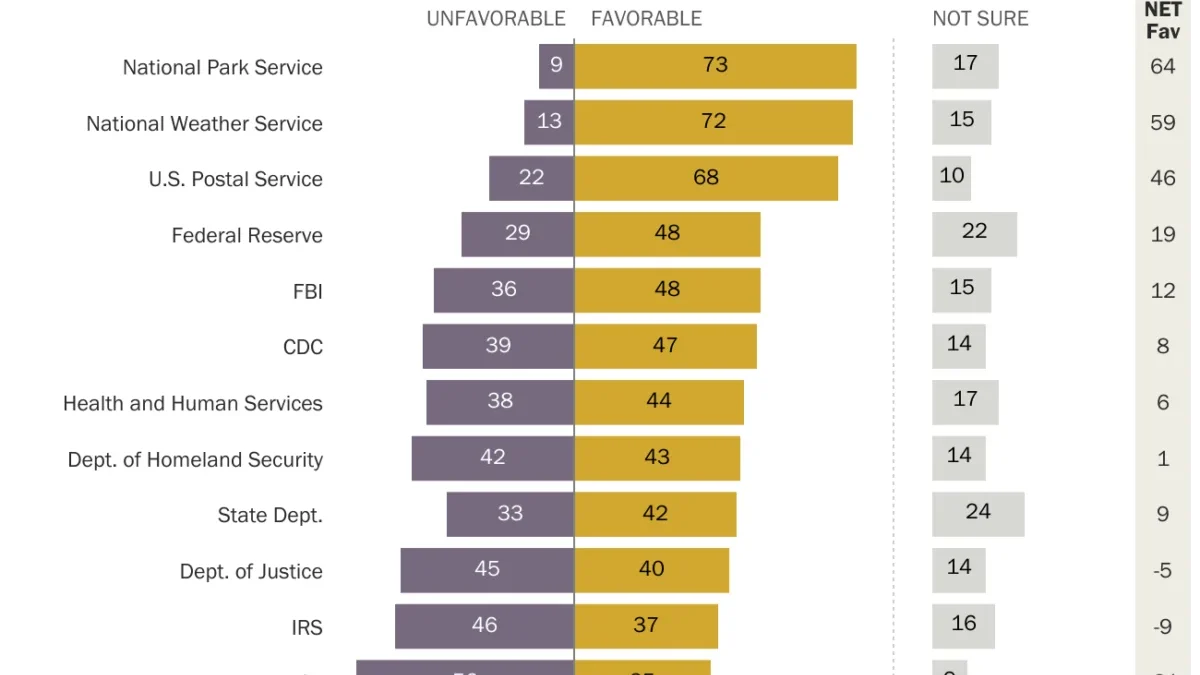
Public sentiment toward the federal government remains a complex tapestry of trust and skepticism, yet new data reveals that Americans maintain broad, cross-partisan support for several core agencies. According to a comprehensive survey of 5,062 U.S. adults conducted by the Pew Research Center between September 28 and October 4, 2026, the National Park Service, the National Weather Service, and the U.S. Postal Service stand out as the most popular fixtures of the federal apparatus. These entities continue to enjoy favorable ratings from two-thirds or more of the American public, regardless of political affiliation.

While these service-oriented agencies maintain high standing, the survey also highlights a deepening divide regarding the nation’s law enforcement and intelligence-related departments. This contrast illustrates a growing trend in American political life where public approval of government institutions is increasingly filtered through a partisan lens.
The Popularity of Service-Oriented Agencies
The National Park Service (NPS) commands the highest favorability among the 12 agencies evaluated in the study, with 73% of Americans expressing a positive opinion. The National Weather Service (NWS) follows closely with a 72% favorability rating, and the U.S. Postal Service (USPS) maintains a robust 68% favorable view.

These agencies share a common characteristic: they provide tangible, daily services that are largely perceived as non-political. The NPS manages the nation’s natural treasures and historical sites, the NWS provides essential data for public safety during weather emergencies, and the USPS acts as a fundamental link for commerce and communication. Because their missions are utilitarian rather than regulatory or ideological, they have largely avoided the intense polarization that currently defines public discourse surrounding other federal bodies.
Partisan Divergence on Law Enforcement and Intelligence
In stark contrast to the popularity of service agencies, institutions responsible for law enforcement, national security, and tax administration face significant partisan headwinds. The survey reveals that Immigration and Customs Enforcement (ICE) is currently the least popular agency among the group, with 56% of the public holding an unfavorable view.
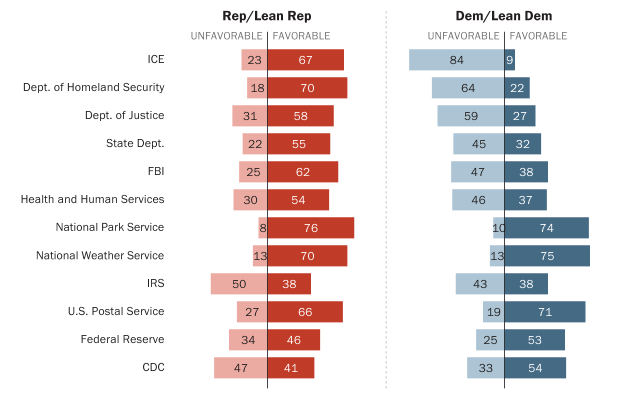
The partisan chasm surrounding ICE is profound. While 67% of Republicans and those who lean toward the party view ICE favorably, only 9% of Democrats and Democratic-leaning independents share that sentiment. This 58-point gap is emblematic of a broader trend in which Republicans and Democrats have moved to opposite poles regarding the Department of Homeland Security (DHS), the Department of Justice (DOJ), and the Federal Bureau of Investigation (FBI).
The DOJ, in particular, has seen a shift in its perception. Republicans have increasingly warmed to the department, with 58% now viewing it favorably—a significant increase from 51% just one year ago. Meanwhile, a majority of Democrats (59%) express a negative view, reflecting a persistent distrust that has remained largely unchanged over the past year.

Shifting Trends: A Chronology of Sentiment
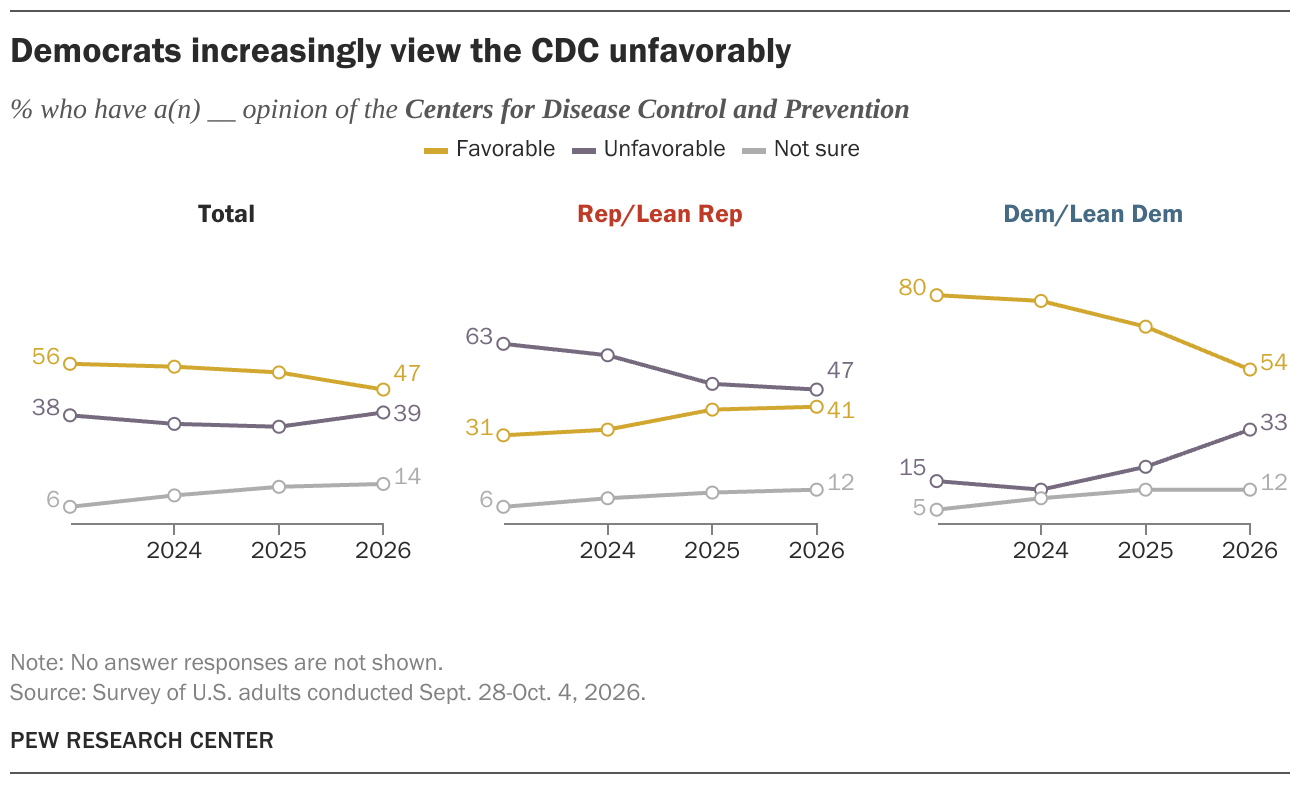
The 2026 data provides a clear snapshot of how these views have evolved over the last twelve months. The decline in favorability for agencies like the Centers for Disease Control and Prevention (CDC) and the Department of Health and Human Services (HHS) is particularly noteworthy.
Historically, the CDC enjoyed high levels of bipartisan support, but the current climate has seen that favorability erode, particularly among Democrats. While in 2025 roughly 69% of Democrats viewed the CDC positively, that number has dropped to 54% in 2026. Conversely, Republican views of the CDC have remained relatively stable, with 41% viewing it favorably compared to 40% a year prior.

The State Department has similarly experienced a shift. While Republican favorability remains steady at 55%, Democratic sentiment has grown more critical, with 45% now expressing an unfavorable view compared to 32% who view it favorably. This marks a departure from previous years where Democratic support for the diplomatic wing of the government was more consistent.
The Impact of Economic and Regulatory Agencies
Economic institutions such as the Federal Reserve and the Internal Revenue Service (IRS) also demonstrate the influence of the current political environment. The Federal Reserve, traditionally tasked with maintaining economic stability, has seen its favorability fluctuate. Currently, 48% of the public views the Fed favorably, though the partisan breakdown shows that 53% of Democrats view it positively compared to 46% of Republicans.

The IRS continues to struggle with low overall popularity, though it has seen a slight improvement among Republicans. With 38% of Republicans now viewing the IRS favorably—up from 28% in 2025—the agency is experiencing a modest thaw in partisan hostility. However, this is offset by a cooling among Democrats, who have grown more critical of the tax agency over the same period.
Methodological Context and Research Implications
Understanding these shifts requires acknowledging the complexities of polling. This study, conducted via the Pew Research Center’s American Trends Panel, uses a methodology that allows for high-quality data collection. However, as noted in the research documentation, comparisons to older telephone-based surveys must be handled with caution.

The move from telephone polling, where respondents had to volunteer an "I don’t know" answer, to online surveys, where "Not sure" is an explicit option, has fundamentally changed how respondents interact with the questions. The result is a more accurate reflection of public opinion, but one that cannot be directly mapped onto data from a decade ago without accounting for these "mode effects."
The Implications for Governance
The persistence of these wide partisan gaps has significant implications for the functioning of the federal government. When public perception of key agencies becomes tied to party identity, the ability of those agencies to carry out their missions can be compromised.
For instance, the divergence in views regarding the FBI and the DOJ suggests that the "rule of law" itself is being viewed through a political lens by significant portions of the electorate. If the public perceives these institutions as partisan actors, the perceived legitimacy of their investigations and regulatory actions may decline.
Conversely, the enduring popularity of the National Park Service and the National Weather Service proves that federal agencies can maintain broad support when they focus on non-ideological, essential public services. These agencies serve as a reminder that a government, even in a hyper-polarized era, can still act as a unifying force by providing services that all citizens value.

Conclusion
The data from the fall of 2026 presents a clear mandate for those observing the health of American institutions: public trust is not a monolith. While the nation remains deeply divided over its regulatory and security apparatus, there remains a foundation of consensus regarding the agencies that preserve the environment and provide critical public safety information.
Moving forward, the challenge for federal leadership will be to navigate this landscape of polarized skepticism. Rebuilding trust in agencies that have become focal points of partisan contention will likely require a sustained effort to demonstrate impartiality and transparency. Until then, the disconnect between the "service" agencies and the "security" agencies will likely remain a defining feature of the American political landscape, influencing everything from legislative debates to the broader discourse on the role of government in the lives of its citizens.