Despite persistent industry speculation regarding shifting user demographics and the rising prominence of competing platforms, Facebook remains the undisputed titan of the global social media landscape. Recent industry analytics indicate that the platform commands a staggering 2.93 billion monthly active users worldwide. For digital marketers and corporate advertisers, this massive audience translates into an unprecedented reach, with internal advertising metrics demonstrating that campaigns deployed through the ecosystem successfully connect with approximately 42.8 percent of the global internet-using population.
Beyond mere aggregate reach, Facebook’s proprietary Ads Manager has evolved into one of the most sophisticated targeting suites available in modern digital marketing. Advertisers are no longer restricted to broad demographic broadcasts; instead, brands of all sizes possess the granular control required to construct highly specific custom audiences, deploy behavioral targeting matrices, execute complex multivariate A/B tests, and track real-time attribution. To harness this infrastructure effectively, however, media buyers must constantly refine their creative execution. Analyzing top-tier campaigns from global industry leaders offers invaluable insights into the structural components that separate high-performing ads from underperforming digital clutter.

Anatomy of High-Performing Facebook Ad Formats
To understand how elite brands maximize their return on ad spend (ROAS), it is necessary to examine specific deployments across three primary ad formats: static image ads, dynamic carousel placements, and immersive vertical Facebook Stories. Each format serves a distinct psychological and functional purpose in the consumer journey, demanding tailored creative strategies and copywriting frameworks.
Static Image Ads: Precision and Clarity
Static image placements remain a cornerstone of direct-response marketing due to their simplicity and rapid load times across mobile networks. Major enterprises frequently utilize this format to drive targeted awareness campaigns or product launches.
-
Nike: Leveraging Seasonal Momentum
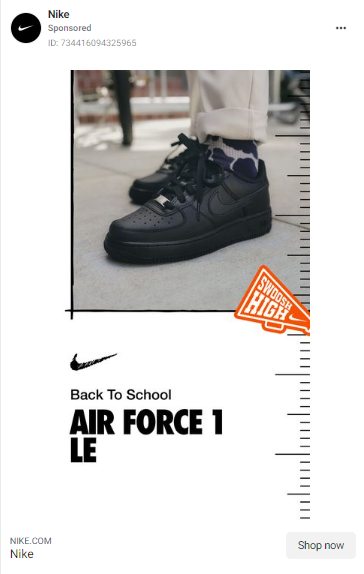
Global athletic footwear giant Nike frequently deploys static image campaigns to capitalize on seasonal shopping shifts, such as Back-to-School initiatives. In campaigns highlighting flagship product lines like the Air Force 1 Le, Nike utilizes clean, high-contrast imagery that places the physical product front and center. Marketers can learn from this minimalist approach by ensuring that the hero product is immediately identifiable within the first second of exposure, removing unnecessary visual noise that could distract the consumer. -
Spotify: Cultural Relevance and Direct Association
Streaming behemoth Spotify utilizes Facebook static ads to promote major album releases, such as Drake’s "Certified Lover Boy." These advertisements rely heavily on recognizable celebrity imagery and familiar branding elements. The primary takeaway for advertisers is the power of cultural currency: associating an ad with an established public figure or trending cultural moment instantly drives higher engagement rates through emotional and parasocial recognition.
-
Shopify: Value Proposition Clarity for SMBs
As a leading e-commerce infrastructure provider, Shopify utilizes static ad units to target aspiring entrepreneurs. Their messaging focuses heavily on lowering the barrier to entry for online retail. Advertisers targeting business-to-business (B2B) or software-as-a-service (SaaS) markets can emulate Shopify by focusing copy on a single, compelling value proposition rather than overwhelming the viewer with an exhaustive feature list. -
PayPal: Communicating Ecosystem Expansion
Financial technology leader PayPal leverages static ads to inform users of feature expansions, such as the incorporation of alternative payment methods. By visually mapping out secure transaction processes or newly supported financial gateways, PayPal builds immediate trust. The strategic lesson here is transparency; clearly communicating security credentials and expanded utility directly combats user hesitation. -
Salesforce: Lead Generation Through Educational Content
Enterprise Customer Relationship Management (CRM) pioneer Salesforce frequently uses static ad placements to drive downloads of specialized educational resources, such as comprehensive CRM handbooks. Rather than pushing an immediate software purchase, Salesforce trades value for data via downloadable guides. Advertisers operating in complex sales cycles can utilize this top-of-funnel strategy to capture qualified leads by offering authoritative, gated content.
Carousel Ads: Interactive Storytelling and Multi-Product Showcases
Carousel ads allow brands to showcase multiple images or videos within a single ad unit, each with its own headline, description, and landing page link. This format is uniquely suited for narrative progression and comprehensive catalog browsing.
-
Sephora: Highlighting Flexible Financing
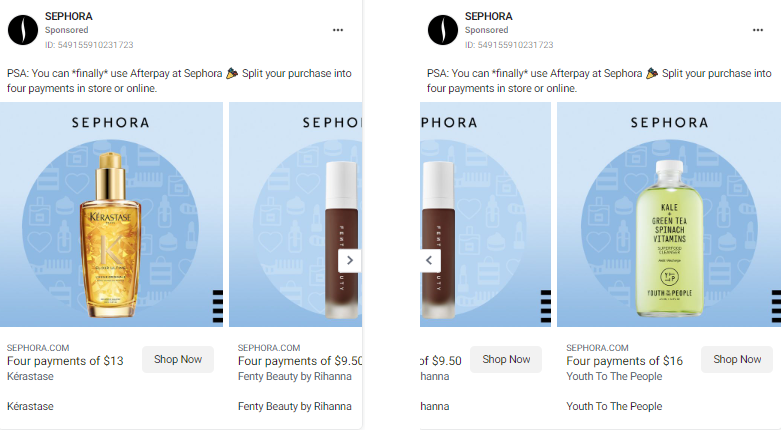
Beauty retail giant Sephora utilizes carousel placements to educate consumers on payment flexibility, specifically integrating Buy Now, Pay Later (BNPL) services like Afterpay. Each card in the carousel demonstrates a different aspect of the shopping experience. Retailers can learn from this by using carousels not just for product variations, but to explain multi-step purchasing benefits or flexible financing options.
-
Dell: Promotional Urgency and Product Specialization
Technology hardware leader Dell deploys carousel ads to drive conversion during major retail holidays, such as Labor Day sales. Individual cards highlight specific computing powerhouses, such as XPS laptops integrated with Intel processors. The strategic takeaway is segmentation; by dedicating individual carousel cards to distinct product tiers or price points, brands cater to diverse buyer intents within a single ad unit. -
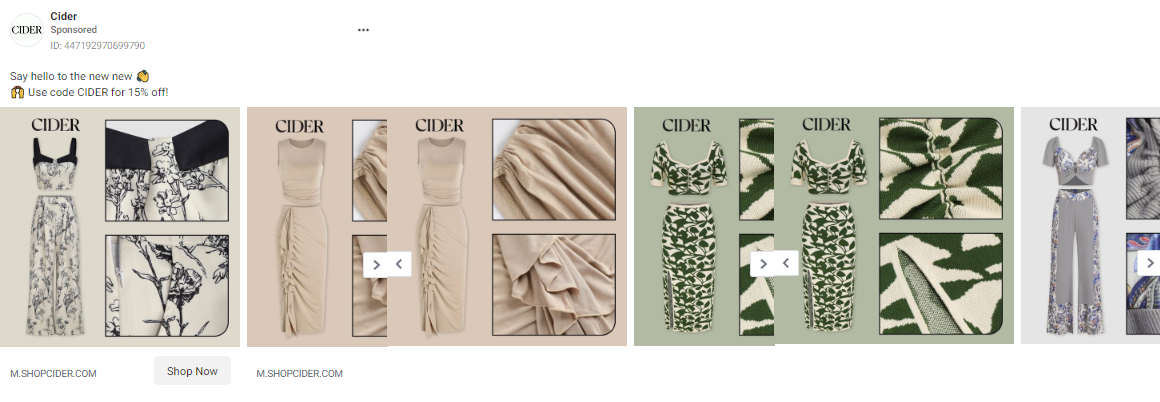
Cider: Direct-to-Consumer Visual Catalogs
Fast-fashion disruptor Cider utilizes the carousel format to mimic an interactive digital catalog, showcasing cohesive outfit combinations across multiple swipable cards. This enables users to visualize complete ensembles rather than isolated items, significantly increasing average order value (AOV) by encouraging cross-category purchasing. -
Bayrite: Incentive-Driven Jewelry Marketing
Jewelry brand Bayrite employs carousel ads to showcase individual pieces while prominently featuring direct financial incentives. Alongside lifestyle imagery, Bayrite integrates transparent promotional mechanics—such as an immediate 20-percent discount code—directly into the ad copy and card overlays, bridging the gap between aesthetic desire and immediate transactional motivation.
-
Yoga International: App Adoption and Goal Alignment
Fitness and wellness platform Yoga International utilizes carousel cards to break down the core pillars of their mobile application experience, such as guided meditation, personalized yoga flows, and instructor-led courses. Advertisers promoting subscription apps can apply this method by dedicating each card to a specific user pain point resolved by the application.
Facebook Stories Ads: Immersive, Full-Screen Engagement
With mobile consumption dominating social media traffic, vertical full-screen Stories ads provide an immersive canvas that commands undivided user attention.
-
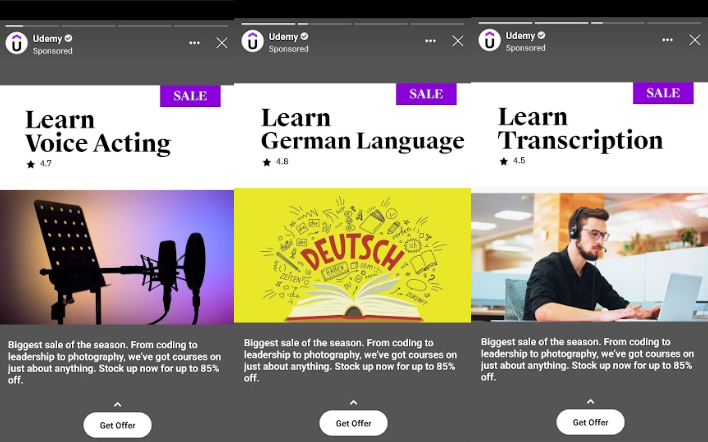
Udemy: Skill Acquisition and Career Mobility
Online learning marketplace Udemy utilizes Stories ads to promote high-demand professional courses. The vertical format forces concise, impactful visual storytelling that aligns with fast-paced mobile viewing habits. -
Authority Hacker: High-Intent Educational Funnels
Digital marketing educators Authority Hacker deploy Stories ads to drive traffic to specialized web-building masterclasses. Their creative strategy relies on bold, readable on-screen typography that conveys immediate professional transformation. -
Coursera: Credentialing and Career Advancement
E-learning platform Coursera leverages the Stories placement to market industry-recognized credentials, such as the Google Analytics Certificate. By highlighting career advancement statistics within the vertical frame, Coursera establishes immediate credibility and professional ROI.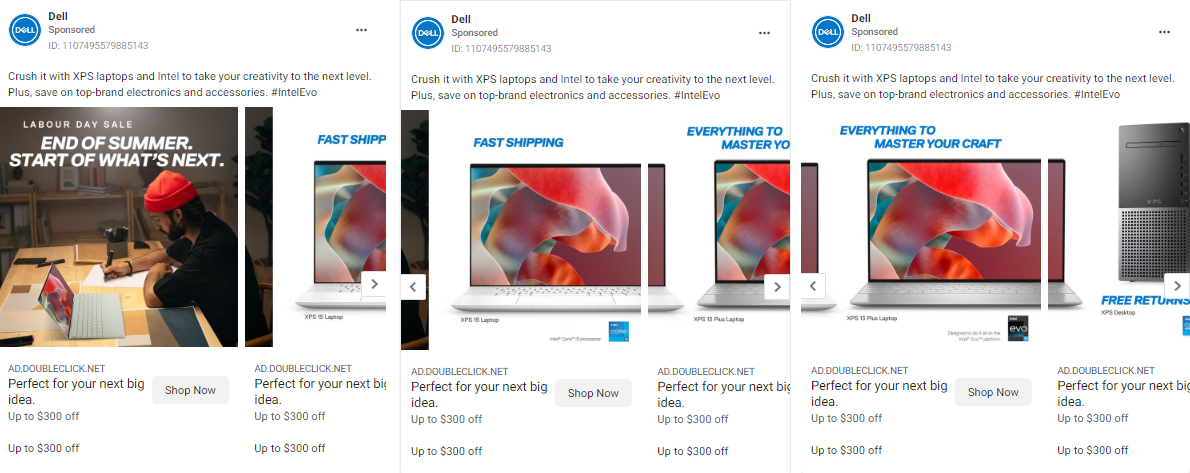
-
Bolt Food: Instantaneous App Installation Incentives
Delivery service Bolt Food utilizes Stories ads to drive localized mobile application downloads by pairing mouth-watering culinary visuals with time-sensitive delivery discounts. The direct swipe-up or tap-to-install mechanic minimizes friction in the conversion funnel. -
IDP Nigeria: Event Registration and International Mobility
International education consultancy IDP Nigeria uses full-screen vertical ads to drive registrations for live informational sessions regarding studying abroad. The immersive format allows for detailed event information without cluttering the user interface.
Strategic Frameworks for Modern Facebook Advertising
A rigorous cross-analysis of successful campaign structures reveals five core pillars essential for modern Facebook advertising optimization:
Scroll-Stopping Visuals
Because social media users exhibit exceptionally brief attention spans when navigating high-velocity feeds, visual assets must be instantly arresting. Advertisers can elevate creative quality by prioritizing native-looking user-generated content (UGC), utilizing high-contrast color palettes that break feed monotony, and designing specifically for vertical and square aspect ratios to maximize screen real estate.
Concise and Direct Copywriting
Data indicates that top-performing ad captions average one to two sentences in length. Mobile users rarely read dense paragraphs of ad text. When long-form copy is necessary for complex B2B offerings, the core hook must be established immediately within the first two lines, well above the platform’s truncation fold.
Mobile-First Engineering
With industry reports highlighting that nearly 99 percent of all active Facebook users access the platform via mobile devices, responsive design is non-negotiable. Text overlays must be large enough to be legible on compact smartphone screens, and landing pages linked from ads must feature accelerated mobile loading speeds to prevent immediate bounce rates.
Compelling and Explicit CTAs
The call-to-action (CTA) dictates user trajectory following ad exposure. Optimizing performance requires aligning the CTA button—such as "Shop Now," "Learn More," or "Sign Up"—with the specific psychological intent of the funnel stage. Vague instructions diminish conversion probability, whereas explicit, value-driven prompts guide the consumer effortlessly toward completion.
Rigorous Audience Research and Thoughtful Targeting
Deploying high-intent campaigns requires meticulous alignment between creative messaging and audience segmentation. Sending top-of-funnel awareness creative to cold audiences requires broad lifestyle messaging, whereas retargeting sequences demand hyper-specific product-focused assets. By leveraging custom and lookalike audiences based on verified customer lifetime value (LTV) data, advertisers ensure budgetary efficiency and maximize sustainable return on investment across the Facebook ecosystem.