In the modern corporate ecosystem, brand visibility and customer trust have increasingly shifted away from traditional top-down corporate marketing and toward peer-to-peer validation. Employee advocacy programs—where staff members voluntarily share corporate content, career milestones, and industry insights on their personal social networks—have evolved from experimental social media tactics into core drivers of enterprise growth. However, as marketing budgets face tighter scrutiny and executive leadership demands verifiable fiscal returns, the mandate to accurately measure the success of these initiatives has never been more urgent.
Without rigorous data collection and performance tracking, employee advocacy programs frequently struggle to secure long-term budgetary support, headcount allocation, and stakeholder buy-in. Modern organizations are moving past vanity metrics like raw likes and superficial impressions, pivoting instead toward comprehensive frameworks that tie employee-driven social sharing directly to lead generation, recruitment pipelines, and bottom-line revenue.

The Evolving Landscape of Employee Advocacy and Accountability
For years, marketing and communications teams measured social media success through rudimentary indicators such as follower growth and post reactions. While these metrics provided a surface-level view of brand awareness, they failed to answer the fundamental question asked by chief financial officers and executive boards: What is the financial return on this investment?
Today, the integration of sophisticated tracking tools, customer relationship management (CRM) software, and unique tracking links has transformed how organizations evaluate advocacy. A primary catalyst for this shift is the need to justify resource allocation in competitive corporate environments. Initiatives that lack quantifiable business outcomes face the constant risk of defunding during fiscal reviews. Conversely, programs equipped with robust analytics can vividly demonstrate their worth, protecting their budgets and securing institutional expansion.
Real-world applications highlight the tangible power of this data-driven approach. Victoria Samways, Marketing and Brand Manager at digital agency Major Tom, successfully utilized employee advocacy measurement to demonstrate a remarkable three-figure return on investment from a single targeted campaign. By implementing UTM tracking links across employee-shared content, Samways and her team monitored the downstream journey of social media traffic.

“Thanks to the UTM tracking links, over the coming weeks, we saw a healthy amount of leads that we attributed back to this campaign,” Samways noted. This strategy successfully injected over $100,000 into the company’s sales pipeline. Furthermore, because these leads arrived via the referral-like context of trusted professional connections rather than cold advertisements, they yielded a significantly higher-than-average win rate.
Building a Comprehensive Measurement Framework
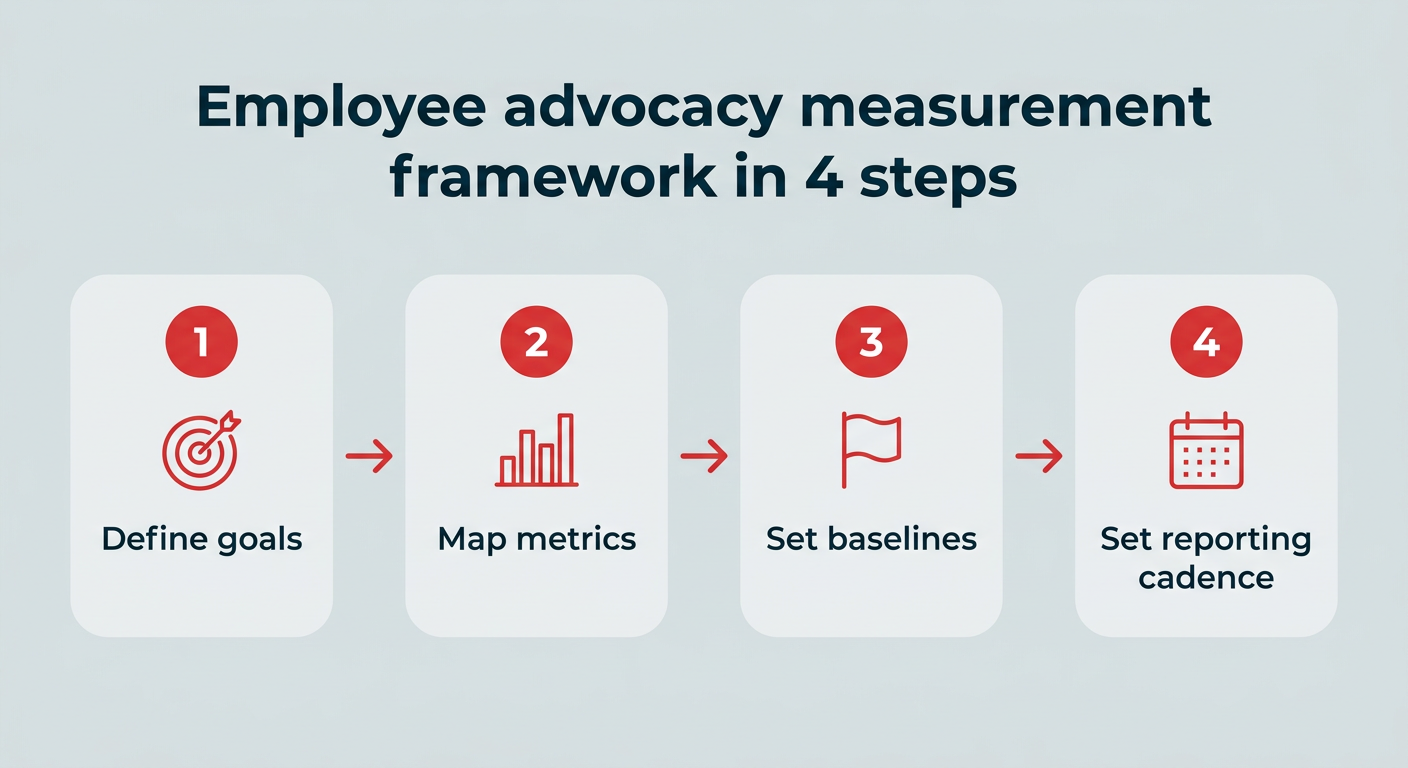
Establishing a successful employee advocacy measurement framework requires organizations to define clear program objectives before selecting performance metrics. Drowning in an ocean of irrelevant data often obscures the insights that matter most to business leaders. A structured, four-step methodology ensures alignment between communication teams and executive stakeholders prior to the launch of any social sharing initiative.
The foundational phase begins with defining precise business goals. Whether an organization aims to accelerate recruitment cycles, boost inbound sales leads, or foster internal cultural pride, every metric tracked must trace back to a specific objective. Once goals are established, teams must map relevant key performance indicators (KPIs) to each objective, set historical baselines or competitive benchmarks, and establish a consistent reporting cadence—typically combining monthly operational updates with quarterly business impact reviews.
When this framework is documented and shared transparently with stakeholders, periodic reporting transforms from a contentious debate into a streamlined progress update. Agreement on what constitutes success eliminates ambiguity and establishes accountability across departments.
Key Performance Indicators Across Seven Critical Categories
To capture the true multi-dimensional impact of an employee advocacy program, enterprises must evaluate performance across seven distinct categories: awareness and reach, engagement, recruiting, sales and lead generation, employee participation, cultural impact, and employee retention.
Awareness and Reach
Reach and impression metrics quantify the expanded footprint of company messaging when distributed across personal networks. When evaluating these metrics, communication leaders often translate raw impressions into earned media value (EMV). Stating that employee posts reached 100,000 individuals is informative, but contextualizing that reach as the equivalent of $15,000 in saved paid advertising expenditures provides immediate financial clarity to executive leadership.
Engagement
Engagement metrics evaluate how audiences interact with employee-shared content compared to traditional corporate channels. Industry data consistently underscores the superior potency of employee voices. Research from Gartner and LinkedIn indicates that engagement rates on employee-shared content can be up to ten times higher than brand-pushed posts, while click-through rates (CTR) are frequently double those of corporate page distributions. Tracking likes, comments, shares, sentiment analysis, and CTRs reveals whether humanizing the brand yields deeper audience connections.
Recruiting
Recruitment metrics measure the tangible influence of advocacy on an organization’s talent acquisition pipeline. By tracking applicant volume, applicant quality, and time-to-hire, human resources teams can directly correlate employee advocacy with hiring efficiency. When prospective candidates witness authentic employee experiences shared online, the quality of inbound applications improves, simultaneously reducing external recruitment agency costs and time-to-fill metrics.
Sales and Lead Generation
For revenue-focused leadership, sales metrics provide the ultimate proof of performance. Monitoring site traffic generated from employee shares, lead volume, conversion rates, and pipeline influence allows organizations to calculate direct revenue attribution. Notably, data from LinkedIn indicates that sales professionals who actively share industry and company content are 45% more likely to exceed their sales quotas, proving that advocacy functions as a powerful enablement tool for commercial teams.

Employee Participation
An advocacy program’s viability depends entirely on workforce involvement. Participation metrics track adoption rates, active sharing percentages, and the average number of shares per employee. Tracking these metrics ensures that the program maintains momentum and avoids stagnation. Furthermore, gamification strategies—such as internal leaderboards and rewards for consistent participants—have proven effective in sustaining high engagement levels over extended periods.
Cultural Impact
Cultural metrics assess how advocacy initiatives influence employee pride, professional reputation building, and overall sentiment. By integrating advocacy questions into regular employee engagement surveys, organizations can evaluate whether staff members view sharing company content as a valuable career asset or an unwelcome corporate mandate. In an era where Chief Human Resources Officers (CHROs) frequently cite employee disengagement as a primary barrier to growth, fostering a culture of voluntary pride is paramount.
Retention
Employee retention metrics investigate the correlation between brand advocacy and workplace longevity. Employees who feel sufficiently valued to champion their employer publicly are often more invested in their long-term professional futures with the company. With employer trust metrics shifting across the global labor market, monitoring voluntary turnover rates among active advocates versus non-participating staff provides valuable insights into workplace stability and recruitment cost savings.
Industry Benchmarks and Maturity Stages
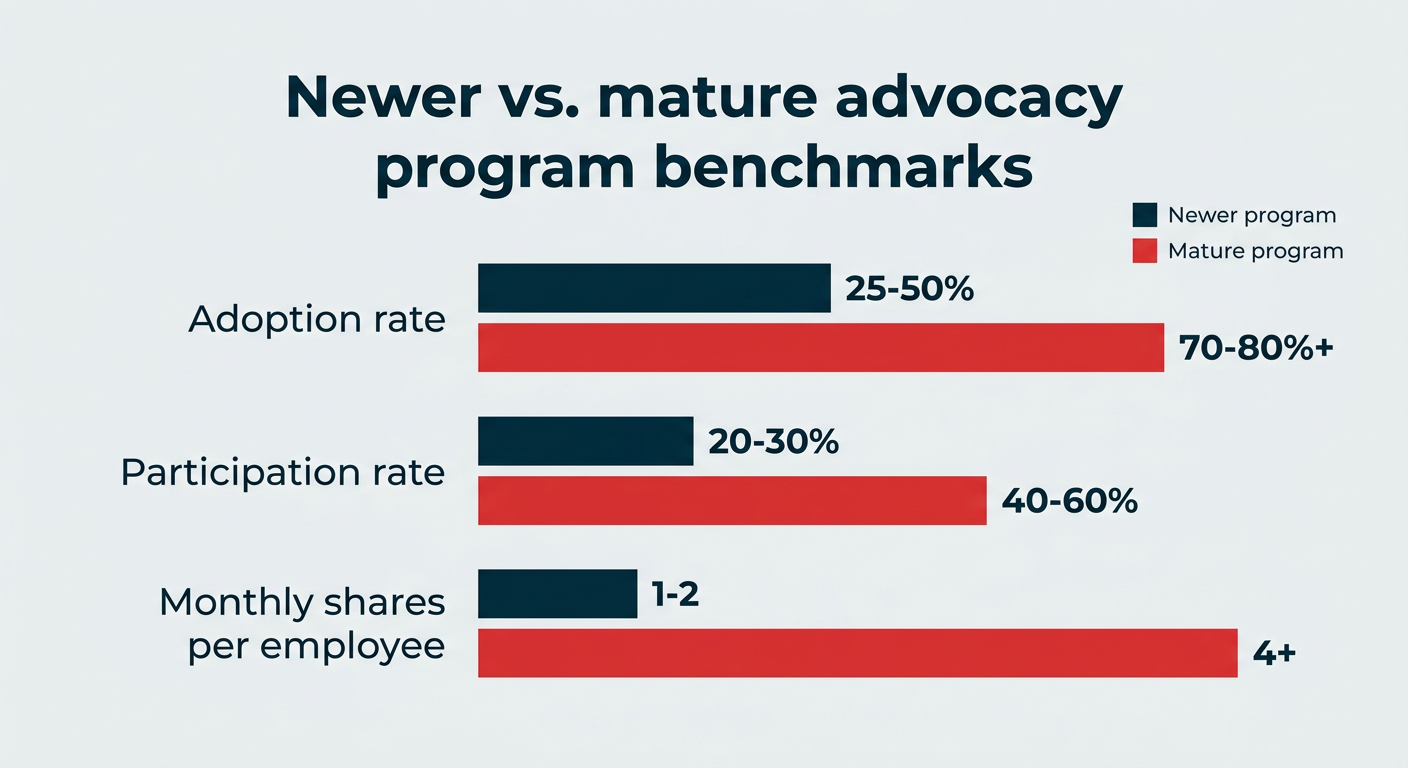
Performance expectations for employee advocacy must scale in alignment with program maturity. Newer initiatives—typically operating within their first six months—generally experience adoption rates between 25% and 50%, with active participation resting around 20% to 30%. In contrast, mature enterprise programs that have benefited from years of internal promotion and executive backing routinely achieve adoption rates exceeding 70% to 80%, with monthly participation climbing to 60%.
Hootsuite’s own internal employee advocacy program serves as an established benchmark for mature initiatives. Following sustained promotional efforts, the company’s internal platform achieved an 80% sign-up rate—marking a year-over-year increase of 9%—and generated millions of employer brand impressions attributed directly to employee-driven distribution.
While external benchmarks offer helpful directional targets, the most reliable point of comparison remains an organization’s own historical performance. Consistent quarter-over-quarter growth in adoption, participation, and attributed revenue signals a healthy, scalable advocacy ecosystem.
Calculating and Maximizing Return on Investment
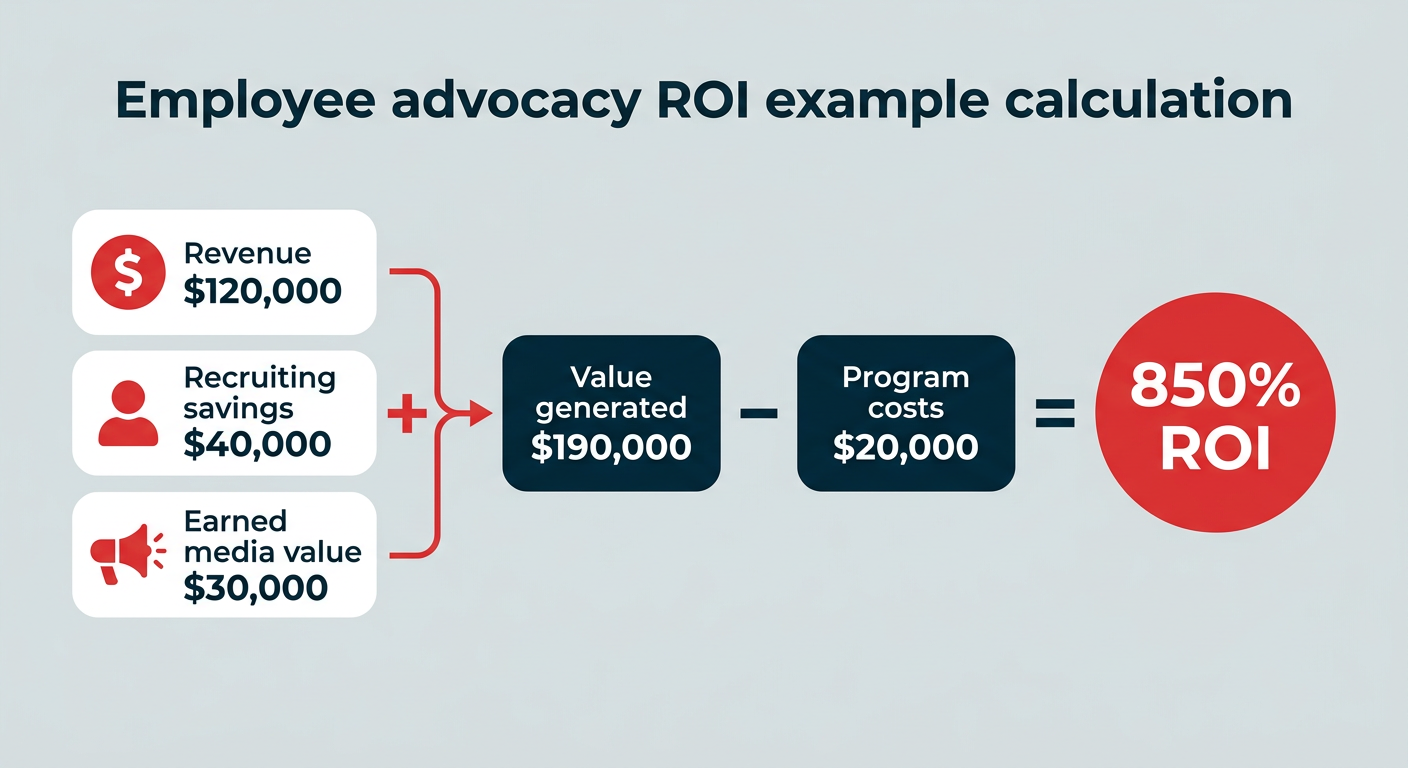
Calculating the precise financial return of an employee advocacy program requires balancing total program expenditures—such as software licensing, administrative overhead, and incentive costs—against the comprehensive dollar value generated across multiple business units.
The standard financial formula calculates advocacy ROI as the net value generated minus program costs, divided by program costs, multiplied by 100. To accurately compute the "value generated" side of the equation, organizations aggregate financial contributions from four primary sources:
- Attributed sales revenue tracked via UTM links.
- Recruitment cost savings resulting from organic applicant pools and reduced agency fees.
- Earned media value calculated from total employee-driven impressions multiplied by industry average cost-per-thousand (CPM) rates.
- Retention savings achieved by reducing voluntary employee turnover.
When these variables are synthesized, advocacy programs frequently demonstrate exceptional financial returns, often exceeding several hundred percent when factoring in pipeline acceleration and talent acquisition efficiencies.
Strategic Implications and Best Practices for Implementation
To sustain long-term program health, organizations must adhere to proven operational best practices. First, advocacy must remain strictly voluntary. Building a culture where employees feel genuinely proud to share authentic content yields far superior engagement than mandatory corporate posting policies. Second, rigorous technical maintenance of integrations and social profile connections is essential; technical friction or frequent disconnects rapidly erode user trust and participation.
Additionally, organizations must maintain open feedback loops with their workforce. Analyzing which content formats, topics, and narratives receive the highest employee engagement acts as an organic focus group, guiding future content strategy and ensuring that distributed materials align with both corporate objectives and employee personal branding goals.
Ultimately, measuring employee advocacy transforms social media from an ambiguous branding exercise into a transparent, accountable business engine. By grounding advocacy metrics in hard data, revenue attribution, and recruitment efficiency, communication leaders can secure enduring executive backing, elevate their workforce’s thought leadership, and drive measurable enterprise growth.