In the fast-paced landscape of digital marketing, the days of ad-hoc posting and last-minute social media scrambles are rapidly coming to an end. As brands compete for shrinking attention spans across an increasing number of digital channels, structured social media content planning has emerged as a critical operational necessity for modern marketing teams. Industry analysts note that without a repeatable framework, businesses frequently fall victim to content fatigue, inconsistent brand messaging, and team burnout.

Content planning extends far beyond the basic scheduling of daily posts. At its core, it represents a strategic methodology for determining what content to publish, the precise timing of its distribution, and how individual assets directly align with overarching corporate objectives. By mapping topics, formats, and campaigns well in advance, organizations can build sustainable workflows that eliminate monthly chaos while connecting day-to-day engagement metrics with broader business goals.
The Evolution and Imperative of Content Planning

The modern approach to social media management requires shifting away from reactive posting toward batch creation and multi-platform repurposing. Historically, marketing teams expended significant time and resources building unique content pieces for every individual channel. Today, efficiency dictates a more consolidated model where a single foundational concept—such as a comprehensive research report or a product launch brief—is systematically adapted into a diverse array of formats. A single core insight can effortlessly transform into a detailed LinkedIn article, a series of short-form vertical videos for TikTok and Instagram Reels, informative carousel graphics, and text-driven updates.
This multi-format repurposing approach allows organizations to maximize their return on creative investments without proportionally increasing their budgets or headcount. Furthermore, maintaining a centralized content calendar protects teams from unexpected operational disruptions. By accounting for seasonal milestones, industry events, holidays, and major product launches weeks or months ahead of schedule, brands can maintain a steady drumbeat of communication.

Crucially, planning ahead does not equate to rigidity. Industry experts emphasize that a well-structured content plan actually creates tactical flexibility. When routine publishing is organized and automated, marketing teams retain the cognitive bandwidth and scheduling clearance necessary to respond swiftly to breaking industry trends, cultural moments, or unexpected headlines without throwing their entire editorial calendar into disarray.
The Ten-Step Blueprint for Effective Social Media Planning

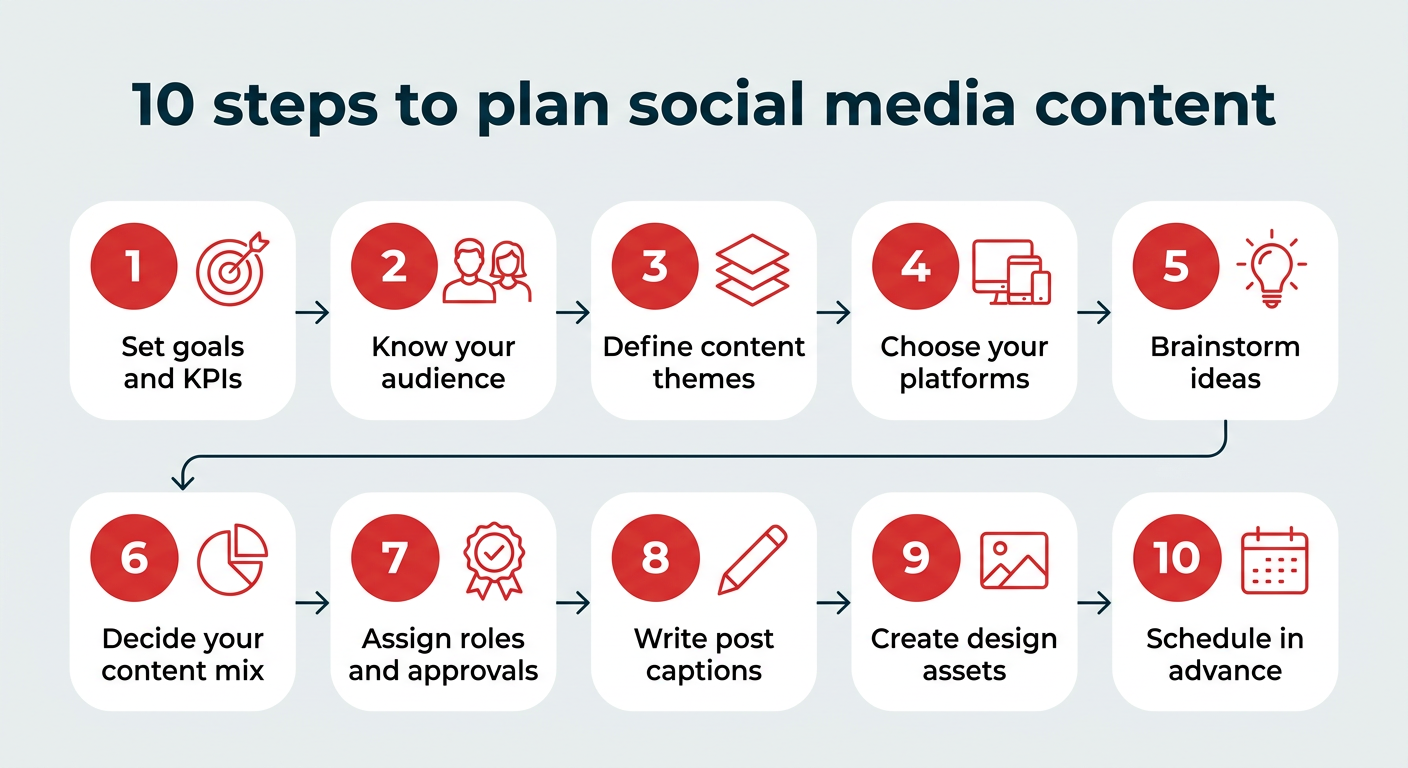
Building a resilient social media content plan requires a disciplined, step-by-step methodology. Leading digital strategists recommend a comprehensive ten-phase framework designed to take a team from initial conceptualization to final performance measurement.
Step 1: Establishing Strategic Goals and Key Performance Indicators
Every successful content plan begins with clearly defined objectives. Social media goals typically encompass brand awareness, lead generation, community building, or direct sales conversions. However, setting vague ambitions such as "increasing awareness" is insufficient for modern marketing attribution. Teams must pair each goal with specific, measurable Key Performance Indicators (KPIs), such as boosting monthly impressions by twenty percent or lifting click-through rates by a targeted margin within a designated quarter. Limiting a campaign to two or three primary goals ensures the content strategy retains sharp focus.

Step 2: Conducting Rigorous Audience Research
Content that resonates must be rooted in audience behavior rather than internal assumptions. Before drafting copy, marketers must analyze demographic data, historical engagement metrics, and platform-specific analytics. Integrating social listening tools further enhances this phase by tracking unprompted conversations, industry sentiment, and the precise language consumers use when discussing a brand or category. Documenting these insights in a shared repository ensures that institutional knowledge scales across the entire organization.
Step 3: Defining Core Content Themes and Pillars
Content pillars act as strategic guardrails for an organization’s messaging. These recurring themes—ranging from educational tutorials and industry thought leadership to behind-the-scenes glimpses and product highlights—must ladder directly up to the brand’s broader marketing objectives. If a proposed post does not fit comfortably within an established theme, it indicates that the post either belongs outside the strategy or that the strategy itself requires expansion.
Step 4: Prioritizing Platform Selection
Spreading resources thinly across every available social network is a primary driver of campaign failure. Organizations must utilize their audience research to prioritize the channels where their target demographics spend the majority of their time. Once core platforms are selected, teams must establish target publication cadences for each channel, acknowledging that the frequency requirements of a fast-moving network like X differ vastly from the visual-first demands of Instagram or the professional standards of LinkedIn.
Step 5: Establishing a Robust Brainstorming and Idea Pipeline
To prevent the exhausting cycle of starting from scratch every week, high-performing marketing teams maintain an active pipeline of campaign and post ideas. Establishing dedicated communication channels, regular brainstorming forums, and cross-departmental contribution workflows ensures a steady influx of creative concepts. These ideas should consistently draw inspiration from historical performance data, customer support inquiries, and emerging industry trends.

Step 6: Optimizing the Content Mix
A balanced content marketing strategy relies on an intentional blend of original creations and curated third-party material. While original assets drive brand differentiation, curated content helps maintain active, relevant feeds without exhausting creative resources. Many organizations adhere to a foundational ratio of roughly forty percent original content to sixty percent curated insights, ensuring all shared material meets rigorous quality standards and aligns with the brand’s overarching narrative.
Step 7: Defining Responsibilities and Approval Workflows
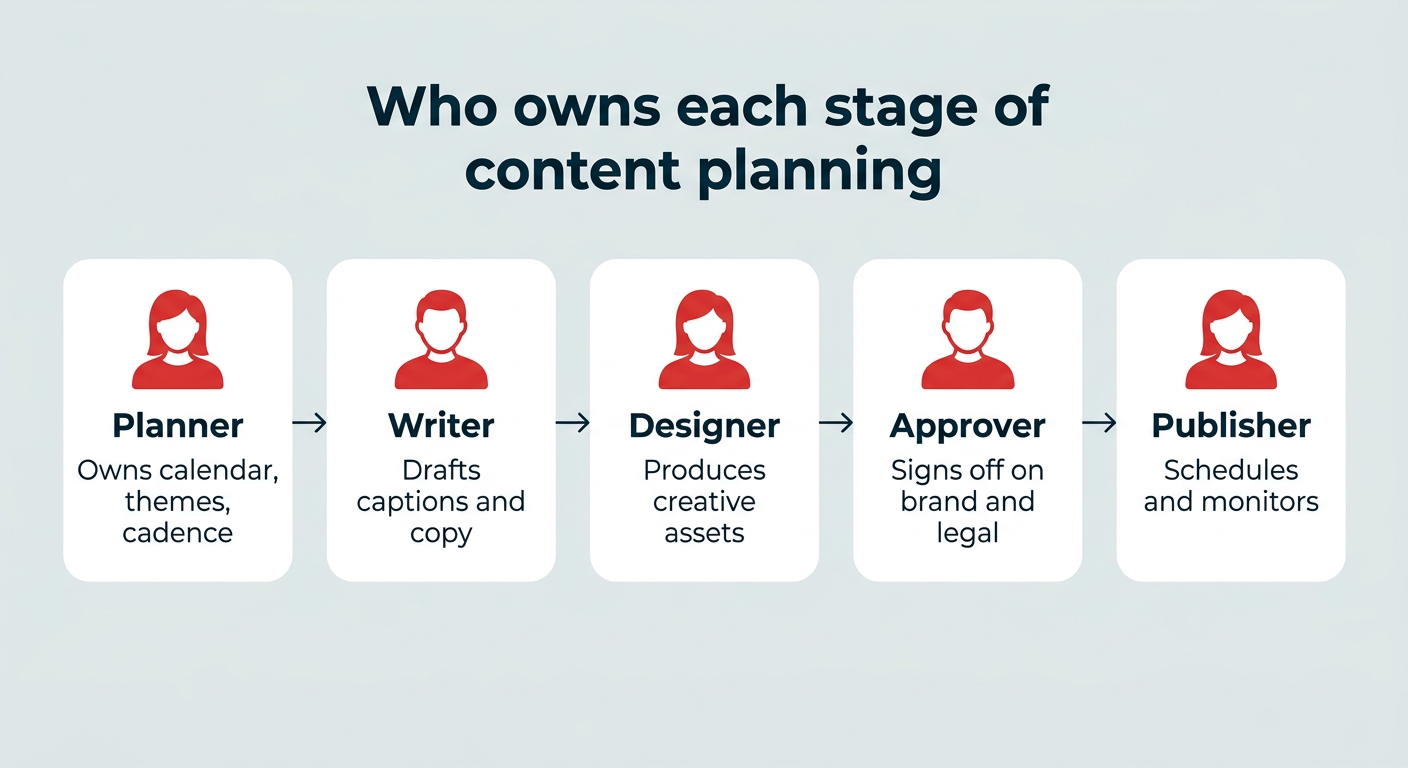
Ambiguity in task ownership frequently leads to missed deadlines and compromised content quality. A mature content plan clearly assigns operational roles for every stage of the lifecycle, designating specific owners for planning, writing, design, approval, and final publishing. Furthermore, complex organizations—particularly those operating in highly regulated sectors such as finance, healthcare, and legal services—must incorporate mandatory compliance and legal reviews into their production timelines to mitigate brand risk and regulatory exposure.

Step 8: Drafting Compelling Copy and Leveraging AI Assistants
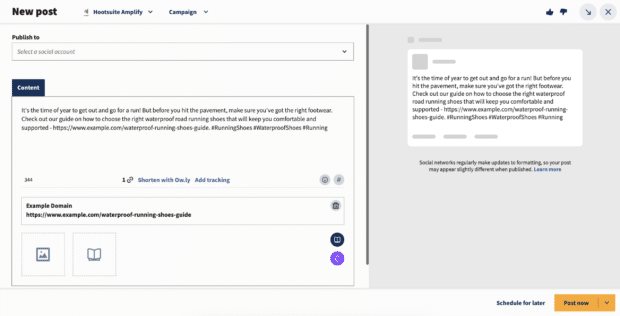
Writing social copy prior to visual asset creation ensures that design elements serve the narrative rather than forcing text to fit rigid graphic templates. In recent years, generative artificial intelligence has fundamentally transformed this stage of the workflow. Modern marketing operations frequently integrate AI-assisted writing tools to accelerate caption generation, brainstorm alternative post angles, and suggest relevant hashtags. Despite these efficiency gains, industry standards maintain that human editing and oversight remain non-negotiable to preserve brand voice and factual accuracy.
Step 9: Producing and Sourcing Visual Design Assets
A brilliant conceptual campaign will fail to capture attention without high-quality visual execution. Bottlenecks in graphic design and video production frequently derail publishing schedules. Establishing strict, realistic production timelines for creative assets—and utilizing centralized collaboration tools that streamline stakeholder feedback—ensures that multimedia content moves smoothly from draft status to final approval.
Step 10: Advanced Scheduling and Timing Optimization
Publishing consistently is only half the battle; content must also go live when the target audience is actively engaged. Relying on predictive analytics and algorithmic scheduling features allows marketing platforms to analyze historical audience activity and automatically suggest optimal posting times across different networks. Cross-platform scheduling tools further empower teams to batch their workloads, managing dozens or hundreds of posts simultaneously while maintaining a holistic view of the master calendar.
The Role of Artificial Intelligence and Modern Software
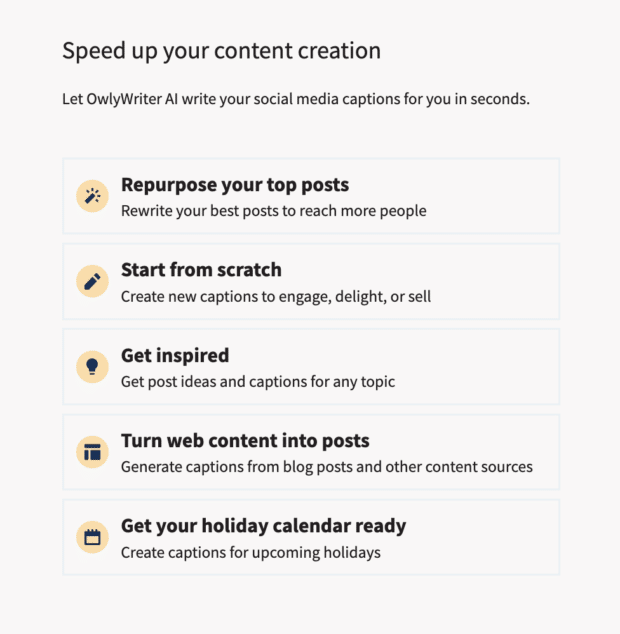
As the digital marketing ecosystem matures, artificial intelligence has evolved from a novelty into an embedded operational layer. Data from technology research firms indicates that while a vast majority of marketing professionals actively explore generative AI tools, realizing significant, measurable benefits depends heavily on proper training and brand alignment. In contemporary content planning, AI functions primarily as an accelerator for foundational research, multi-platform draft generation, and predictive timing analysis, leaving strategic judgment firmly in human hands.
Enterprise-grade marketing platforms now unite multiple operational disciplines—including planning, publishing, social listening, performance analytics, and governance controls—into single, connected ecosystems. This consolidation allows insights gathered from real-time social listening to instantly inform content creation, while automated compliance layers ensure that large distributed teams adhere strictly to brand guidelines across diverse geographical regions.

Measuring Success and Continuous Refinement
A content plan that lacks regular performance reviews functions as little more than a static schedule. True optimization requires treating the content calendar as a living document shaped by continuous data analysis. Teams must consistently measure their output against the KPIs established during the initial planning phase, tracking core metrics such as engagement rates, click-through volume, net follower growth, and overall reach.
Establishing a disciplined review cadence is essential for long-term success. Weekly check-ins allow teams to pivot quickly in response to trending topics and immediate performance fluctuations. Monthly reviews help identify broader patterns regarding which content themes and visual formats resonate most powerfully with the audience. Finally, comprehensive quarterly evaluations provide the necessary perspective to adjust overarching goals, modify platform priorities, and refine publication frequencies.
By systematically feeding these analytical insights back into the planning cycle, organizations can transform their social media content strategies from unpredictable guesswork into a precise, compounding driver of business growth.