The digital marketing landscape is undergoing its most profound structural shift since the mainstream adoption of search engines. As consumers increasingly rely on conversational artificial intelligence tools like OpenAI’s ChatGPT, Perplexity, and Google’s Gemini to answer complex queries, traditional search engine optimization (SEO) is no longer sufficient. Instead of scanning a traditional results page populated by a list of clickable blue links, users frequently receive synthesized, direct answers. This zero-click phenomenon means that brand visibility can easily vanish into an AI-generated summary that users never click through to verify. To combat this loss of visibility, modern digital strategists are turning to Answer Engine Optimization (AEO) and specialized diagnostic software known as AEO checkers.
Understanding the Shift from Traditional Search to Answer Engines
![AEO checker tools that measure answer engine visibility [2026]](https://53.fs1.hubspotusercontent-na1.net/hubfs/53/aeo-checker-1-20260903-3858273.webp)
Answer Engine Optimization is the systematic practice of improving how often and how accurately a brand is cited, referenced, or mentioned within AI-generated responses. While traditional SEO focuses primarily on earning higher rankings on a results page through keyword density, technical site performance, and backlink acquisition, AEO addresses how algorithms parse, synthesize, and attribute information. When a user asks a generative engine a multi-part question, the underlying large language model (LLM) reads across dozens of sources, extracts relevant facts, and compiles a single, coherent response.
This behavior fundamentally alters user intent and engagement. Google’s May 2024 rollout of AI Overviews (AIOs) catalyzed this evolution, bringing summary-first mechanics directly to the world’s most dominant search engine. Consequently, brands must adapt to an environment where being cited as a primary source within the conversational answer is vastly more valuable than ranking tenth on the second page of a traditional query list. Despite these differences, AEO and SEO remain complementary. The foundational pillars of traditional SEO—such as robust crawlability, fast site architecture, and strong domain authority—supply the exact trust and verification signals that answer engines rely on when deciding which sources to cite.
The Mechanics of Modern AEO Checkers
![AEO checker tools that measure answer engine visibility [2026]](https://no-cache.hubspot.com/cta/default/53/9dd5e54b-fbef-4dd0-bc44-1689feb1ea18.png)
To manage this complex visibility, digital marketing teams utilize AEO checkers. These diagnostic tools are designed to measure a brand’s footprint across multiple answer engines, diagnose underlying content or structural gaps, and deliver prioritized optimization recommendations.
An effective AEO checker performs several distinct functions. First, it tracks brand visibility across major generative platforms, distinguishing between a literal hyperlink citation and a textual brand mention. Second, it benchmarks these metrics against key industry competitors to highlight lost opportunities. Third, it evaluates technical readiness, ensuring that structured data schema, entity definitions, and web crawler permissions are properly optimized for LLM consumption. Finally, these tools aggregate data into actionable dashboards, bridging the gap between raw algorithmic insights and practical content updates.
Manual Audit Techniques for AI Overviews and Citations
![AEO checker tools that measure answer engine visibility [2026]](https://53.fs1.hubspotusercontent-na1.net/hubfs/53/aeo-checker-2-20260903-852936.webp)
While automated software is necessary for scaling enterprise campaigns, understanding how to manually audit AI visibility provides foundational insight into how algorithms operate. For Google AI Overviews, digital marketers begin by compiling a target list of branded search terms, product categories, and high-intent informational queries. Executing these searches in incognito or signed-out sessions allows auditors to record whether an AI Overview is triggered, whether the target domain appears in the inline source links, and what specific claims the engine makes.
Because Google’s systems determine when an AI summary adds value to a classic search, these overviews do not trigger universally across all queries. Furthermore, because AI Overviews fluctuate dynamically between sessions, establishing a reliable baseline requires repeated sampling over time. Marketers must document these results diligently, as standard analytics tools like Google Search Console historically aggregate AI Overview data into broader organic metrics, though search engine providers are slowly rolling out dedicated generative performance reporting to isolate impressions.
Checking citations in conversational platforms like ChatGPT and Perplexity follows a similar methodology. Perplexity natively attaches inline citations to every generated response, paired with a dedicated sidebar listing all referenced domains. ChatGPT similarly provides inline source indicators and a secondary sources panel whenever web browsing is enabled. Auditors must craft prompt phrases that naturally trigger web retrieval—such as comparative product research queries—and execute these prompts across fresh sessions to account for algorithmic variability.
![AEO checker tools that measure answer engine visibility [2026]](https://53.fs1.hubspotusercontent-na1.net/hubfs/53/aeo-checker-3-20260903-8904553.webp)
Evaluating and Selecting AEO Software Solutions
As manual tracking quickly reaches its operational limits, organizations are adopting automated AEO platforms. When evaluating these software solutions, several critical buyer criteria must be considered:
- Multi-Engine Coverage: The tool must monitor visibility across the dominant AI ecosystems, including ChatGPT, Perplexity, Google AI Overviews, and Gemini.
- Citation Versus Mention Tracking: The software should accurately differentiate between a clickable source citation and a plain-text brand mention.
- Competitor Benchmarking: Teams need clear visibility into which rival domains are capturing market share for target informational queries.
- Actionable Recommendations: The platform must translate abstract visibility scores into concrete technical, schema, and content creation tasks.
- CRM and Analytics Integration: Enterprise-grade tools should connect AI-driven traffic sources directly to downstream pipeline data and closed revenue.
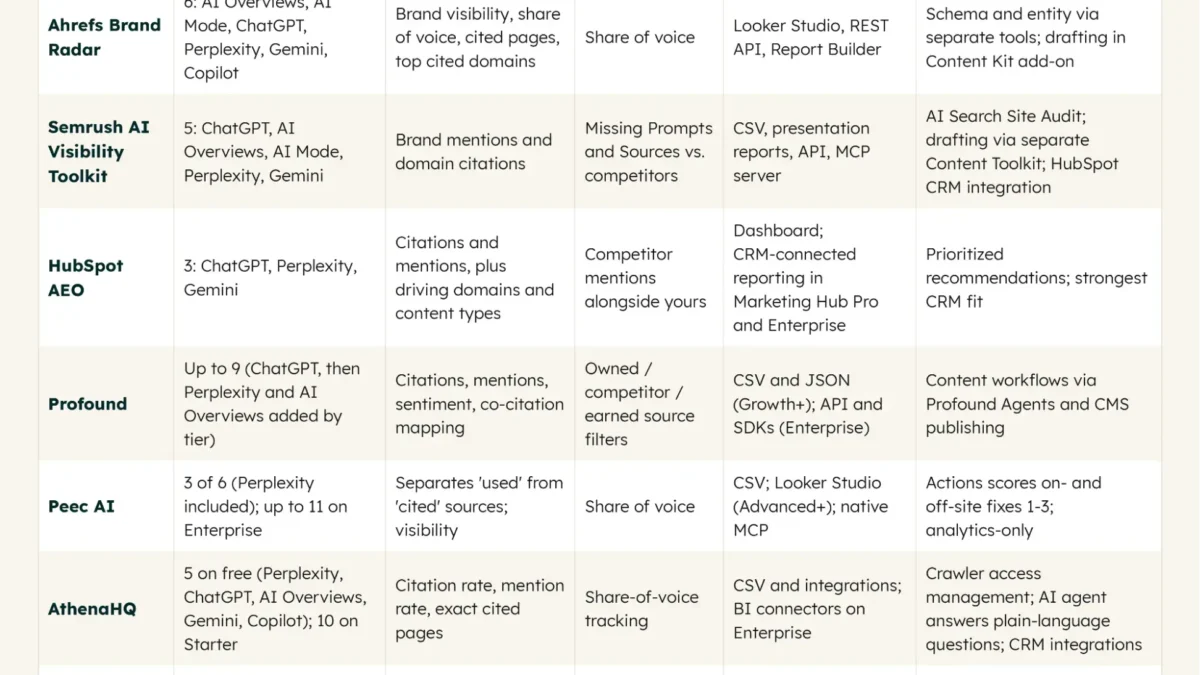
The current market offers a diverse array of specialized tools designed to meet these criteria. Platforms like Ahrefs Brand Radar and Semrush AI Visibility Toolkit excel at tracking Google AI Overviews by leveraging vast historical search indexes. HubSpot AEO provides comprehensive visibility tracking across ChatGPT, Perplexity, and Gemini while directly tying insights into CRM data for Marketing Hub users. Meanwhile, specialized solutions like Profound focus on citation sentiment and source-type categorization, Peec AI and AthenaHQ offer dedicated Perplexity monitoring, and Scrunch AI alongside Conductor emphasize technical schema and entity readiness.
![AEO checker tools that measure answer engine visibility [2026]](https://53.fs1.hubspotusercontent-na1.net/hubfs/53/aeo-checker-4-20260903-6212698.webp)
Key Metrics for Measuring Answer Engine Performance
Monitoring success in the zero-click era requires tracking a specialized suite of performance indicators rather than relying solely on traditional keyword rankings. Essential AEO metrics include:
- Visibility Share: The percentage of target queries where your brand is either cited or mentioned by an answer engine relative to your competitors.
- Citation Frequency: The rate at which your specific domains are utilized as authoritative source links within synthesized responses.
- Brand Sentiment Analysis: The contextual tone and accuracy with which an LLM describes your products or services.
- Zero-Click Influence and Referral Lift: Tracking downstream metrics such as branded search volume spikes and direct referral traffic from AI platforms to gauge indirect pipeline impact.
Because answer engines frequently resolve user intent without prompting a click, digital marketers must view visibility scores and traditional web analytics as two complementary halves of a larger picture. High visibility builds brand equity and thought leadership even when a direct referral session is not immediately registered.
![AEO checker tools that measure answer engine visibility [2026]](https://53.fs1.hubspotusercontent-na1.net/hubfs/53/aeo-checker-5-20260903-8938354.webp)
The Future of Digital Discovery
The transition toward answer engine optimization represents a permanent structural evolution in how information is indexed, retrieved, and consumed. As artificial intelligence systems become the primary intermediaries between businesses and their prospective buyers, traditional ranking strategies must evolve to embrace semantic authority, structured data optimization, and rigorous algorithmic tracking. By adopting specialized AEO checkers and integrating automated insights directly into content production pipelines, organizations can secure their digital footprint, maintain brand accuracy, and thrive in an increasingly automated search ecosystem.