The modern digital landscape has fundamentally transformed how businesses interact with their consumer base, shifting contact points away from static email threads and traditional telephone hotlines toward fast-moving social media platforms. Social customer relationship management, widely known as social CRM, has emerged as an indispensable strategy for organizations seeking to unify disparate data streams. By bridging the gap between raw social media activity—such as direct messages, public mentions, user comments, and sentiment signals—and centralized customer databases, modern enterprises are reshaping how they approach sales, marketing, and customer support.

This evolution addresses a critical operational hurdle: the traditional customer relationship management system was built primarily for structured, historical data. Standard CRM platforms historically tracked past purchases, logged support tickets, and recorded email exchanges. However, these legacy systems frequently leave a massive blind spot regarding real-time, unstructured consumer interactions occurring across platforms like Instagram, X, LinkedIn, and Facebook. Social CRM integrates these real-time conversational contexts directly into the customer lifecycle, providing customer-facing teams with an immediate, comprehensive profile of every buyer.
The Growing Expectations Gap and Consumer Realities

The urgency behind adopting social CRM strategies stems from a widening expectations gap between the customer experience brands believe they are delivering and the reality perceived by the consumer. According to recent market analysis from Forrester’s Global Customer Experience Index, this disconnect continues to expand, often manifesting publicly in comment sections and direct messaging queues. When consumers air grievances, compare competitor products, or pose direct service inquiries on social networks, they expect prompt, contextual resolutions.
Data from comprehensive industry studies underscore the high stakes of social responsiveness. Research highlights that a significant majority of consumers view rapid brand interaction on social media as a primary indicator of strong customer service. Conversely, prolonged silence or ignored complaints carry immediate repercussions, with sizeable portions of digital audiences willing to unfollow or abandon brands that fail to engage with their community. At contemporary scales of digital traffic, manual data entry—such as copy-pasting social mentions into a database spreadsheet—is no longer viable, making automated social CRM integrations an operational necessity.
Bridging Traditional and Modern CRM Frameworks
To fully grasp the mechanics of social CRM, industry analysts often examine how it diverges from its traditional predecessor. While a standard CRM looks backward at structured historical data and focuses primarily on reactive processes managed by a single department, a social CRM looks forward. It captures unstructured, real-time data and acts as a collaborative hub shared simultaneously across marketing, sales, and customer care divisions.
Industry technology stacks generally categorize social CRM solutions into three distinct architectures:
- Built-in options: These embed basic social capabilities directly into existing CRM systems, consolidating data into a single tool while sometimes sacrificing advanced social functionality.
- Standalone platforms: Specialized software solutions that manage social media management workflows natively and sync intelligence back to primary CRM databases via API integrations.
- Hybrid operating systems: Emerging platforms—such as Hootsuite Social OS and its AI-driven layers—that sit between traditional software models, handling native publishing, listening, and engagement while simultaneously feeding real-time intelligence into enterprise systems like Salesforce and Microsoft Dynamics 365.
The Four-Step Data Flow Architecture
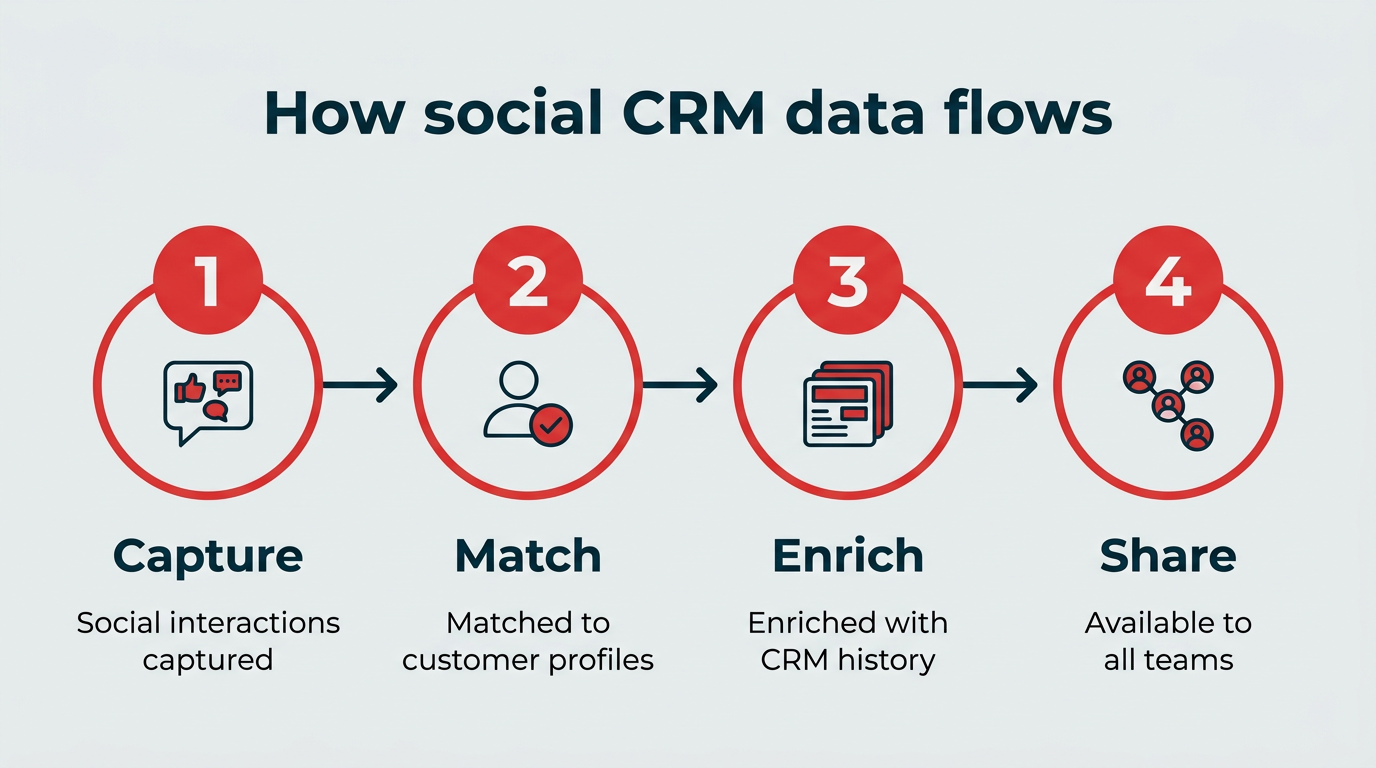
Implementing an effective social CRM infrastructure requires a standardized data pipeline that ensures information moves seamlessly from public networks to secure internal databases. The operational framework typically follows a four-stage process:
- Capture: Social media interactions, ranging from direct inquiries to sentiment shifts, are continuously monitored and gathered from connected brand channels.
- Match: Incoming interactions are algorithmically matched to existing customer profiles within the database or flagged for the creation of new prospective leads.
- Enrich: The system supplements the social data profile with historical context, including previous purchase records, past support tickets, and historical brand interactions.
- Share: The unified, comprehensive view of the customer is made instantly accessible across all relevant departmental teams, eliminating duplicate efforts and reducing internal silos.
The Transformative Impact of Artificial Intelligence
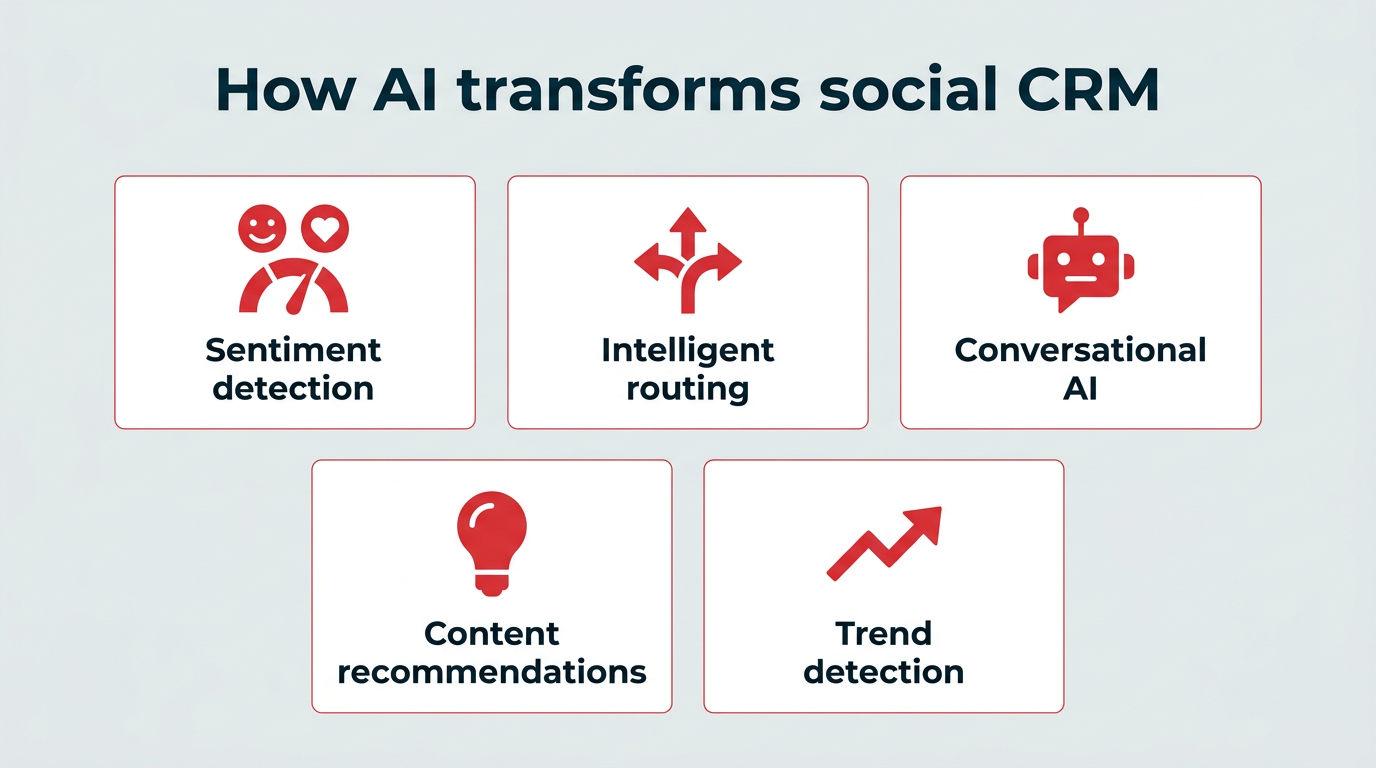
Artificial Intelligence has dramatically accelerated the utility of social CRM by automating the heavy lifting of data sorting, text analysis, and message triage. Gartner’s evolving definitions of sales and CRM platforms increasingly classify modern systems as AI-driven environments. Rather than requiring human agents to manually sift through hundreds of unorganized notifications, AI-powered triage queues automatically categorize messages by emotional tone, urgency, and customer history.
Advanced natural language processing tools analyze conversations across multiple languages and regional markets, allowing multinational corporations to detect emerging customer service issues before they escalate into global public relations challenges. Furthermore, AI-driven social listening goes beyond simple keyword tracking by interpreting sarcasm, emotional drivers, and nuanced sentiment changes. This transforms social listening from a passive monthly reporting exercise into an active operational input that feeds directly into content calendars, product development roadmaps, and proactive sales outreach.

Optimizing Departmental Outcomes: Support, Sales, and Marketing
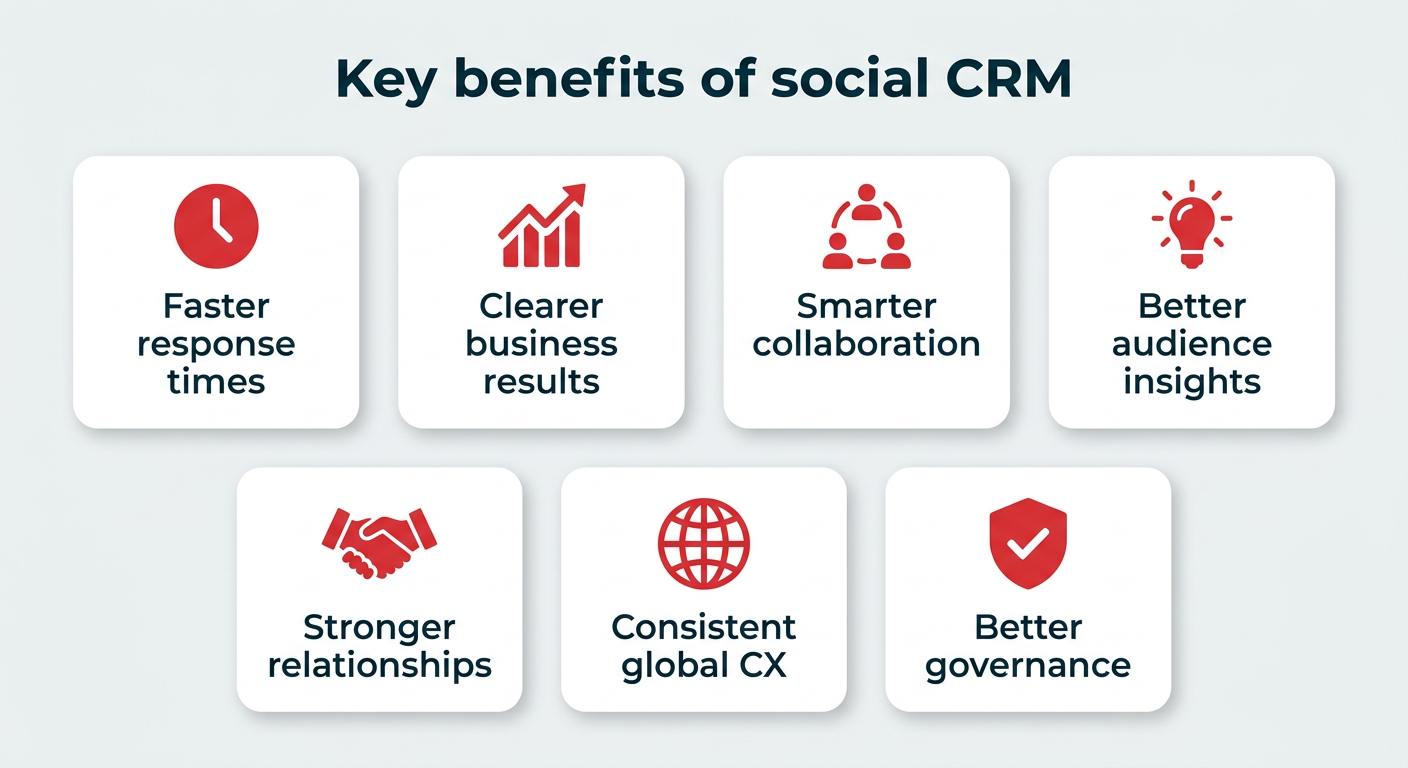
The implementation of a unified social CRM infrastructure yields measurable benefits across three core business units: customer service, sales, and marketing.
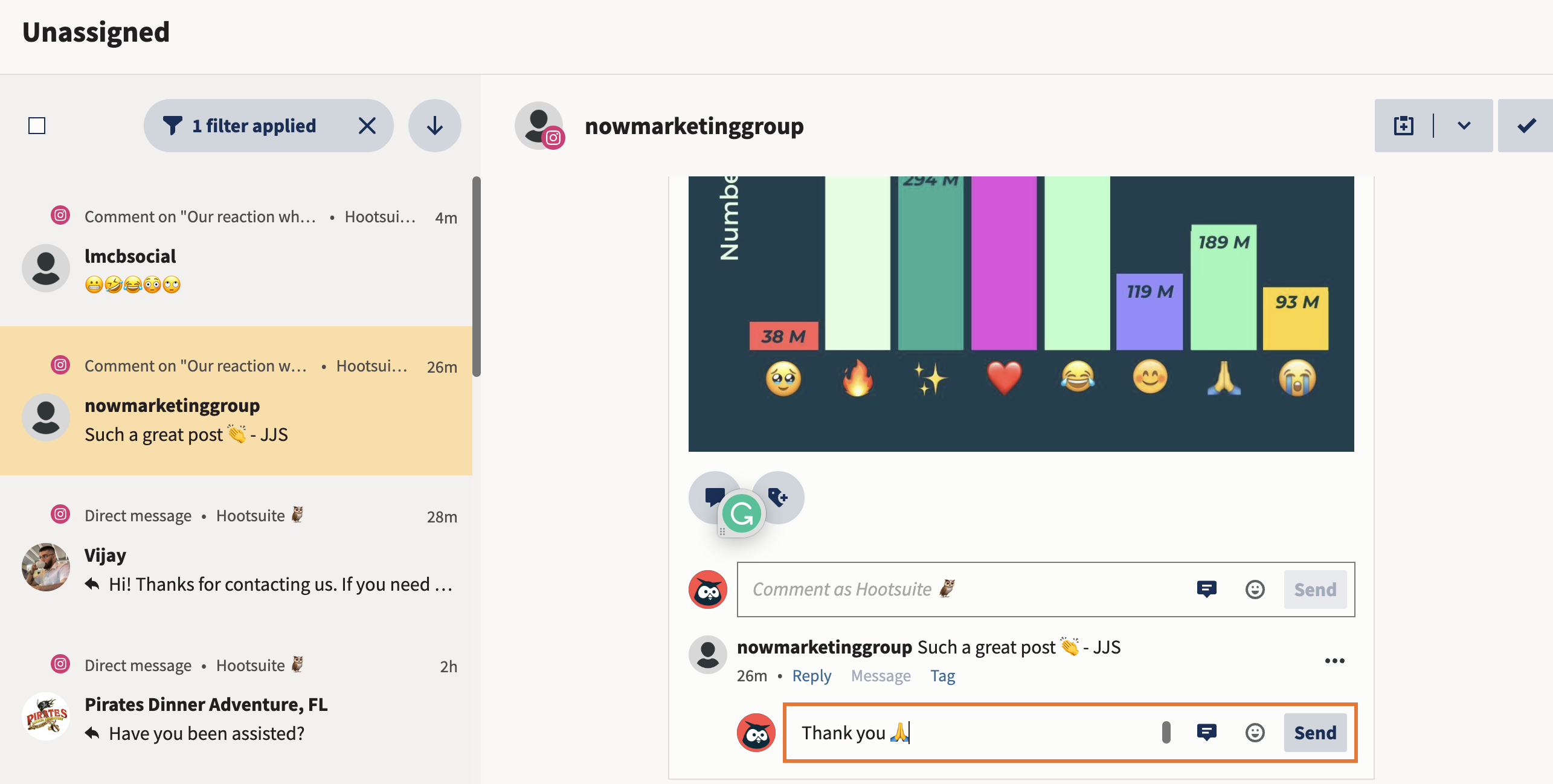
In customer service, response times and relationship quality see immediate improvements. Support agents equipped with a complete historical and social view can resolve inquiries efficiently without forcing customers to repeat details they have already shared on other channels. Automated routing ensures that critical complaints bypass general queues and land directly with specialized representatives.
For sales teams, social interactions provide critical intent signals that outperform traditional cold-outreach methods. A prospective buyer who consistently engages with product tutorials, comments on promotional reels, and submits pricing queries via direct message exhibits a clear readiness to buy. By syncing these social touchpoints with CRM lead scoring models, sales professionals can prioritize outreach based on demonstrated behavioral intent rather than arbitrary alphabetical lists.

Meanwhile, marketing departments leverage social CRM insights to refine content strategies, optimize advertising spend, and construct accurate audience lookalike profiles. By connecting social engagement metrics directly to closed sales pipelines, marketing leaders can accurately calculate return on investment and demonstrate the revenue impact of social media initiatives to executive stakeholders.
Overcoming Implementation Challenges
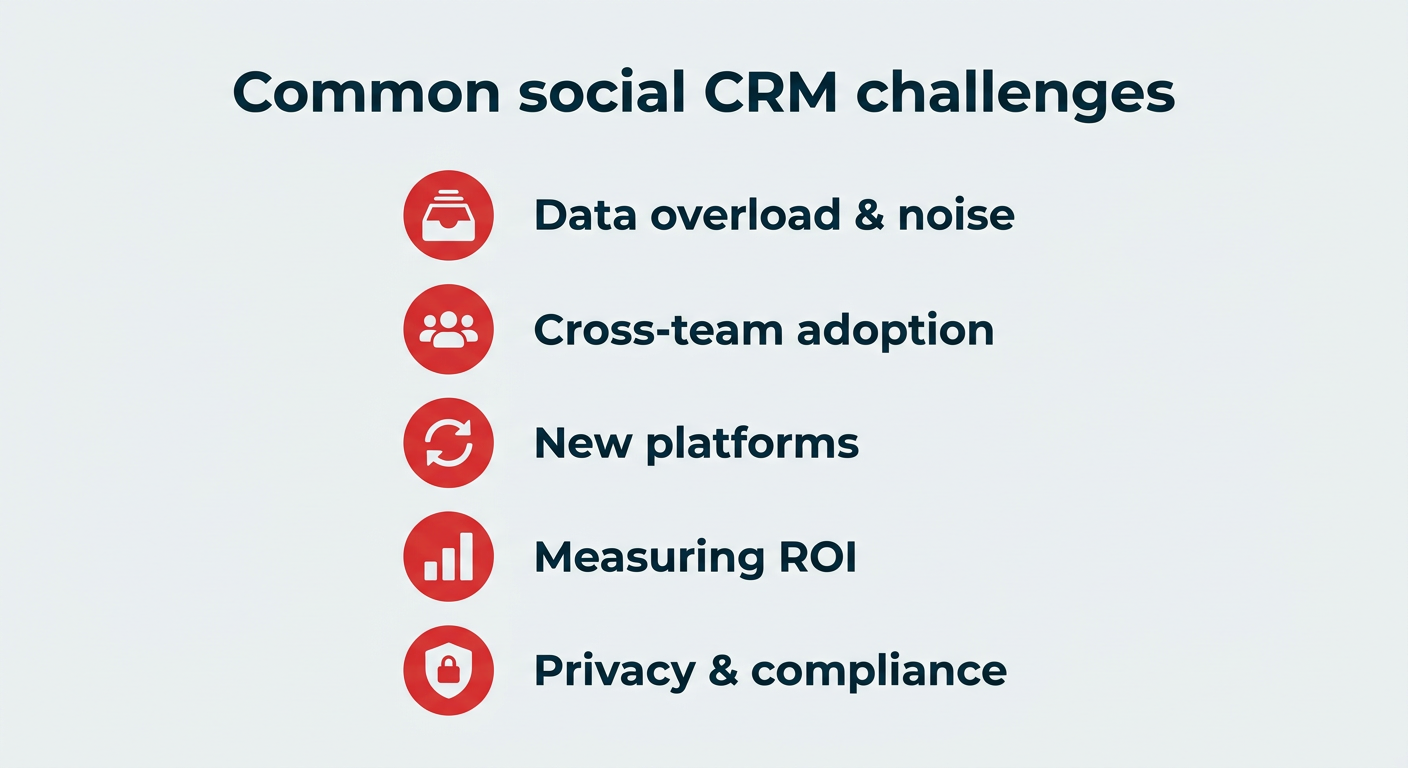
Despite clear advantages, organizations deploying social CRM frequently encounter distinct hurdles. Managing high volumes of unstructured data requires robust technological infrastructure and clearly defined filtering parameters. Additionally, encouraging cross-functional adoption between marketing, sales, and support teams demands structured internal training and unified standard operating procedures. Finally, maintaining rigorous data privacy compliance across global jurisdictions remains a top priority, requiring robust governance protocols to safeguard consumer information while delivering personalized digital experiences.
Strategic Framework for Implementation
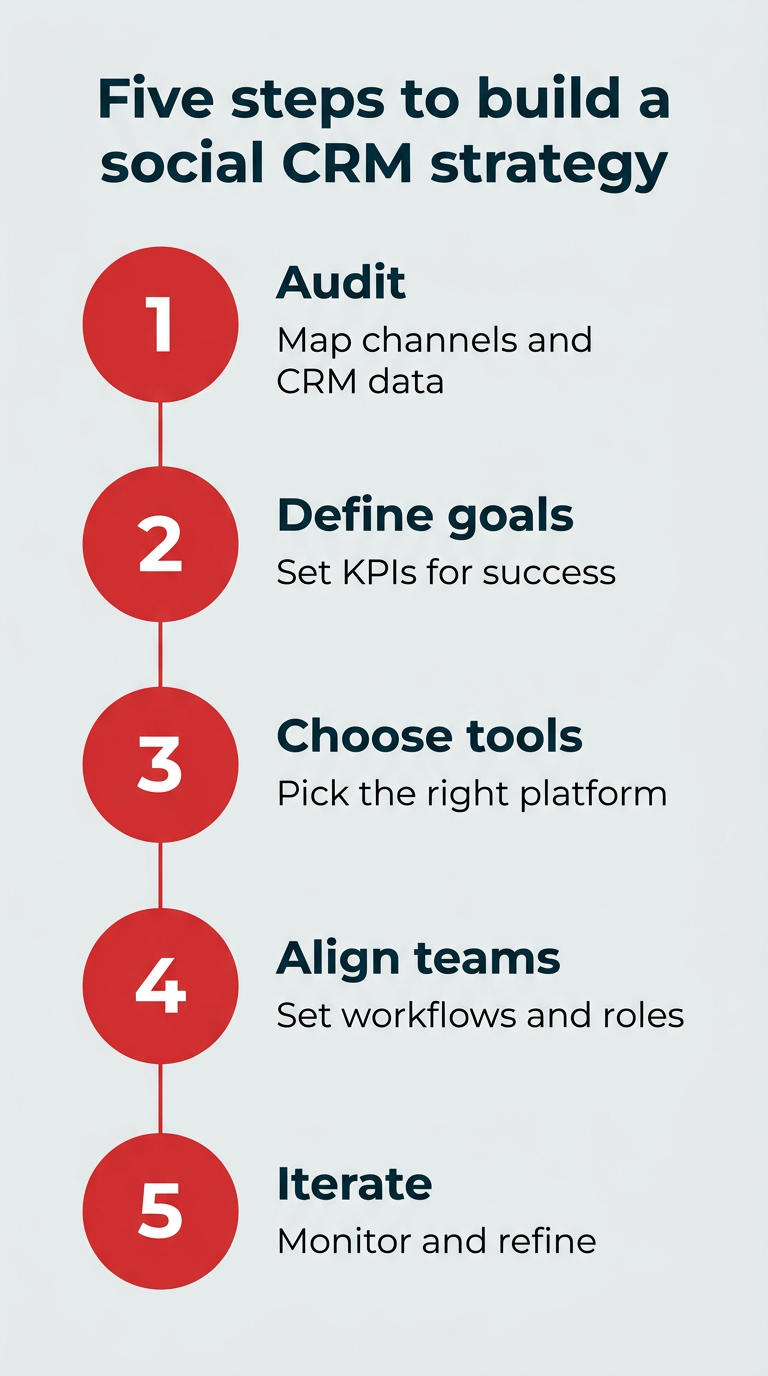
Enterprise organizations and growing businesses aiming to successfully deploy a social CRM strategy typically adhere to a five-step framework:
- Audit Current Infrastructure: Map existing social channels against current CRM data repositories to identify operational gaps and integration opportunities.
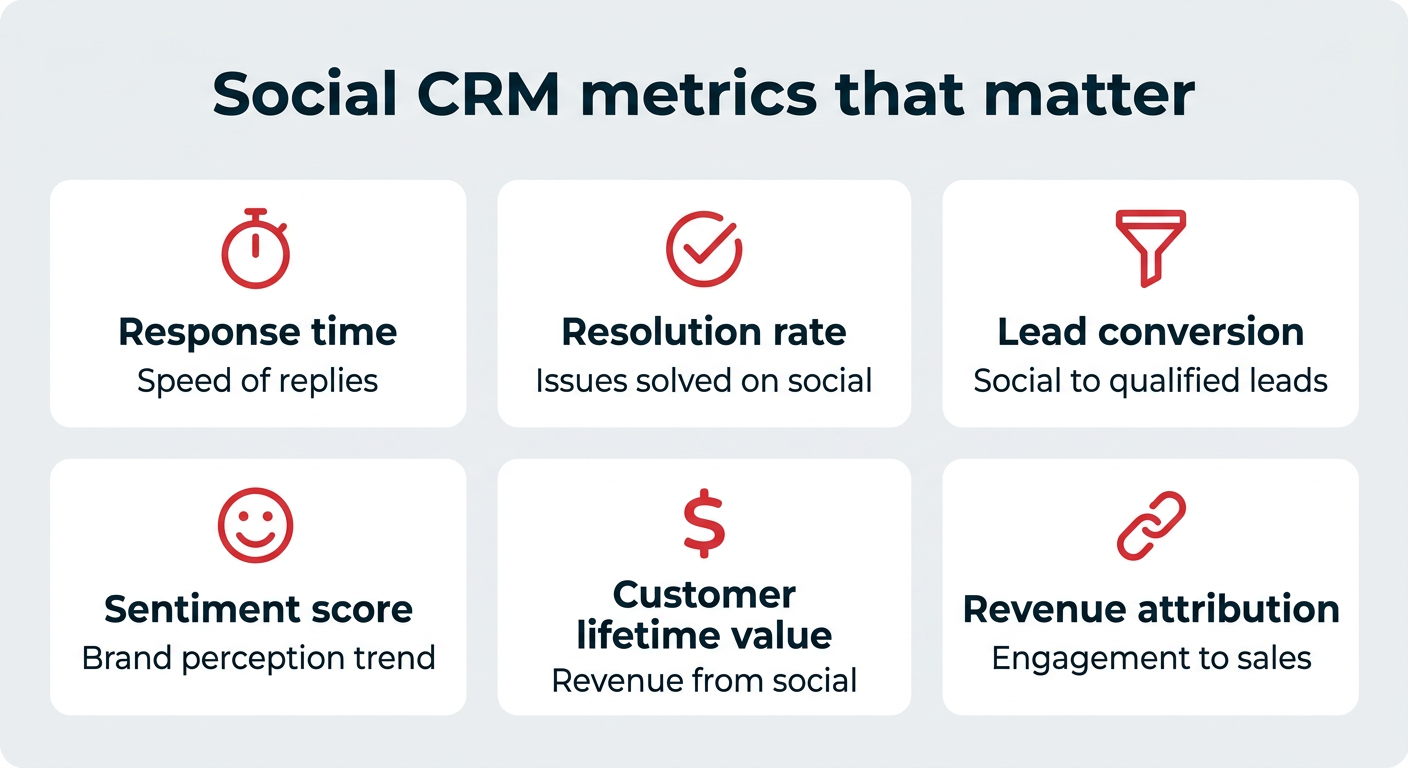
- Define Strategic Goals and KPIs: Establish measurable benchmarks—such as reduced first-response times, increased lead conversion rates, or improved sentiment scores—before deploying new software.
- Select Appropriate Tools: Choose software integrations that minimize manual data entry, seamlessly connect social engagement channels to core CRMs, and scale with organizational growth.
- Align Cross-Functional Workflows: Establish explicit routing rules, ownership guidelines, and communication protocols between marketing, sales, and support teams.
- Monitor, Measure, and Iterate: Continuously evaluate key performance indicators, utilizing AI-driven insights to adapt strategies dynamically in response to fast-moving digital trends.
The Leading Social CRM Platforms
Organizations evaluating software solutions to support these workflows can choose from several prominent enterprise tools, each tailored to distinct operational priorities:
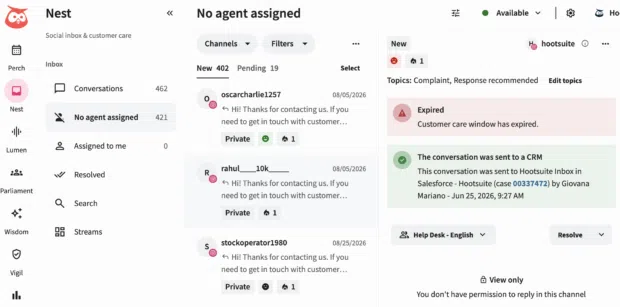
- Hootsuite: Recognized as an all-in-one social media management, listening, and engagement leader, featuring robust native inbox management (Nest) and seamless integrations with major enterprise CRMs.
- HubSpot: Designed as an inbound marketing, sales, and service platform built around a centralized Smart CRM, ideal for full-funnel pipeline management.
- Salesforce: A dominant enterprise CRM utilizing advanced conversational AI assistants and deep data analytics to guide complex sales pipelines and customer service operations.
- Microsoft Dynamics 365: A modular, highly customizable ecosystem that leverages advanced AI modeling to forecast customer intent and optimize audience segmentation.
- SugarCRM: A flexible, highly adaptable CRM focused on providing customizable global dashboards and tailored operational workflows for growing business teams.
Conclusion
As social media platforms solidify their positions as primary commercial contact points, the adoption of social CRM is no longer an experimental luxury for forward-thinking brands; it is a fundamental operational necessity. By tearing down departmental silos and integrating real-time digital conversations with historical customer records, organizations can deliver the speed, personalization, and consistency that modern consumers demand. Those that successfully align their teams, leverage AI-driven insights, and bridge the gap between social engagement and core business results will maintain a distinct competitive advantage in an increasingly connected global marketplace.