The landscape of digital discovery is undergoing its most profound structural shift since the advent of search engines. As consumers increasingly rely on conversational artificial intelligence tools like ChatGPT, Perplexity, Google AI Overviews, and Gemini to find information, traditional search engine optimization (SEO) tactics are no longer sufficient to guarantee brand visibility. When a user asks an AI model a question and acts on the synthesized response without ever clicking a link, traditional ranking metrics fail to capture the interaction. This phenomenon has given rise to Answer Engine Optimization (AEO) and a new class of digital marketing utilities known as AEO checkers.
Understanding the Genesis of Answer Engine Optimization
To comprehend the necessity of AEO checkers, one must examine the fundamental change in how search engines and AI models deliver content. Historically, search engines functioned as directories, indexing web pages and presenting users with a curated list of blue links. Brands competed for top positions in these rankings to drive traffic directly to their domains.
However, the widespread deployment of generative AI has transformed these directories into synthesized answer machines. Instead of sending users to multiple websites to research a topic, answer engines read across diverse sources, evaluate credibility, and compile a single, definitive response directly on the results page. Google’s introduction of AI Overviews in May 2024 institutionalized this summary-first approach within traditional search results, a move that fundamentally altered organic traffic patterns.
![AEO checker tools that measure answer engine visibility [2026]](https://53.fs1.hubspotusercontent-na1.net/hubfs/53/aeo-checker-1-20260903-3858273.webp)
While SEO remains critical for securing the crawlability and foundational authority that AI models rely on, AEO focuses on a distinct objective: ensuring that a brand is explicitly cited, referenced, or recommended within the body of the AI-generated text or its inline source attributions. Without a dedicated strategy to capture these placements, businesses risk losing visibility in channels where their target audiences increasingly spend their time.
The Mechanics and Workflow of an AEO Checker
An AEO checker is a specialized software tool designed to measure, analyze, and optimize a brand’s presence across various generative AI platforms. Because manual spot-checks are time-consuming and prone to the volatility inherent in large language models, automated AEO checkers provide continuous monitoring.
The core workflow of an AEO checker typically encompasses five continuous stages: measuring current visibility, diagnosing content gaps, prioritizing fixes, optimizing existing assets, and reporting on long-term trends. By evaluating specific queries—ranging from branded product searches to broad informational queries—these tools identify whether a brand is being cited, whether competitors are capturing the traffic, and whether the AI engine is accurately representing the brand’s offerings.
Furthermore, advanced checkers evaluate sentiment, differentiate between mere text mentions and active hyperlinks, and assess technical readiness, such as schema markup and entity structuring, which dictate whether AI crawlers can successfully parse a website’s content.
![AEO checker tools that measure answer engine visibility [2026]](https://no-cache.hubspot.com/cta/default/53/9dd5e54b-fbef-4dd0-bc44-1689feb1ea18.png)
Manual vs. Automated Monitoring Across Major Platforms
Before deploying dedicated software, digital marketers often begin by manually auditing their brand footprint across the primary generative search environments. Each platform presents unique structural characteristics that influence how citations are displayed.
Google AI Overviews (AIOs) trigger selectively based on whether Google’s systems determine that a summary adds value to a traditional query. Because AIOs are dynamic and session-dependent, conducting a reliable manual audit requires running targeted queries in incognito sessions, recording whether an overview appears, noting whether the domain is present in the inline source links, and archiving the specific claims made by the engine. Industry professionals must maintain meticulous logs, as standard analytics platforms historically aggregate AI overview impressions within broader web search metrics, though specialized reporting tools are gradually emerging to isolate generative traffic.
In contrast, platforms like Perplexity and ChatGPT rely heavily on inline citation indicators and dedicated side panels. Perplexity typically attaches numbered citations to every assertion, linking directly to the underlying web pages. ChatGPT integrates web search dynamically when current information is required, displaying source links both inline and within a summary panel beneath the dialogue box. Monitoring these platforms manually requires crafting precise, current prompts and executing multiple test runs to account for the stochastic nature of generative outputs.
Evaluating the Market: AEO Software Solutions
![AEO checker tools that measure answer engine visibility [2026]](https://53.fs1.hubspotusercontent-na1.net/hubfs/53/aeo-checker-2-20260903-852936.webp)
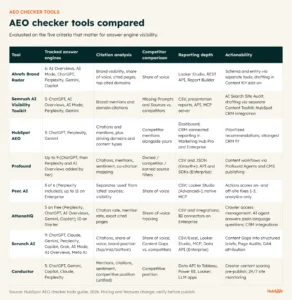
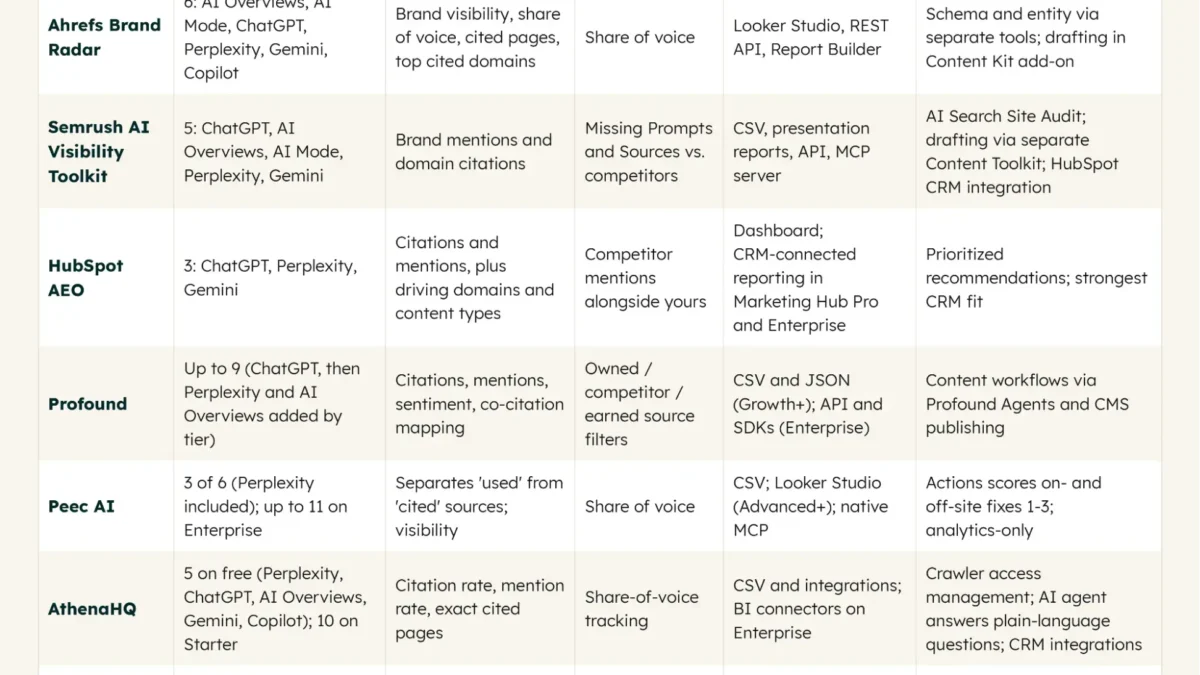
As the demand for visibility analytics grows, the market for AEO software has expanded rapidly, offering distinct tools tailored to different aspects of AI search optimization. Marketers evaluating these platforms typically assess them based on engine coverage, query scale, historical trend tracking, and actionable diagnostic capabilities.
Tools equipped with robust AI Overview tracking, such as Ahrefs Brand Radar and Semrush’s AI Visibility Toolkit, leverage extensive organic search indices to correlate traditional keyword rankings with AI-generated summary triggers. These utilities help organizations identify "near-inclusion" pages—content that already ranks well organically but requires structural refinement to secure a spot in the AI overview.
For dedicated citation detection across conversational models, platforms like HubSpot AEO and Profound offer granular insights. HubSpot AEO tracks visibility scores across ChatGPT, Perplexity, and Gemini while distinguishing between active citations and brand mentions. Profound extends this analysis by incorporating sentiment scoring, unprompted mention tracking, and a categorical breakdown of citations by source type, including owned, earned, and competitor media.
Other specialized platforms focus on niche requirements. Peec AI and AthenaHQ provide focused monitoring of Perplexity interactions, offering accessible entry points and conversational analytics assistants. Meanwhile, technical optimization tools like Scrunch AI and Conductor evaluate the underlying architecture of a website, ensuring that site content is fully accessible to AI crawlers, properly structured with schema markup, and optimized for entity recognition.
Essential Metrics for Measuring AEO Success
![AEO checker tools that measure answer engine visibility [2026]](https://53.fs1.hubspotusercontent-na1.net/hubfs/53/aeo-checker-3-20260903-8904553.webp)
Evaluating the return on investment for AEO initiatives requires tracking a specialized set of Key Performance Indicators (KPIs) that extend beyond traditional SEO metrics. Industry analysts recommend focusing on a core suite of measurements:
- AI Visibility Share: The percentage of target queries where a brand is either cited or mentioned relative to its competitors.
- Citation-to-Mention Ratio: An indicator of whether the brand is being actively referenced as an authoritative source via hyperlinks or merely acknowledged in passing text.
- Sentiment and Accuracy Score: An evaluation of how positively and accurately the AI model describes the brand’s products, services, and core value propositions.
- Zero-Click Influence Proxies: Correlating AI visibility trends with broader indicators of brand health, such as branded search volume lifts and direct traffic growth, to account for the influence of zero-click interactions.
Because generative outputs fluctuate based on prompt phrasing and contextual variables, marketers must evaluate these metrics as long-term trends rather than reacting to isolated daily fluctuations.
Bridging Diagnosis and Action
A significant challenge in the early adoption of AEO tools has been the fragmentation between measurement and execution. Historically, visibility checkers diagnosed content gaps and generated reports, leaving marketing teams to manually export data, brief copywriters, and implement fixes across disparate content management systems.
Modern enterprise integrations are actively closing this gap. By embedding AEO analytics directly into broader marketing ecosystems—such as HubSpot’s integration with Marketing Hub Professional and Enterprise—platforms are now capable of translating visibility diagnostics into automated workflows. When an AEO tool identifies a content gap or a missing citation opportunity, integrated generative agents can draft research-backed, brand-compliant content directly within the content editor. This streamlined loop enables marketing teams to address AI visibility deficiencies with unprecedented speed.
![AEO checker tools that measure answer engine visibility [2026]](https://53.fs1.hubspotusercontent-na1.net/hubfs/53/aeo-checker-4-20260903-6212698.webp)
Furthermore, by anchoring these insights within a smart Customer Relationship Management (CRM) framework, businesses can more accurately attribute traffic referred from AI engines to downstream pipeline and revenue. While zero-click queries will inherently remain invisible to standard session tracking, capturing and converting the traffic that does click through provides a tangible measure of AEO effectiveness.
Future Outlook and Strategic Imperatives
The evolution of answer engines signals a permanent transformation in digital marketing. As search engines and AI assistants become the primary gatekeepers of consumer intent, organizations can no longer rely solely on ranking for keywords in a static list of links.
Adopting a rigorous AEO strategy—supported by automated checking tools, structured data implementation, and authoritative content creation—is no longer an experimental tactic for early adopters. It has become a foundational requirement for maintaining brand authority, protecting market share, and ensuring discoverability in an increasingly automated digital economy.