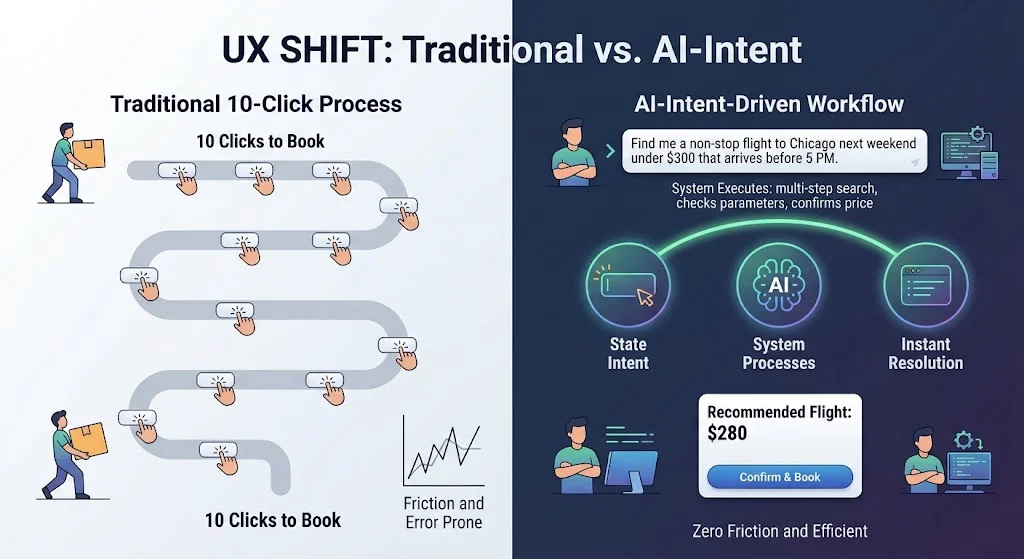
For over four decades, the digital landscape has been defined by the point-and-click paradigm. From the pioneering days of the Xerox Star in the early 1980s to the modern browser-based web, software has functioned as a rigid, menu-driven ecosystem. Users have been trained to navigate complex architectures, filling out forms, adjusting range sliders, and managing browser tabs to achieve simple objectives. However, this interaction model is currently undergoing a structural collapse. As artificial intelligence and large language models (LLMs) mature, the industry is pivoting toward "Intent-Driven Design," a philosophy that seeks to eliminate the interface entirely by focusing on the user’s ultimate goal rather than the mechanical steps required to reach it.

The Chronology of the Graphical User Interface
To understand the magnitude of this shift, one must examine the history of human-computer interaction (HCI). The 1970s and 80s marked the commercialization of the Graphical User Interface (GUI). Apple’s Macintosh and the Xerox Star transformed computing from a text-based, command-line experience into a visual, spatial one. This was a revolutionary leap for accessibility, but it introduced a new form of friction: the "10-click" process.
For decades, software development followed the "Model-View-Controller" pattern, where users were expected to understand the software’s internal logic. Whether booking a flight or researching a health concern, the process remained identical: the user provided the input, the software displayed a database, and the user performed the "grunt work" of synthesis. By the mid-2010s, this began to reach a saturation point. Designers and theorists like Golden Krishna, in his seminal work The Best Interface Is No Interface, argued that the industry’s obsession with "more" (more features, more buttons, more navigation) was paradoxically making software less usable.
Supporting Data: The Friction Economy
Modern digital metrics have historically incentivized "Time Spent in App" and "Page Views per Session." However, data from recent UX research suggests that these metrics are becoming vanity indicators of inefficiency. A 2023 study by the Nielsen Norman Group on the AI-driven paradigm shift indicates that users are increasingly frustrated by multi-step web forms, with abandonment rates rising by nearly 15% when tasks require more than four distinct interaction points.
The transition to intent-driven design is not merely an aesthetic preference; it is an economic necessity. In the current market, platforms that minimize user interaction are seeing higher retention rates. For instance, platforms like Perplexity AI, which synthesize answers from across the web, have successfully challenged the traditional "ten blue links" search model. By bypassing the need for a user to open five different tabs to verify information, these platforms have redefined the standard for search efficiency.
Three Pillars of the New Paradigm
The transition from static, click-based UIs to intent-driven experiences relies on three foundational pillars: High-level goals, Generative UI, and Autonomous AI agents.
1. High-level Goals and Contextual Awareness
Rather than requiring specific parameters, modern systems are designed to parse natural language. By integrating metadata—such as geographic location, device state, and historical interaction patterns—AI systems can anticipate requirements. For example, a travel-booking interface no longer requires a user to manually select airport codes, dates, and seating preferences. A simple request for "a weekend trip to Chicago under $300" triggers a background process that executes the search, filters by arrival times, and presents a single, actionable resolution.
2. The Rise of Generative UI
In the traditional web, every user encounters the same layout. Generative UI shifts this model, allowing the interface to materialize in real-time based on the user’s specific requirement. Tools such as Vercel v0 demonstrate this capability by allowing users to generate functional code and UI components on demand. If a user needs a financial calculator, the interface generates it specifically for that session; once the calculation is complete, the interface recedes. This eliminates the "clutter" inherent in static, feature-heavy websites.
3. Autonomous Execution via Agents
The shift in UX philosophy is also transforming error recovery. Traditional interfaces rely on "prevention"—constantly prompting users with warning modals. Intent-driven systems, conversely, focus on "reversibility." By leveraging autonomous agents, these systems can perform tasks on behalf of the user, provided there is a seamless "undo" mechanism or a clear audit log. This shifts the user’s role from "system operator" to "system supervisor."
Official Perspectives and Industry Reactions
Leading design organizations, including the Google PAIR (People + AI Research) team, have been vocal about the necessity of transparent feedback loops. The primary concern among industry leaders is the "Black Box" problem. When an AI agent executes a task, the user must be able to understand the "why" behind the result. Without clear communication of the system’s intent, trust erodes.
Furthermore, the Center for Humane Technology has cautioned against the potential for manipulative defaults. As companies integrate AI into their user flows, there is a risk that "inferred intent" could be used to steer users toward products or services they did not explicitly choose. Consequently, designers are now tasked with creating "boundary-setting" tools that ensure AI agents act within the user’s stated parameters, particularly in high-stakes environments such as banking or healthcare.
Broader Impact and Implications
The implications for the web design industry are profound. The role of the UX designer is shifting from that of a "screen architect" to a "behavioral strategist." Designers are no longer just drawing rectangles or selecting color palettes; they are mapping the logic that allows AI to navigate, interpret, and resolve human goals.
This transformation suggests a future where the web is less of a "place" one visits and more of a "service" that acts in the background. The "death of the button" is not a loss of functionality; it is a move toward a more human-centric computing experience. The ultimate measure of success for future software will be the degree to which it can disappear, leaving the user with the result of their intent rather than the burden of the software itself.
Conclusion
The evolution toward intent-driven design marks the end of an era where interaction was the primary currency of the web. As we move away from static forms and rigid, linear paths, we are entering a phase of "invisible completion." The digital tools of the next decade will likely be judged by a singular, rigorous standard: did the software solve the problem, and did it do so without requiring the user to navigate a labyrinth of its own creation? While the transition poses challenges—particularly in ethics, transparency, and user control—the movement toward seamless, goal-oriented interaction represents the most significant shift in web architecture since the birth of the GUI. The future of the web is not more interaction; it is the silent, efficient resolution of human intent.