As the United States approaches a pivotal electoral cycle, technology platforms are aggressively positioning themselves as indispensable partners for political campaigns seeking to capture the attention of an increasingly digital electorate. In a strategic move ahead of the November midterm elections, Snapchat has released a comprehensive new research report aimed squarely at advertisers, political strategists, and campaigns. The study, titled to showcase the platform’s unique civic engagement capabilities, highlights how Snapchat users—predominantly younger demographics—interact with political content, discover candidates, and formulate their voting decisions.
The report arrives at a time when political ad spending is shifting rapidly toward digital-first environments. Campaigns are no longer relying solely on traditional broadcast television and direct mail; instead, they are forced to meet voters where they consume media daily. By commissioning this research, Snap Inc. is making a calculated pitch to political marketers: that the platform offers an unparalleled gateway to a politically active, open-minded, and highly impressionable user base that is significantly more likely to participate in the democratic process than the general public.
Methodology and Scope of the Research
The findings released by Snapchat are derived from a detailed survey conducted earlier this year by Alter Agents, an independent market research firm. The study surveyed more than 1,000 Snapchat users ranging in age from 18 to 45, capturing the attitudes, behaviors, and media consumption habits of millennials and Generation Z. These cohorts are frequently categorized by pollsters as difficult to reach through traditional media channels, making platforms like Snapchat critical for modern political outreach.
According to the response data compiled by Alter Agents, Snapchat users exhibit a high degree of interest in civic participation. Furthermore, they are notably receptive to in-app outreach that focuses on specific policy issues and causes rather than traditional partisan messaging. The research indicates that the platform’s user base values substantive engagement, presenting an opportunity for campaigns that move beyond mudslinging to focus on grassroots issues and candidate platforms.
Uniquely Open-Minded Electorate
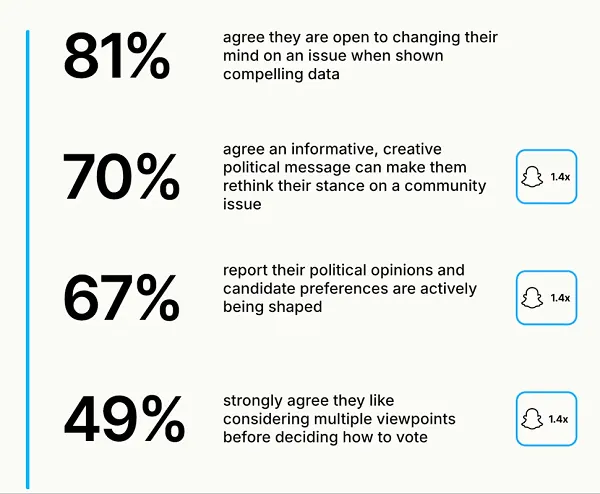
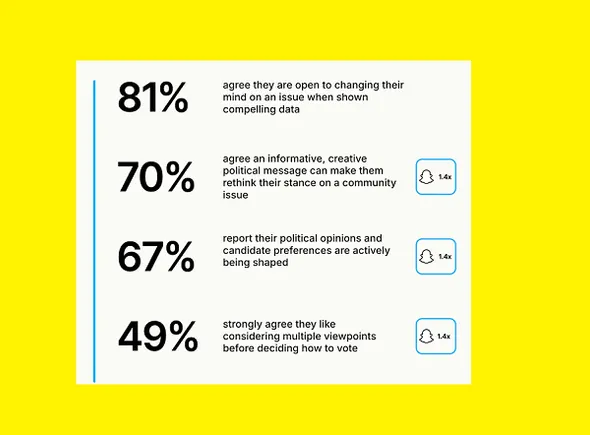
One of the most striking findings highlighted in the report is the psychological posture of Snapchat users regarding politics. In a contemporary political landscape defined by deep polarization and entrenched partisanship, Snap’s research suggests that its users buck this trend.
As articulated in the platform’s official summary: "In a complex political landscape, Snapchatters are uniquely open-minded in their political approach, seeking out viewpoints before choosing how to vote and open to changing their positions."
This intellectual flexibility represents a valuable target audience for political campaigns. Rather than preaching to the choir of dedicated partisans, advertisers on Snapchat have a distinct opportunity to sway undecided voters, introduce alternative policy positions, and capture the interest of individuals who are actively researching candidates before casting their ballots. For political strategists accustomed to preaching to hardened ideological bases, this openness suggests that educational, policy-driven ad campaigns can yield a high return on investment.
Key Statistical Insights and Voter Propensity
The data released in the report paints a clear picture of an active and digitally reliant voter base. Most notably, nearly 80%—specifically 78%—of surveyed Snapchat users indicated that they plan to vote in the upcoming midterm elections. When compared against broader demographic averages and non-users, the data reveals that Snapchat users are 1.2 times more likely to participate in the electoral process than individuals who do not use the application.
This high propensity for voting is mirrored by a heavy reliance on digital advertising for political discovery. According to the study, 80% of respondents reported that political promotions on the platform successfully introduced them to candidates and policy causes they were previously entirely unaware of. This statistic underscores the role of social media advertising not merely as a persuasion tool, but as a fundamental engine of political awareness and civic education.
Furthermore, the advertising impact extends beyond passive awareness. The survey found that 74% of Snapchat users are significantly more likely to proactively research candidates, investigate their voting records, and visit their campaign websites after encountering a political ad on the platform. This behavioral shift demonstrates that in-app advertising acts as a catalyst for deeper offline and online political engagement, bridging the gap between passive scrolling and active civic participation.
A History of Digital Civic Engagement
Snapchat’s latest pitch to political advertisers is not an isolated marketing pivot; rather, it is the continuation of a multi-year institutional focus on civic participation and voter registration. Long before releasing this specific midterm report, Snap recognized that its unique demographic reach carried a societal responsibility to encourage democratic engagement.
The platform’s journey into civic tech dates back several election cycles, punctuated by aggressive, in-app voter registration initiatives. In the 2018 midterm elections, Snapchat deployed native registration tools and reminders that successfully drove more than 450,000 individuals to register to vote. The success of these early initiatives proved that a social media platform could tangibly influence electoral turnout among younger demographics who historically suffer from lower voter participation rates.
Building upon this foundation, the platform scaled its efforts dramatically ahead of the 2020 U.S. presidential election. Through a combination of targeted in-app prompts, non-partisan educational guides, and seamless registration widgets, Snapchat directly drove 1.2 million people to register to vote. This monumental increase cemented the platform’s reputation as a reliable infrastructure partner for non-partisan voter mobilization, earning praise from civic groups on both sides of the political aisle.
The 2022 Midterm Strategy and Industry Context
As the November midterms approach, political ad spending across all digital platforms is reaching historic highs. Competitors such as Meta (Facebook and Instagram), TikTok, and Alphabet (YouTube and Google) are similarly courting political action committees (PACs), national party committees, and individual candidate campaigns. However, each platform offers a distinct value proposition.
While Meta commands a broader age demographic and TikTok dominates short-form video entertainment, Snapchat leverages a trusted, closed-network environment where users interact primarily with close friends. This environment, combined with augmented reality (AR) filters, targeted story ads, and interactive lenses, provides political campaigns with creative avenues to deliver their messages.
Industry analysts note that younger voters often tune out traditional political advertising due to perceived inauthenticity. By utilizing Snapchat’s native ad formats—such as Snap Ads, Collection Ads, and interactive AR experiences—campaigns can craft immersive narratives that resonate more deeply with Gen Z and millennial voters. The data showing that 80% of users discover new candidates through these ads suggests that creative format diversity plays a critical role in cutting through political noise.

Implications for Political Campaigns and Advertisers
The implications of Snapchat’s research extend far beyond corporate earnings for the social media giant; they signal a broader evolution in how political campaigns must allocate resources to remain competitive.
First, campaigns must recognize that digital literacy among younger voters translates into high expectations for political advertising. Ads that rely on outdated television tropes or purely negative partisan attacks are less likely to resonate with an audience that actively seeks out diverse viewpoints and open-minded dialogue. Campaigns that invest in informative, transparent, and visually engaging digital content are poised to capture the attention of the 74% of users who research candidates post-impression.
Second, the data reinforces the necessity of early engagement. Because Snapchat users are actively researching candidates and forming their voting intentions well in advance of election day, campaigns cannot afford to wait until the final weeks of the cycle to deploy their digital budgets. Building brand awareness and establishing policy positions early in the cycle is critical to capturing the mindshare of undecided or open-minded voters.
Finally, the strong correlation between app usage and voter turnout challenges the persistent stereotype of political apathy among younger generations. The finding that Snapchat users are 1.2 times more likely to vote than non-users demonstrates that Gen Z and millennial cohorts are deeply invested in the outcome of elections, provided they are met on platforms they trust and frequent.
Broader Impact on the Democratic Process
The intersection of social media platforms and democratic elections remains a subject of intense public scrutiny, regulatory debate, and academic study. Concerns regarding misinformation, data privacy, and the influence of dark money in digital advertising continue to shape the political discourse surrounding tech companies.
In response to these challenges, platforms like Snapchat have instituted rigorous vetting processes for political ads, often requiring full transparency libraries and barring certain types of micro-targeting or misleading content. By emphasizing non-partisan voter registration, civic education, and open-minded dialogue in its reporting, Snap is attempting to frame its platform not merely as a commercial ad space, but as a constructive public square that strengthens democratic resilience.
As the political establishment pours billions of dollars into digital campaigns ahead of November, the success of these efforts will ultimately be measured at the ballot box. If Snapchat’s research holds true, the millions of young voters utilizing the platform will play a decisive role in shaping the political landscape of the United States. For advertisers and political strategists alike, the message is clear: engaging the modern electorate requires meeting them on their terms, in their digital spaces, and with a commitment to substance over spin.