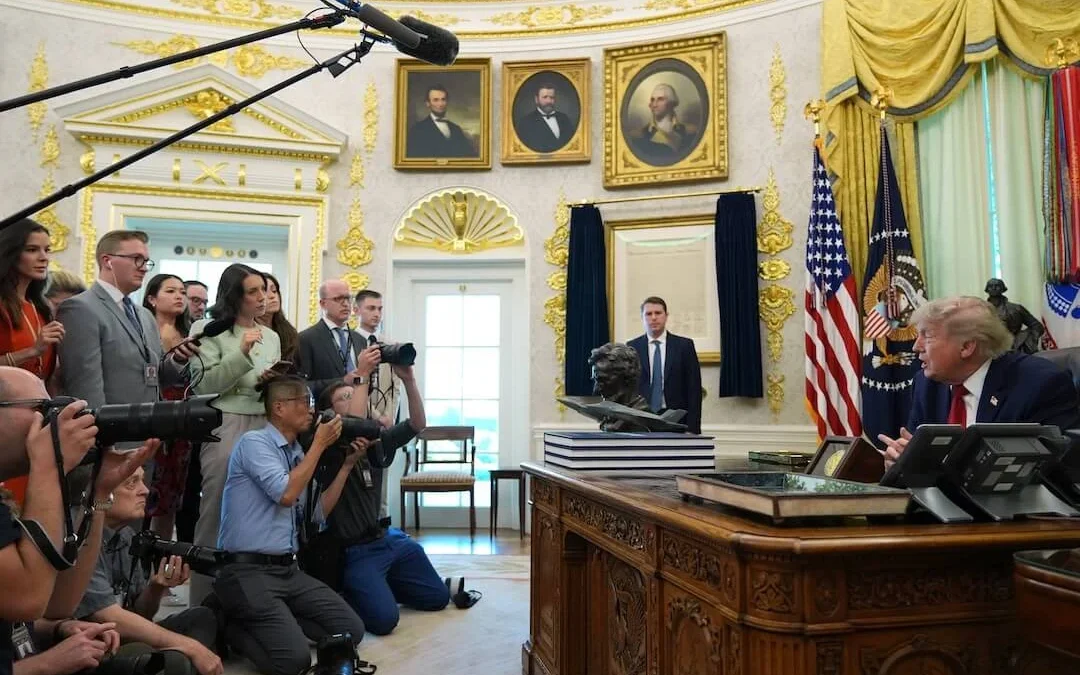
A collaborative research project conducted by the Pew Research Center and the Knight Foundation has unveiled a complex portrait of American attitudes toward the Fourth Estate. While the study confirms that approximately three-quarters of the U.S. public view a free press as essential to the functioning of a democratic society, this broad philosophical support masks deep-seated ideological fractures regarding how that freedom should operate in practice. The data suggests that when theoretical support for the First Amendment encounters real-world scenarios—such as national security concerns or the proliferation of misinformation—a significant portion of the electorate is willing to entertain government intervention that would historically be considered an infringement on press liberty.
The findings, released in mid-September 2026, arrive at a time of heightened political polarization, where the definition of "truth" and the role of the media have become central battlegrounds in the American culture war. By blending quantitative survey data with qualitative focus group discussions, the report provides a rare window into the internal struggle many citizens face when balancing the abstract ideal of a free press against the concrete desire for security and information integrity.
The National Security Paradox
Perhaps the most striking finding in the Pew-Knight report is the willingness of a majority of Americans to grant the government authority to suppress journalistic content under the guise of "national security." Over 50% of respondents agreed that the government should have the power to order a news organization to retract or withhold a story if it is deemed a risk to national safety.
This sentiment crosses partisan lines, though with varying intensity. While half of Democrats and those who lean Democratic support such government intervention, the number climbs to over 70% among Republicans and Republican-leaning independents. This data point highlights a significant shift in public trust: many citizens appear to prioritize the state’s classification of sensitive information over the media’s role as an independent watchdog.
Focus group participants expressed the tension inherent in this trade-off. One male respondent in his 30s argued that the classification process exists for a reason, emphasizing that the public cannot always be privy to information that might put lives in danger. Conversely, a female participant in her 40s raised a point that continues to haunt journalism ethics: the potential for administrative overreach. She questioned whether the "national security" label is being used legitimately or as a strategic shroud to suppress whistleblowers and shield the executive branch from accountability. This skepticism is the crux of the debate, as the "persuasive power" of the national security label often overrides the public’s instinct to protect the free press.
The Challenge of Misinformation
The report identifies a similar trend regarding the government’s role in curbing inaccuracies. Nearly half of the American public believes the government should possess the authority to order the removal of news stories found to contain false information. This desire for regulation reflects a public weary of the digital age’s rapid-fire spread of falsehoods, yet it ignores the legal and ethical complexities of defining "falsehood."
Journalism professionals point to the "wrinkles" in this proposal: the difference between a good-faith editorial error, a lack of journalistic due diligence, and intentional, malicious fabrication. Historically, the U.S. legal system has relied on the "marketplace of ideas" rather than government intervention to resolve disputes over truth. However, the survey suggests that a growing portion of the public is losing patience with this slow-moving mechanism, preferring a top-down regulatory approach to ensure the veracity of news.
Partisan Divergence on Press Threats
The report further delineates how political identity shapes one’s perception of what constitutes a threat to the press. For those on the left, the primary concerns are rooted in the administrative actions of the Trump administration. Documented instances, such as the effort to revoke Pentagon press credentials for journalists who published leaked (though unclassified) documents, the use of Justice Department subpoenas to obtain journalists’ private communications, and an increase in defamation litigation, are viewed as an existential threat to investigative reporting. According to the study, roughly 70% of Democrats believe that press freedom has diminished under the current administration.
In contrast, the view from the right is markedly different. Only 15% of Republicans believe the press is less free today, while 20% argue that the media environment has become freer. For many in this demographic, the primary "threat" to the information ecosystem is not government suppression, but rather "gatekeeping" and perceived ideological bias within traditional newsrooms.
The acquisition of Twitter (now X) by Elon Musk serves as a touchstone for this perspective. Supporters of this shift view the platform’s change in leadership as a restoration of free expression, allowing voices previously sidelined by traditional editorial boards to reach a wider audience. To this group, the "free press" is not a protected class of institutional journalists, but rather a chaotic, open-market of individual speech.
Misconceptions Regarding the First Amendment
A critical takeaway from the study is the profound gap between public sentiment and constitutional reality. Despite the high value placed on the First Amendment, the report found that only one-third of Americans understand that the First Amendment does not mandate that social media platforms or news organizations publish anyone’s speech. Furthermore, there is a widespread misunderstanding that the government possesses the power to force private companies to remove false information—a power that, under current U.S. law, the government does not have.
Perhaps most concerning for media advocates is the finding that only half of the adult population correctly identifies that the First Amendment explicitly guarantees freedom of the press. This suggests that the foundational concepts of American democracy are becoming increasingly detached from the public’s working knowledge of the Constitution. If the public does not understand the scope of these protections, they are less likely to defend them when they are challenged.
Broader Implications for Journalism
The Pew-Knight report serves as a warning for those in the media industry who assume that the public’s theoretical support for the press will translate into institutional protection during times of crisis. The data indicates that the "watchdog" function of the press—the ability to publish leaked, sensitive, or critical information—is viewed with skepticism by a significant percentage of the population. Approximately 40% of the public believes that reporters should rarely or never publish leaked materials, suggesting that the public’s definition of "responsible journalism" is increasingly at odds with the traditional adversarial role of the press.
As the industry grapples with these findings, the path forward requires a re-evaluation of how news organizations communicate their value to the public. Technical knowledge of constitutional law cannot be assumed, and the assumption that the public inherently trusts the media’s role in democracy is increasingly tenuous.
The upcoming industry discussions, including webinars featuring legal experts from organizations such as CNN and Poynter’s Press Freedom Watch, are expected to pivot toward these challenges. The core issue remains: if a democracy’s citizens are willing to trade press freedom for the comfort of government-managed security and the sanitization of information, the structural integrity of that democracy may be at risk.
The study highlights that while the U.S. public remains philosophically committed to the ideal of a free press, the practical application of that ideal is undergoing a significant transformation. Whether this shift represents a temporary reaction to the current political climate or a permanent change in the American social contract remains to be seen. What is clear, however, is that the future of the First Amendment will be decided not only in the halls of justice but in the court of public opinion, where the appetite for regulation currently competes with the foundational necessity of an uninhibited press.