
As the nation prepares to observe Constitution Day on September 17, a renewed focus has been placed on the foundational document that governs American life. While public opinion polls frequently reveal that a majority of Americans support significant structural changes to the U.S. political system—including the implementation of term limits for members of Congress, adjustments to the age requirements for federal officials, and stricter regulations on campaign finance—these aspirations often collide with a structural reality: the U.S. Constitution is one of the most rigid and difficult-to-amend governing documents in the global democratic landscape.
The U.S. Constitution, which has served as the bedrock of American governance for 237 years, has been formally amended only 27 times since its ratification in 1788. This rarity is not accidental; the Framers intentionally designed an arduous process to prevent impulsive or fleeting political majorities from fundamentally altering the republic’s charter. However, in an era of intense political polarization, this high threshold for change has transformed the amendment process from a deliberate check on power into a near-insurmountable barrier, raising questions about the long-term adaptability of American democracy.
A Comparative Analysis of Constitutional Rigidity
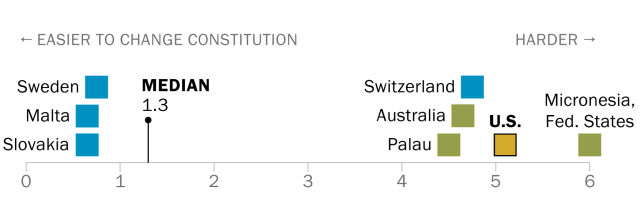
To understand where the United States stands in the global context, researchers at the Pew Research Center utilized a classification system originally developed by the late political scientist Donald S. Lutz in his seminal 1994 American Political Science Review paper, "Toward a Theory of Constitutional Amendment." By analyzing the amendment rules of 101 democratic nations, this research provides a quantitative score for the "difficulty of amendment," focusing on the least arduous path provided by each constitution.
The data reveals a stark hierarchy. At the top of the list—representing the most difficult constitutions to alter—is the Federated States of Micronesia (FSM). With a difficulty score of 6.00, the FSM’s amendment process requires a complex sequence of legislative supermajorities and regional referendums. The United States follows closely behind with a score of 5.10. Other nations that occupy the upper echelon of difficulty include Switzerland (4.75), Australia (4.65), and Palau (4.50).

These countries share a common structural trait: they are federal systems that require consensus not only at the national legislative level but also among subnational entities—such as states, cantons, or territories—to ratify any proposed changes. In contrast, many other democracies, particularly those with unicameral legislatures, possess "softer" constitutions. These nations can often amend their founding documents through mechanisms that mirror the passage of standard legislation, albeit with higher vote thresholds, placing them at the bottom of the difficulty scale with scores often falling below 1.00.
The Anatomy of the U.S. Amendment Process
The U.S. Constitution’s amendment pathway, outlined in Article V, requires a two-step process that demands overwhelming consensus. First, a proposed amendment must secure a two-thirds vote in both the U.S. House of Representatives and the U.S. Senate. If successful, the proposal enters the ratification stage, where it must be approved by three-quarters of the individual state legislatures (currently 38 out of 50 states).
This dual-layer hurdle is what accounts for the infrequency of formal changes. The first ten amendments—the Bill of Rights—were adopted almost immediately after ratification, largely as a prerequisite for the support of several states. In the more than two centuries since, only 17 additional amendments have been ratified. Notable examples include the 13th Amendment, which abolished slavery; the 19th Amendment, which granted women the right to vote; and the 26th Amendment, which lowered the voting age to 18. Each of these required a unique alignment of social pressure, legislative will, and state-level approval.
Chronology of Constitutional Evolution
- 1787: The Constitutional Convention concludes in Philadelphia, drafting the document that would replace the Articles of Confederation.
- 1788: New Hampshire becomes the ninth state to ratify the Constitution, ensuring its legal enactment.
- 1791: The Bill of Rights (Amendments 1–10) is ratified to address concerns regarding individual liberties.
- 1865: Following the conclusion of the Civil War, the 13th Amendment is ratified, formally ending slavery.
- 1920: The 19th Amendment is ratified, guaranteeing women’s suffrage after decades of activism.
- 1971: The 26th Amendment lowers the voting age to 18, reflecting the changing demographic landscape during the Vietnam War era.
- 1992: The 27th Amendment, originally proposed in 1789, is finally ratified, setting limits on when congressional pay raises can take effect.
Implications of Legislative Stasis
The difficulty of the amendment process has significant implications for modern governance. When the formal process for updating the Constitution becomes effectively closed, political stakeholders often turn to other, more volatile methods of change. This includes reliance on judicial interpretation by the Supreme Court—which can lead to accusations of "judicial activism"—or the use of executive orders, which are subject to reversal by succeeding administrations.
Political scientists argue that this cycle contributes to the current atmosphere of hyper-polarization. When citizens feel that the formal system cannot respond to their preferences for change, their frustration with the democratic process grows. The "stickiness" of the Constitution acts as a stabilizer, preventing radical shifts, but it also creates a pressure cooker effect. When constitutional reform is impossible through the front door, politics becomes a battle over the makeup of the courts, as parties fight to achieve their policy goals through judicial rulings rather than the deliberative, consensus-building process intended by the Founders.
A Global Perspective on Democracy
While the United States is frequently cited as the world’s oldest functioning democracy, it is also an outlier in how it manages its own evolution. Among the 106 countries classified as democracies in the Pew analysis, the U.S. is consistently found to be among the most rigid. This rigidity is a reflection of the Founders’ fear of "mob rule" and their desire to protect the rights of the minority against the whims of a temporary majority.
However, as the 21st century progresses, the gap between the public’s desire for reform and the legislative reality remains a defining feature of the American political experience. Whether the nation will eventually find a way to navigate this structural hurdle remains one of the most critical questions for the future of American democracy. For now, as Americans celebrate Constitution Day, they do so with the awareness that the document is not merely a historical relic, but an active, albeit deeply resistant, participant in the ongoing governance of the United States.
The analysis serves as a sobering reminder for policymakers and citizens alike: the mechanisms for change are intentionally narrow, designed to prioritize stability over speed. In a world that is rapidly shifting, the challenge for the United States will be to maintain that stability while ensuring that the governing framework remains relevant to the needs and values of its modern electorate.