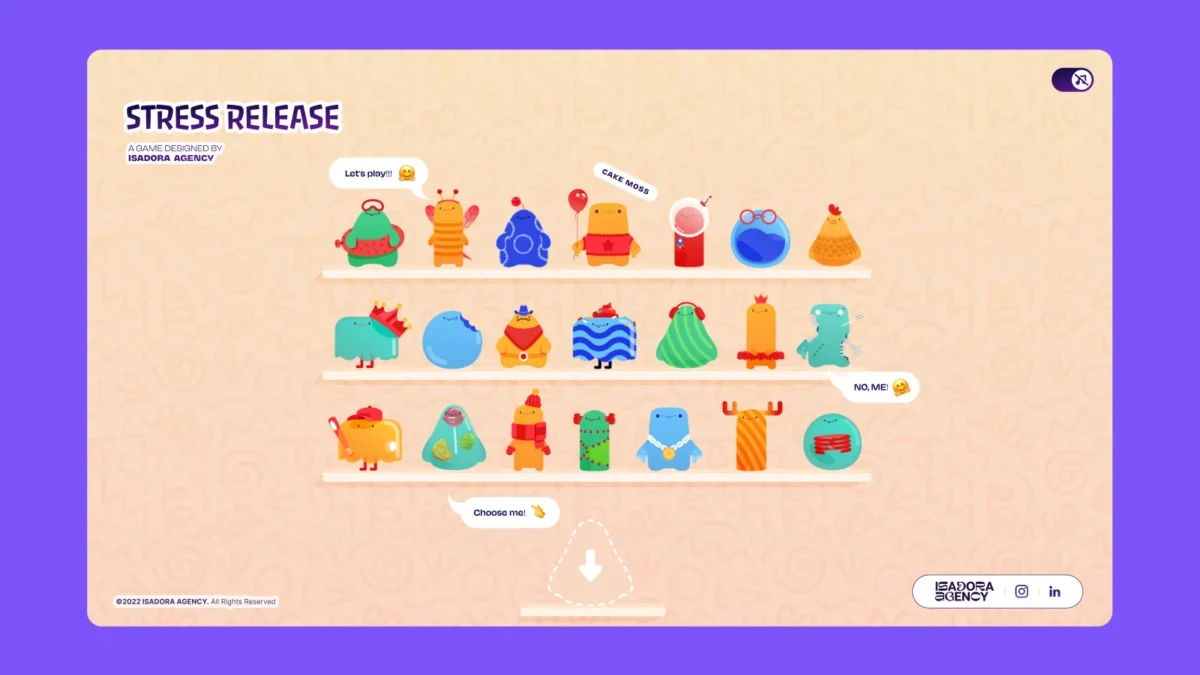
In the modern landscape of web development, the pursuit of "tactile" user interfaces has become a primary objective for creative agencies seeking to differentiate their digital products. When Isadora Agency was tasked with developing "Stress Release"—a web-based interactive experience designed to alleviate burnout through digital play—the engineering team faced a fundamental architectural choice: should they utilize physics-based simulations or deterministic, hand-crafted animation sequences? The decision to prioritize artistic intent over algorithmic motion has since become a compelling case study in balancing performance with high-fidelity visual design.
The Physics Dilemma: Simulation vs. Specification
Historically, the industry standard for creating responsive, reactive web content has been the integration of physics engines such as Matter.js or Cannon.js. These libraries are designed to replicate real-world forces, including gravity, friction, and velocity, providing a sense of realism that is ideal for games requiring unpredictable, emergent behavior. However, for the Isadora Agency team, the requirement was not to simulate the chaos of rubber objects in a vacuum, but to deliver a specific, curated emotional release.
The animators involved in the project had meticulously crafted high-precision JSON-based Lottie animations. These assets relied on frame-by-frame timing that defined the exact "squish" and "distortion" of the character models. When developers attempted to apply standard physics constraints to these assets, the results were often erratic, with the physics engine’s calculations overriding the designers’ aesthetic choices. This conflict underscored a growing trend in UX engineering: when a brand identity is tied to bespoke, character-driven animation, deterministic control is often more valuable than realistic simulation.
Chronology of Development and Strategic Shifts
The project began with a prototyping phase that lasted several weeks, during which the team tested various WebGL implementations. By the second week, the team reached a critical inflection point: the "mega squeeze" reaction, which required a precise 181-frame build-up sequence, could not be reliably achieved through standard physics-based collision detection.
Recognizing that the "feel" of the interaction was degrading under the weight of excessive calculations, the lead developers made the strategic decision to abandon physics-based frameworks entirely. Instead, they pivoted toward a custom architecture built on three pillars: Lottie’s native API, standard DOM event listeners, and distance-based mathematics. This shift moved the project timeline back by a few days to account for the necessary re-engineering of the interaction layer, but the result was a significant improvement in both the reliability of the animations and the perceived responsiveness of the application.

Technical Implementation: The Geometry of Interaction
To ensure the "tactile" feel remained consistent across different devices, the developers utilized radial input mapping. This approach treats the character’s hit area not as a complex SVG shape, but as a mathematical circle. By capturing the user’s click position relative to the character’s center point, the system employs the Pythagorean theorem to calculate the exact distance of the input.
This distance-based approach provides a tiered scoring system. A click within 10 pixels of the center triggers a "bullseye" event, rewarding the user with maximum points, while clicks further from the center trigger decreasing feedback intensity. This method is highly efficient, as it bypasses the need for complex raycasting, relying instead on the speed of JavaScript’s native math functions.
The spatial accuracy achieved here is paramount. By dynamically repositioning the explosion animation at the exact coordinates of the user’s click, the developers created an illusion of physical impact that feels immediate and responsive. This reinforces the psychological feedback loop necessary for a stress-relief application, where the user’s action is met with a consistent, intentional reaction.

Managing Performance and Scale
The decision to rely on DOM-based SVG rendering through Lottie presents its own set of challenges, particularly regarding mobile performance. Loading 21 distinct character animations simultaneously is computationally expensive. To mitigate this, the engineering team implemented a tiered quality system. On the main "shelf" screen, where multiple animations loop at once, the team reduced the Lottie playback speed to 60% and set the quality to 50% to minimize the burden on the browser’s main thread.
Conversely, when a user selects a character to interact with, the application switches to a single-character view where quality is set to 100%. This dynamic allocation of resources ensures that the experience remains fluid on mobile devices, which often struggle with the heavy CPU usage required by high-fidelity vector animations. Furthermore, by using CSS variables to handle responsive resizing, the team avoided the need for complex media queries or recalculating bounding boxes, allowing the SVGs to scale fluidly within their parent containers.
Broader Implications for UX Engineering
The "Stress Release" project serves as a broader proof-of-concept for the web development industry. It suggests that for highly interactive interfaces, developers should not reflexively reach for heavy physics libraries. Instead, when the design requires a specific narrative or character behavior, programmatic state control—where the code acts as a conductor for pre-designed animation segments—is often the superior approach.

Industry experts have noted that this shift toward "intentional motion" aligns with the increasing importance of micro-interactions in brand storytelling. As web browsers continue to evolve, the capacity for the DOM to handle complex animations has increased, yet the principle of keeping the logic simple remains valid. By decoupling the interaction logic (the "where and how") from the animation assets (the "what"), developers can maintain strict adherence to design specifications without sacrificing performance.
Future Perspectives
As the web continues to move toward more immersive, "app-like" experiences, the integration of Lottie and similar vector-based animation formats will likely become more prevalent. The success of the Isadora Agency’s methodology highlights that the most effective way to honor design is to build an architecture that supports it, rather than one that attempts to simulate it.
For agencies and developers looking to replicate this level of interactivity, the lesson is clear: invest in the mathematics of the interaction layer. By mapping input coordinates to specific animation segments and managing playback through clean, predictable state machines, teams can create experiences that feel physically tangible while maintaining absolute, pixel-perfect control over their creative assets. The future of interactive web design lies not in the complexity of the simulation, but in the precision of the execution.