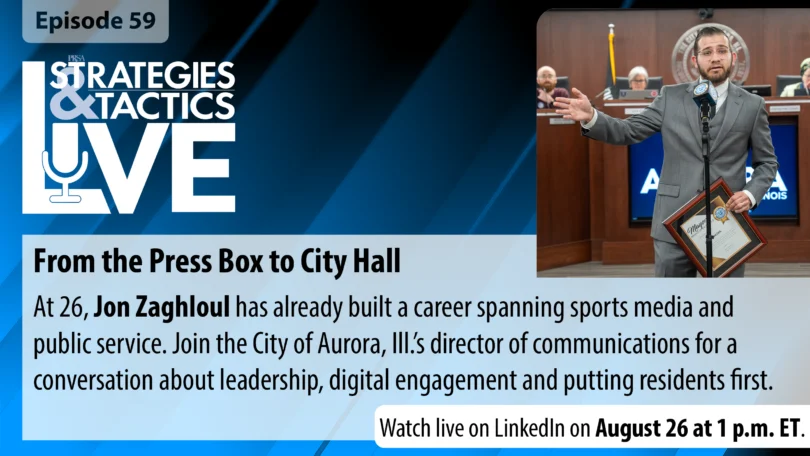
The trajectory of modern communications careers is increasingly defined by the ability to bridge the gap between grassroots digital content creation and high-level institutional strategy. For Jon Zaghloul, the current director of communications for the city of Aurora, Illinois, the path to public service was not paved by traditional internships alone, but by a decade of self-directed media experimentation. His professional evolution—from a teenager broadcasting from a bedroom in the Chicago suburbs to managing the information flow for the second-largest city in Illinois—offers a compelling case study on the value of early-career agility and the efficacy of data-driven municipal engagement.
The Foundation of a Communications Career
Zaghloul’s immersion into the media landscape began at age 13 with the launch of "Sports Talk Chicago," a podcast venture that served as a low-stakes laboratory for high-stakes public relations. While many peers were engaging with media as consumers, Zaghloul operated as a producer, learning the intricacies of talent management, narrative framing, and media outreach. By the time he reached the University of Chicago as an economics major, he had established a workflow for booking high-profile sports icons, including MLB legends Roger Clemens, Fergie Jenkins, and Ozzie Smith.
This period of his life was formative in ways that went beyond mere technical skill. By treating his podcast as a legitimate news outlet, he learned the essential mechanics of PR: writing persuasive press releases, understanding news cycles, and securing coverage in established publications. These experiences, discussed during an appearance on PRSA’s Strategies & Tactics Live on August 26, proved that the fundamental skills of communications—persistence, clarity, and the ability to capture an audience—are platform-agnostic.
Zaghloul admits that his early efforts were far from polished. "At 13 or 14 years old, my first podcasts were awful," he noted. However, the iterative process of broadcasting, failing, and refining allowed him to develop the poise required for public speaking and the discipline necessary for effective writing. By the time he entered the professional workforce, these skills were deeply ingrained, allowing him to pivot seamlessly from sports media to the complex, often high-pressure environment of municipal government.
A Rapid Ascent in Aurora
Zaghloul’s rise within the Aurora municipal government was characterized by a combination of situational readiness and the willingness to accept ownership of under-resourced projects. Upon joining the city staff as a communications coordinator, he was presented with a significant organizational challenge: the overhaul of the city’s municipal website.
In many municipal settings, web redesigns are bureaucratic hurdles characterized by slow timelines and internal friction. Initially, expectations for the project were modest. However, Zaghloul applied the same "hustle" mentality he had cultivated as a podcaster, viewing the website not as a digital directory, but as the primary interface for civic engagement. As he demonstrated his ability to not only manage the technical aspects of the site but to craft content that resonated with residents, his role expanded. This trajectory underscores a broader trend in local government: as cities compete for digital attention, they are increasingly rewarding staff members who can demonstrate measurable impact through media coverage and community engagement.
Data-Driven Civic Engagement: Listening to the Public
The core of Zaghloul’s success in Aurora lies in his shift toward a "resident-first" communication strategy. Rather than relying on traditional, top-down announcements, his team implemented a proactive listening phase during the city’s digital transformation. By soliciting feedback through mock-ups and direct user testing, the city was able to align its web architecture with the actual needs of its residents.
The communications team deployed granular surveys, asking residents not just how they felt about existing outreach, but specifically which channels they preferred and which they found redundant or intrusive. This data-gathering exercise provided a roadmap for the city’s modern communications strategy. The result was a pivot toward platforms that had previously been underutilized by the local government, most notably Nextdoor. By establishing an official agency presence on the neighborhood-based platform, the city reached a demographic that had been largely disconnected from municipal updates.
The Strategic Shift to Omnichannel Communication
Modern municipal communication is increasingly defined by the concept of "meeting residents where they are." For Aurora, this has meant moving beyond the city’s primary website to create an omnichannel experience. This includes:
- Nextdoor Integration: Providing localized, hyper-relevant updates to neighborhood-specific audiences.
- Facebook Engagement: Utilizing the platform for visual storytelling and real-time community interaction.
- Direct Digital Newsletters: Leveraging email and SMS to ensure that critical information reaches residents directly, bypassing the volatility of social media algorithms.
This strategy reflects a broader professional consensus within public relations: that the "spray and pray" approach to communication is obsolete. Data suggests that municipal engagement increases significantly when information is delivered through a variety of trusted, preferred channels. By diversifying these touchpoints, Aurora has improved the transparency of its operations and, by extension, the level of trust between the city and its constituents.
Implications for the Future of Public Relations
The career path of Jon Zaghloul serves as an indicator of how the communications profession is changing. As the barrier to entry for content creation continues to lower, the premium on "traditional" PR skills—writing, strategy, and audience analysis—remains high. However, these skills are now being applied in new contexts, from municipal government to corporate sustainability and beyond.
For aspiring communications professionals, the implications are clear: the value of early experience is not just in the resume building, but in the development of a professional instinct. Whether it is managing the reputation of a professional athlete or the public image of a city, the core principles remain constant. The ability to identify an audience, craft a compelling narrative, and utilize the right distribution channels is the foundation of effective communication.
Furthermore, the emphasis on resident feedback in Aurora’s recent initiatives highlights a growing requirement for public servants: the ability to listen. As the digital landscape becomes more crowded, the most successful communicators will be those who can cut through the noise not by being the loudest, but by being the most responsive.
The story of the Aurora communications team, under Zaghloul’s guidance, suggests that the future of the field is inextricably linked to technological adaptability and an unwavering focus on the end-user. As the city continues to refine its digital presence, the lessons learned from those early days in a bedroom in Aurora continue to provide a framework for how local government can effectively communicate in the 21st century. By prioritizing the resident experience and maintaining a consistent, data-informed strategy, the city has created a blueprint for sustainable growth in its communications operations. As Zaghloul noted during his Strategies & Tactics Live appearance, every step of his professional journey—from his teenage podcasting days to his current role—was a necessary investment in the skill set required to serve his community today.