As 2026 unfolds, LinkedIn stands firm as an indispensable platform for Business-to-Business (B2B) marketers, offering unparalleled precision in reaching key decision-makers within a professional ecosystem. Unlike consumer-focused platforms that rely on inferred interests, LinkedIn’s strength lies in its foundation of verified career data, enabling advertisers to target audiences with surgical accuracy based on job title, company, seniority, and industry. This granular targeting is particularly critical in B2B sales cycles, which often involve complex buying committees rather than individual shoppers.
The Evolving Landscape of B2B Digital Advertising
The trajectory of B2B social trends in 2026 continues to emphasize sophisticated first-party data strategies, making LinkedIn’s robust targeting capabilities more valuable than ever. The platform’s audience has swelled to over 1.3 billion members globally, providing an unmatched scale for professional outreach. For B2B organizations prioritizing quality leads over sheer volume, this combination of expansive reach and precise targeting forms the bedrock of a compelling argument for sustained investment in LinkedIn advertising. Industry analysts project that B2B digital ad spend will continue its upward trend, with a significant portion allocated to platforms that demonstrate clear ROI and high lead quality, a space where LinkedIn consistently outperforms. This sustained growth underscores LinkedIn’s transformation from a mere professional networking site into a powerhouse advertising conduit, a shift that has gained considerable momentum over the past decade with continuous platform enhancements and new ad formats.
Setting the Stage: Your LinkedIn Ad Account in 2026
Establishing an advertising presence on LinkedIn is streamlined through the Campaign Manager, a user-friendly interface designed for efficiency. The process for launching a first campaign in 2026 remains straightforward, typically completed in a few minutes through four key steps:
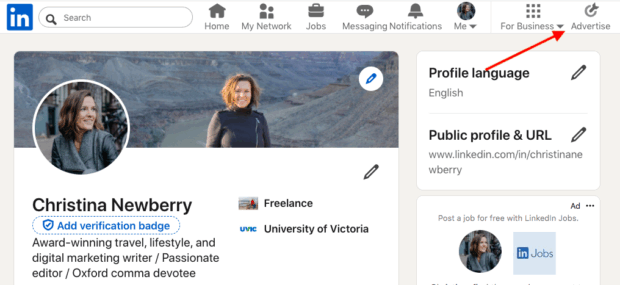
- Accessing Campaign Manager: Users log into their LinkedIn accounts and navigate to the "Advertise" option located in the top navigation bar.
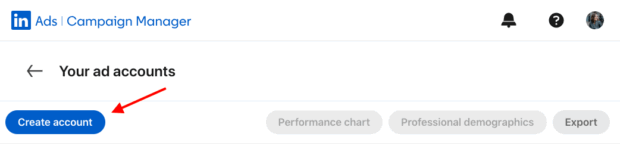
- Account Creation: A new ad account is initiated by clicking "Create account," where advertisers define an account name and select their preferred billing currency.
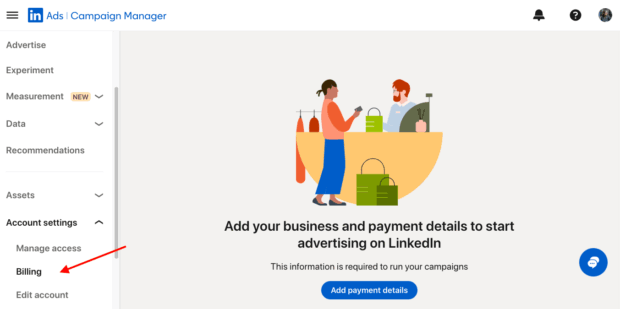
- Administrative Configuration: This crucial phase involves associating the ad account with a LinkedIn Company Page, adding a payment method (accessible via Account settings → Billing → Add payment details), and assigning appropriate permissions to team members (found under Account settings → Manage access). While some ad formats can operate independently, linking a Company Page is considered best practice for comprehensive campaign management and brand consistency.
- Launching the Inaugural Campaign: From the account dashboard, advertisers click "Create" to begin building their first campaign, selecting an objective and choosing between the AI-assisted Accelerate mode or the manual Classic mode, depending on their desired level of control and speed to market.
Understanding the Auction Dynamics and Cost Implications
LinkedIn’s advertising ecosystem operates on a sophisticated auction system, determining ad placement and cost. Advertisements compete based on factors such as bid amount, relevance, and quality, with the winning ad selected to maximize value for both the platform’s member experience and the advertiser’s objectives.
Bid Strategies: Advertisers can choose from three distinct bid strategies per campaign:
- Maximum Delivery (Automated): LinkedIn automatically adjusts bids to optimize budget allocation and maximize results aligned with the campaign objective. This strategy is ideal for achieving scale and simplicity, especially for new campaigns seeking to establish a performance baseline.
- Cost Cap: This strategy allows advertisers to set a target cost per result, with LinkedIn’s algorithms dynamically adjusting bids to maintain the average cost at or below the specified cap while maximizing volume. It offers a balance between cost control and performance, available for objectives like brand awareness, website visits, engagement, video views, and lead generation.
- Manual Bidding: For advanced users or highly niche campaigns, manual bidding provides granular control over the bid amount. This strategy is best suited for precise testing, specific audience segments, or situations where close monitoring and frequent adjustments are feasible.
Budgeting and Pacing: Advertisers can allocate daily or lifetime budgets. Lifetime budgets enable LinkedIn to intelligently pace spending over the campaign duration, aiming for more efficient objective achievement. Experts advise against frequent, reactive budget changes, as the system’s learning algorithms perform optimally with stable settings. A recommended approach involves starting new campaigns with Maximum Delivery, transitioning to Cost Cap or Manual bidding once a stable baseline is established, and utilizing lifetime budgets for consistent performance. Any adjustments to bids or budgets should be incremental and spaced out to allow the system time to re-learn and stabilize delivery.
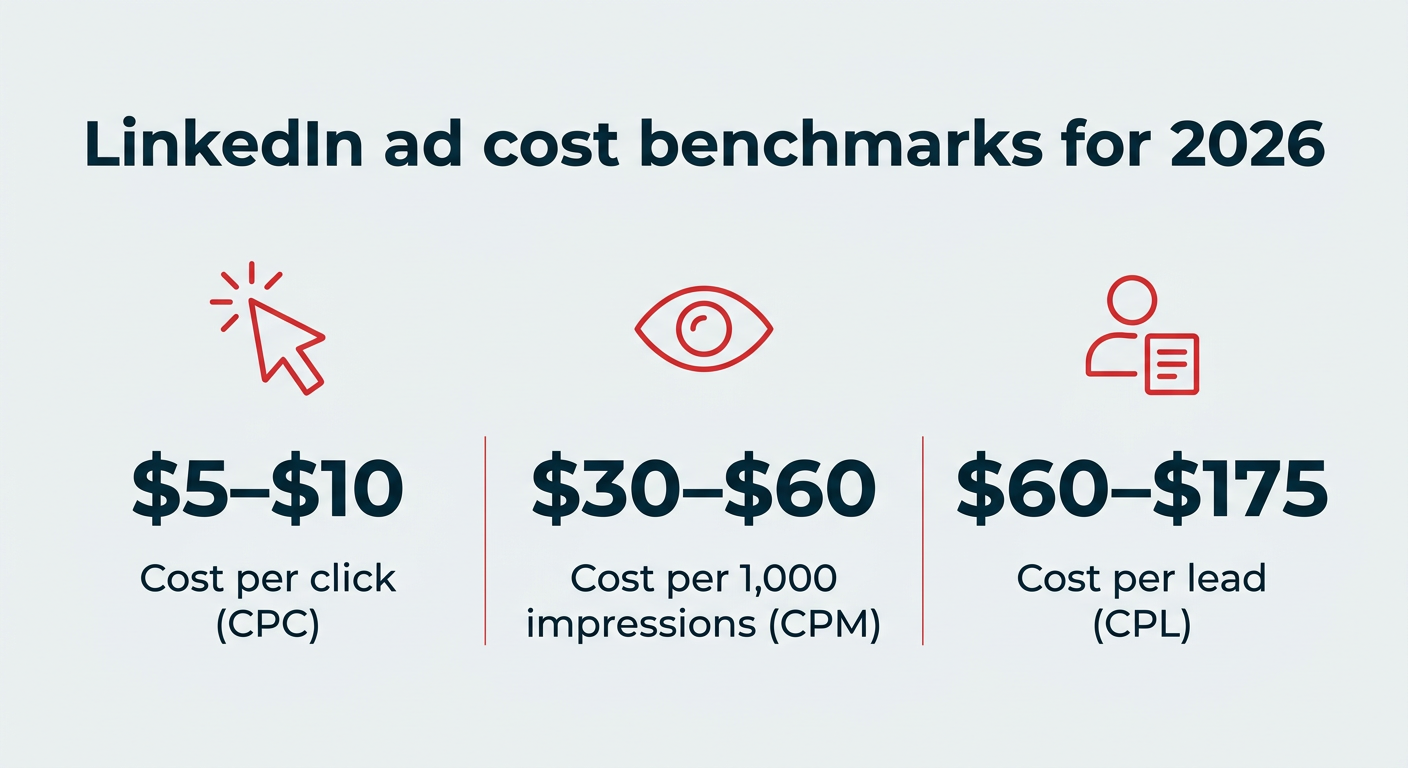
Cost Benchmarks for 2026:
While LinkedIn does not publish fixed ad rates due to the auction-based model, third-party benchmarks for 2026 suggest typical costs ranging from $5 to $10 per click (CPC), $30 to $60 per 1,000 impressions (CPM), and $60 to $175 per lead (CPL). These figures are directional, with actual costs fluctuating based on audience competitiveness, campaign objective, industry, and chosen bid strategy.
Several factors significantly influence LinkedIn ad costs:
- Target Audience: Highly specific or competitive audiences tend to incur higher costs.
- Campaign Objective: Objectives focused on lower-funnel conversions (e.g., lead generation) often have higher CPLs but deliver more qualified prospects.
- Ad Relevance and Quality Score: High-quality, engaging ads with strong relevance to the target audience can achieve lower costs and better placement.
- Industry: Certain industries with higher customer lifetime values (LTV) might have more aggressive bidding, driving up costs.
- Geographic Targeting: Regional market dynamics and competition play a role.
- Bid Strategy: Automated strategies might optimize for volume, while manual bids offer control but require more active management.
Compared to other social platforms, LinkedIn’s costs per click and lead are generally higher. However, this premium is often justified by the superior quality of leads and the direct access to B2B decision-makers. Marketing leaders advocate evaluating value based on the downstream quality of opportunities generated, rather than solely on the raw click price, emphasizing that a higher CPL for a qualified pipeline is more valuable than a cheaper lead that never converts.
Strategic Choices: Accelerate vs. Classic Campaigns
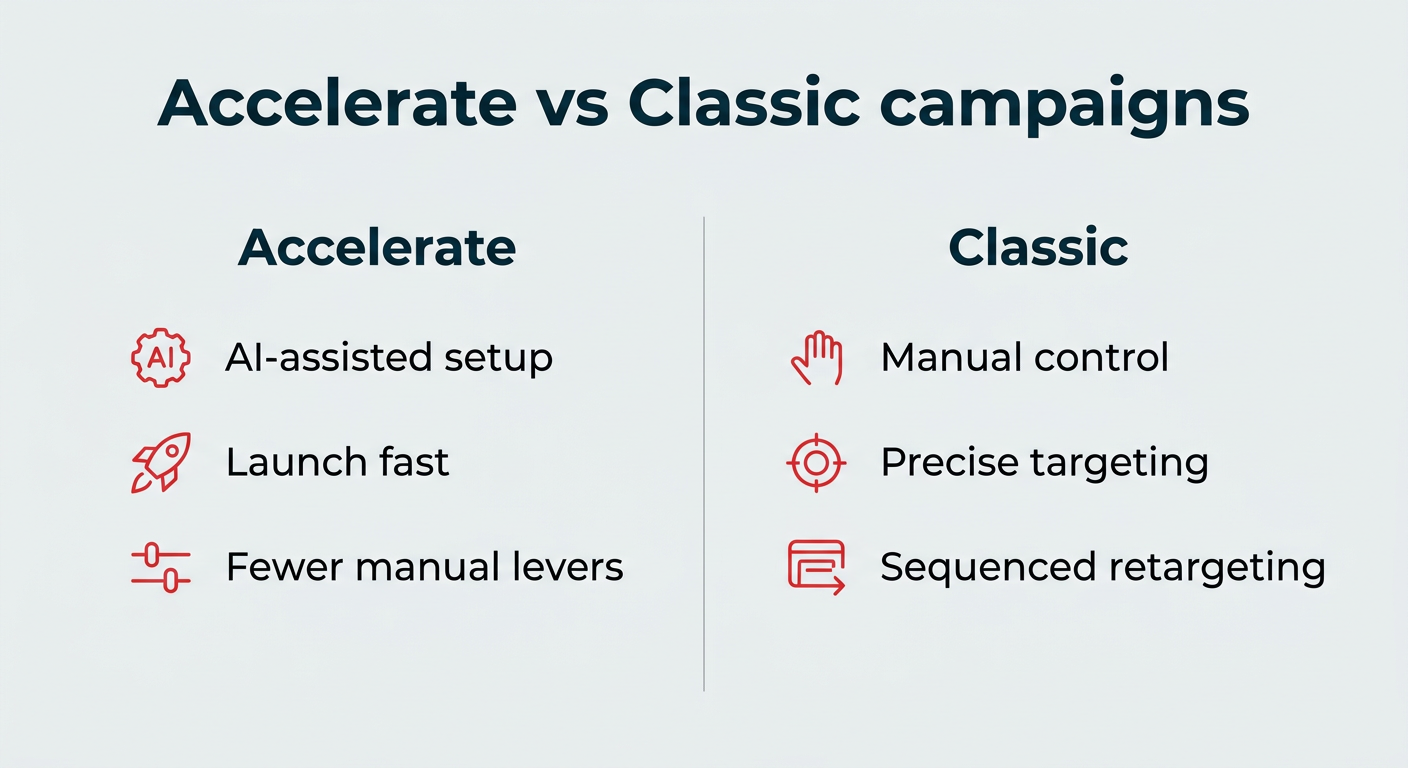
LinkedIn offers two distinct campaign building approaches, both supporting the same objectives and formats but differing in the degree of automation and manual control.
Accelerate (AI-Assisted) Campaigns:
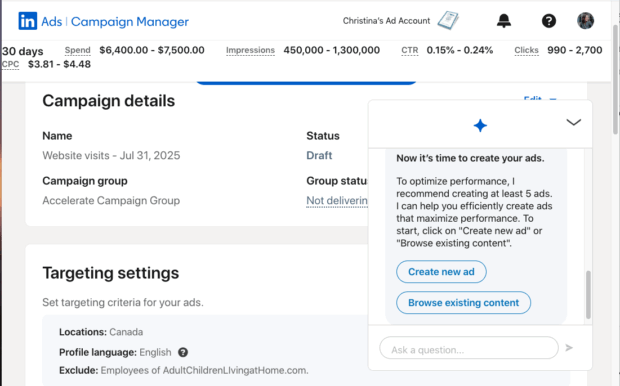
- What it is: Accelerate is a guided campaign mode leveraging LinkedIn’s advanced AI to optimize targeting, creative, bidding, and placements based on the advertiser’s stated objective and inputs. It aims to simplify campaign setup and management, allowing the machine learning algorithms to identify the most effective combinations for goal attainment. Upon launch, campaigns typically undergo a 10-14 day optimization period as Accelerate refines its strategy.
- Best for:
- Marketers new to LinkedIn advertising or those seeking quick setup and launch.
- Companies with limited resources for daily campaign management.
- Campaigns focused on broad awareness or lead generation where LinkedIn’s AI can efficiently find relevant audiences.
- Teams looking to quickly establish qualified remarketing pools.
- Implications: While offering fewer manual levers, Accelerate requires careful initial review of suggested audiences and clear budget caps. It provides an efficient entry point, with the option to transition to Classic mode for greater control later.
Classic (Manual Control) Campaigns:
- What it is: The traditional ad builder, Classic campaigns provide advertisers with full manual control over every aspect, including defining audiences (attributes, lists, exclusions), placements, bidding strategies, and scheduling.
- Best for:
- Experienced advertisers requiring precise control over campaign parameters.
- Niche B2B segments demanding highly specific targeting and exclusions.
- Complex, multi-stage funnel programs that require intricate sequencing and retargeting.
- A/B testing specific variables to optimize performance.
- Pro Tip: Many B2B teams strategically combine both modes, initiating with Accelerate to build initial awareness and prospect pools, then transitioning to Classic for precise retargeting and lead capture efforts. LinkedIn’s training materials frequently highlight the benefits of a full-funnel approach utilizing both campaign types.
Precision Targeting: Reaching the B2B Buying Committee
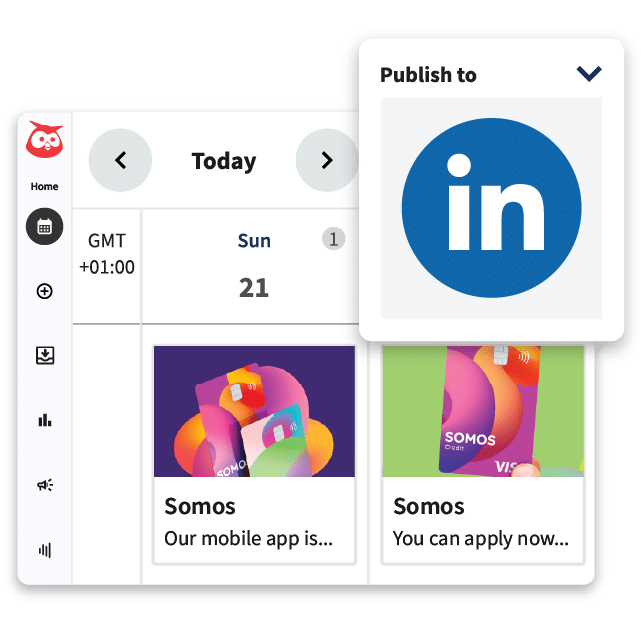
LinkedIn’s core advertising advantage lies in its unparalleled ability to target specific professional audiences, ensuring budget efficiency by focusing on ideal buyers. This precision is paramount in B2B, where purchase decisions are often collaborative. Gabe Feingold, Product Marketing Leader at LinkedIn, emphasizes this, stating, "LinkedIn is the only platform purposefully built for B2B advertisers and the most powerful platform to influence B2B decision-makers. On LinkedIn, you can engage the full buyer group, from the C-suite to daily practitioners, in a trusted, professional environment."
Professional Attribute Targeting: This method leverages the rich, self-reported career data of LinkedIn members, allowing advertisers to construct audiences based on:
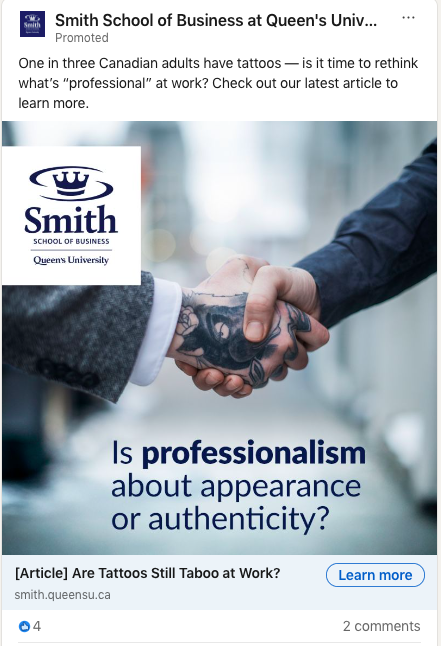
- Job Title and Function: Targeting specific roles (e.g., "VP of Marketing," "Software Engineer").
- Seniority: Reaching professionals at various levels (e.g., "Director," "Manager," "Entry Level").
- Industry: Focusing on specific sectors (e.g., "Healthcare," "Financial Services," "Technology").
- Company Size: Targeting businesses based on employee count.
- Company Name: Directly reaching employees of specific organizations (Account-Based Marketing).
- Skills: Identifying individuals with particular expertise.
- Education: Targeting alumni of specific institutions or fields of study.
Matched Audiences and Retargeting: This powerful feature allows advertisers to re-engage with known contacts or expand reach to similar profiles:
- CRM Contact Lists: Uploading customer relationship management (CRM) data to target existing contacts or create lookalike audiences.
- Company Lists: Targeting employees of specific companies from a provided list.
- Website Visitors: Retargeting individuals who have visited the advertiser’s website using the LinkedIn Insight Tag.
- Video Viewers: Engaging with users who have watched specific video content.
- Lead Form Openers/Completers: Targeting individuals who interacted with lead generation forms.
- Post Engagers: Reaching users who have interacted with organic LinkedIn content.
- Lookalike Audiences: Creating new audiences that share characteristics with existing high-value customer segments.
To optimize spend, advertisers consistently employ exclusions, ensuring that budgets are not wasted on current employees, competitors, existing customers, or recent converters. The strategic combination of professional attributes and matched audiences ensures messages resonate with the entire buying group, maximizing campaign effectiveness.
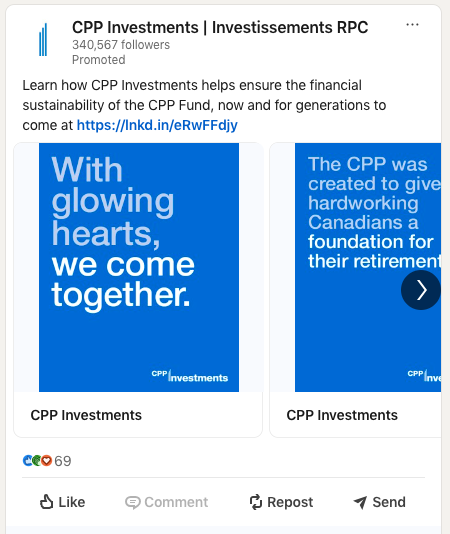
A Spectrum of Engagement: Exploring LinkedIn’s Ad Formats
LinkedIn offers over a dozen ad formats, each tailored to specific marketing objectives and stages of the buyer journey. Selecting the appropriate format is crucial for maximizing campaign impact.
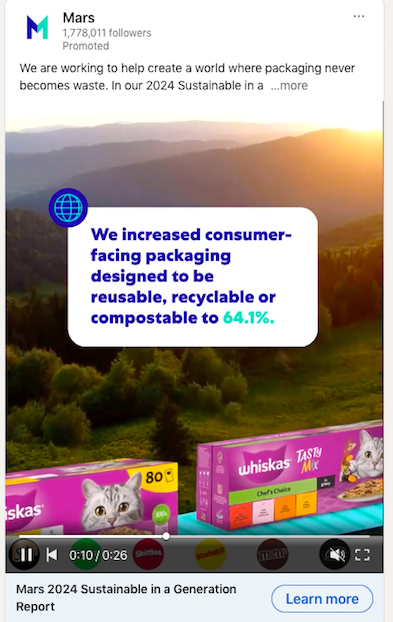
In-Feed Visuals: Single Image, Carousel, Video, Document
- Single Image Ads: Versatile and direct, ideal for awareness and conversions with a clear visual and concise value proposition.
- Specs: 7680×4320 px recommended, up to 5 MB (JPG, PNG, GIF), intro 150 chars (max 600), headline 70 chars (max 200), aspect ratios 1.91:1, 1:1, 4:5.
- Carousel Ads: Tell a sequential story with 2-10 swipeable images, each with its own headline and link. Excellent for showcasing features, steps, or product comparisons.
- Specs: 1080×1080 px (square), up to 10 MB per card (JPG, PNG), intro up to 255 chars, card headline up to 45 chars, 1:1 aspect ratio only.
- Video Ads: A rapidly growing format, recognized by eMarketer as a top platform for B2B video, offering 20x more shares and 3x the engagement than other posts. Best for brand building, product demos, and thought leadership.
- Specs: MP4 (AAC audio), 3 secs–30 mins (15-30 secs sweet spot), 1:1, 16:9, 4:5, 9:16 aspect ratios, 360-1920 px, up to 500 MB, intro ~150 chars (max 600), headline ~70 chars (max 200). Captions and clear thumbnails are essential due to auto-play mute.
- Document Ads: Allow users to read and download assets directly within the feed, either ungated for reach or gated with a Lead Gen form. Perfect for guides, reports, and case studies.
- Specs: PDF, DOC, PPT file types, up to 100 MB, under 10 pages recommended (max 300 pages), design for mobile legibility.
Interactive & Event-Driven: Event, Thought Leader, Article/Newsletter
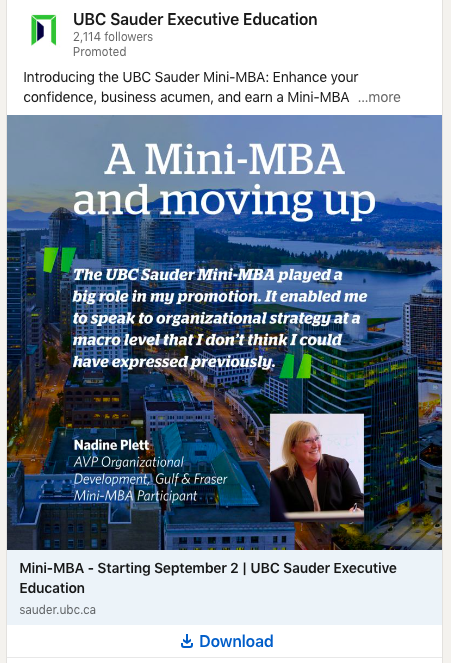
- Event Ads: Promote LinkedIn Events directly, driving RSVPs and attendance, with reported viewership increases of up to 31x. Can be run pre-, during-, and post-event.
- Specs: Pulls data from LinkedIn Event, 4:1 banner ratio, intro up to 600 chars, links to LinkedIn Event page.
- Thought Leader Ads: Amplify a member’s organic post (e.g., executive, expert, customer) with a "Promoted by [Your Company]" label. Authenticity drives strong engagement.
- Best for: Executive insights, employee storytelling, event promotion, brand awareness, engagement. Requires author approval.
- Article and Newsletter Ads: Promote native long-form content directly within LinkedIn, driving qualified readership. Can capture leads with an "Unlock Article" feature for Articles.
- Creative source: Uses original Article or Newsletter post; no separate ad fields. Clicks lead to LinkedIn page.
Direct Engagement: Sponsored Messaging, Lead Gen Forms
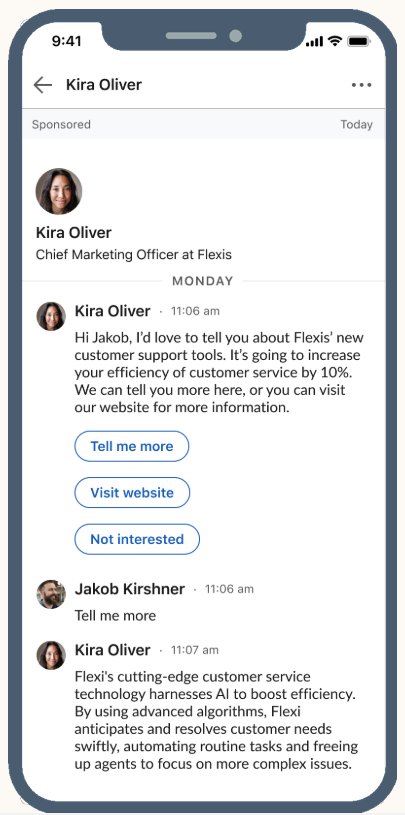
- Sponsored Messaging (Message Ads & Conversation Ads): Engage prospects with personalized messages delivered to their LinkedIn inbox.
- Message Ads: One-to-one messages for a single, clear action (e.g., webinar invites, product offers).
- Specs: Subject up to 60 chars, message up to 1,500 chars, CTA up to 20 chars. Frequency cap: ~once every 45 days per member.
- Conversation Ads: Create multi-path, interactive experiences in messaging, allowing users to self-select offers.
- Specs: Message up to 8,000 chars, up to 5 CTAs per message (25 chars each). Frequency cap: ~once every 45 days per member.
- Message Ads: One-to-one messages for a single, clear action (e.g., webinar invites, product offers).
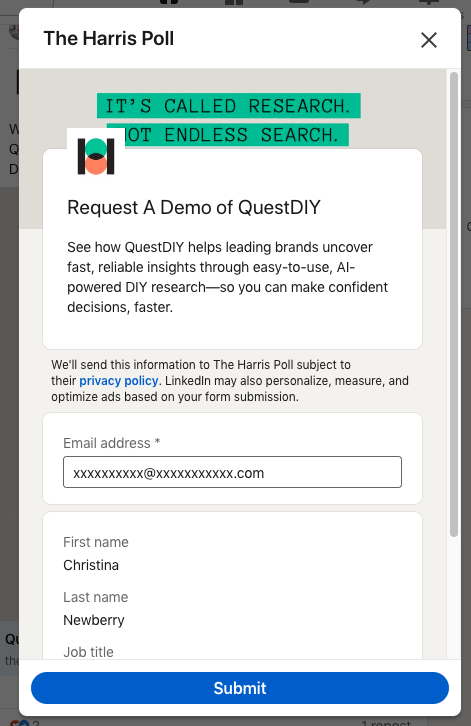
- Lead Gen Forms: Capture prospect information directly on LinkedIn, pre-filled with profile data. Attachable to in-feed ads and Sponsored Messaging, or used to unlock Articles.
- Specs: Up to 12 fields (3-4 recommended), custom questions, privacy policy URL required. Leads can be synced to CRM.
Dynamic & Niche Placements: Dynamic Ads (Follower, Spotlight, Text)
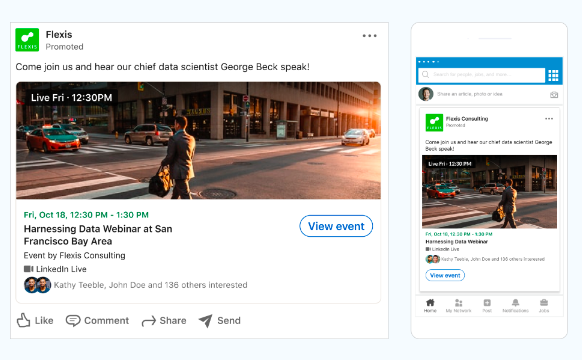
- Dynamic Ads: Desktop right-rail ads personalized with member’s name and photo.
- Follower Ads: Promote your LinkedIn Page to grow high-quality followers.
- Spotlight Ads: Drive traffic to specific landing pages, product pages, or promotions.
- Text Ads: Small, efficient PPC/CPM units for reinforcing messages and driving traffic on desktop.
- Common Specs: Company logo 100×100 px, headlines and descriptions with character limits. Personalization with member name macros.
The New Frontier: Connected TV (CTV) Ads
- Connected TV Ads: Extend B2B reach to professional audiences streaming on platforms like Paramount and NBCUniversal. Campaigns are managed in Campaign Manager with LinkedIn’s targeting data, and viewers can be retargeted with in-feed formats.
- Specs: 1920×1080 px (16:9), MP4 (H.264), 6-60 seconds (15 or 30 secs recommended), up to 500 MB.
- Best for: Upper-funnel reach, brand storytelling, product launches, building high-quality video audiences for subsequent retargeting.
Crafting Impactful Campaigns: Strategy and Creative Excellence
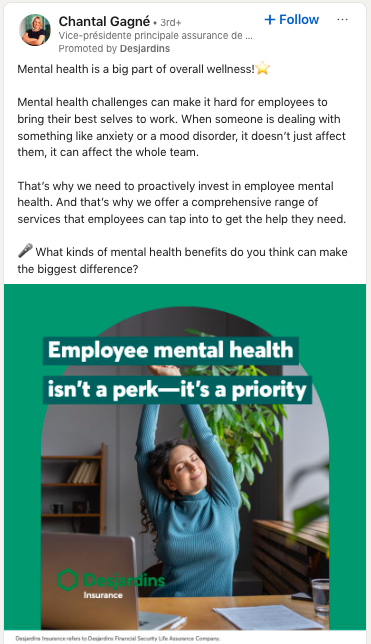
Building high-impact LinkedIn ads necessitates a strategic, outcome-oriented approach. Gabe Feingold emphasizes, "One of the most effective ways to create a LinkedIn campaign is to start with your business objective and work backwards. Begin by choosing the right campaign objective in Campaign Manager, tailor the creative to the business outcome you want to drive, and make sure you have the right measurement in place to measure what actually drives pipeline, rather than vanity metrics."
- Objective-First Approach: Every campaign decision, from creative to targeting, must align with the chosen objective. An awareness campaign prioritizes quick attention and brand recall, while a lead generation campaign focuses on reducing friction for conversion.
- Creative that Captivates: In a crowded digital landscape, creative must immediately convey value. Advertisers should lead with the buyer’s benefit, keep copy concise, and integrate brand elements early. Mobile-first design is paramount, utilizing square or vertical crops and legible typography. For video, compelling visuals in the first three seconds, coupled with captions, are critical for engagement in muted auto-play environments. Document ad covers should clearly state the value proposition.
- Strategic Sequencing: Campaigns should be viewed as a journey. A common strategy involves warming new audiences with thought leadership or educational content (video, document, article), followed by more direct offers (single image, carousel), culminating in a form fill request once curiosity is established. This full-funnel approach, targeting the entire buying committee at each stage, is crucial for nurturing prospects effectively.
- Measuring What Truly Matters: Success metrics must directly correspond to the campaign objective, moving beyond superficial engagement metrics. Brand awareness campaigns focus on reach and quality attention, while lead generation initiatives prioritize completion rates and the downstream creation of qualified opportunities. Consistent attribution windows and diagnostic tools are essential for accurate performance analysis and explaining shifts.
Measuring Success: From Clicks to Pipeline ROI
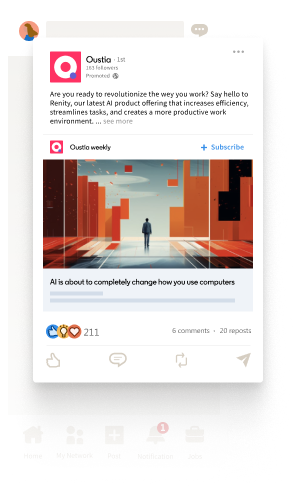
Accurate measurement is the cornerstone of effective LinkedIn advertising. Connecting ad spend to pipeline generation requires meticulous tracking and reporting.
Key Metrics by Objective:
- Awareness: Reach, Frequency, Video Completion Rate, Impressions.
- Engagement: Reactions, Comments, Shares, Follows, Cost per Engagement.
- Consideration: Landing Page Views, Click-Through Rate (CTR), Cost per Landing Page View.
- Leads: Lead Form Open Rate, Completion Rate, Cost per Lead (CPL).
- Pipeline: Opportunity Creation, Cost per Opportunity, Revenue Generated, Return on Ad Spend (ROAS).
Initial checks on day 1 and day 3 are crucial for identifying any campaign breakage, with weekly deep dives informing optimization decisions.
Conversion Tracking Setup:
The LinkedIn Insight Tag is a lightweight JavaScript snippet that must be installed on every page of an advertiser’s website. This tag is foundational for accurately measuring ROI, enabling website retargeting, and gathering demographic insights on site visitors. Once deployed, conversion actions for key events (e.g., demo requests, sign-ups, purchases) are defined within Campaign Manager. Assigning a monetary value to each conversion allows LinkedIn to report on cost per conversion and ROAS. For end-to-end pipeline attribution, integrating these conversions with a CRM system is vital, enabling marketers to trace a lead from initial click to a closed deal. This comprehensive tracking transforms raw click data into actionable ROI insights for leadership.
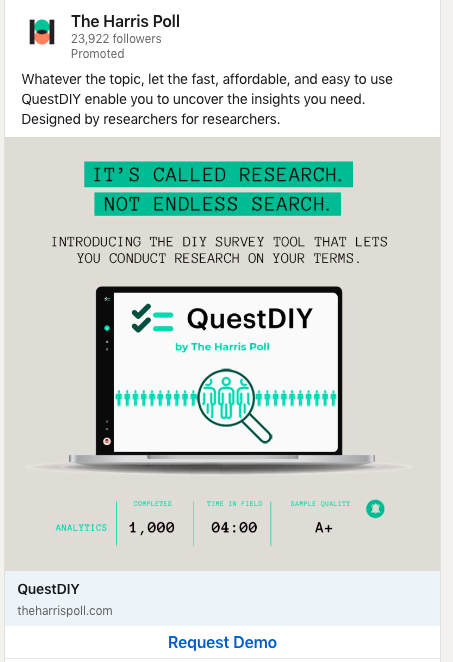
Optimizing for Growth: Scaling Your LinkedIn Ad Strategy
With account setup complete, formats chosen, and a clear measurement plan in place, the final phase involves optimizing campaigns for sustained performance and scaling what works effectively.
- Tuning for Delivery: Launching with automated bid strategies establishes a performance baseline. Once stable, advertisers can transition to cost control strategies. Adjustments should be small, incremental, and spaced out, allowing the system to re-learn. Early signals (day 1, day 3) help identify issues, with weekly adjustments driving ongoing optimization.
- Prioritizing Creative Improvement: Significant performance gains often stem from enhancing ad creative rather than constant bid micromanagement. Regularly rotating 3-5 distinct creative concepts, retiring underperforming or fatigued ads, and focusing on clear outcomes in the messaging are paramount. For video, the initial three seconds are critical for capturing attention, and captions are essential.
- Audience Segmentation and Sequencing: Creating granular audiences for various intent levels (site visitors, video viewers, lead form completers, post engagers) and managing them in separate ad sets allows for precise pacing and message delivery. The buyer’s journey should be sequenced: educate new prospects with thought leadership, build trust with social proof for warm visitors, and only then present conversion-focused offers. For Sponsored Messaging, strict adherence to frequency caps (approximately once every 45 days per member) is vital to ensure messages are perceived as useful, not intrusive.
- Careful Scaling: When a campaign consistently meets its goals, scaling should be gradual. This involves widening reach to adjacent audiences or incrementally increasing the budget. If performance declines during expansion, reverting to the last stable settings and adjusting one variable at a time (creative, audience, or bid) helps diagnose the issue. Feingold reiterates that "just like B2B advertising, LinkedIn Ads is not about quick wins; it’s about quality outcomes that advance pipeline performance by nurturing your ideal customers and building your brand." He advises B2B marketers to target the entire buying group, not just executives, and to engage audiences with thought leadership and brand storytelling before directly asking for a lead.
In conclusion, LinkedIn advertising in 2026 represents a sophisticated and powerful avenue for B2B marketers. Its unique professional targeting, diverse ad formats, AI-assisted optimization capabilities, and robust measurement tools combine to create an environment where strategic investment can yield high-quality leads and significant pipeline growth. By adhering to best practices in setup, creative development, targeting, and ongoing optimization, businesses can leverage LinkedIn to build strong brands and drive measurable success in the complex B2B landscape.