The digital marketing realm is undergoing a profound transformation, driven by the ascendancy of artificial intelligence in search. The traditional paradigm of search engine optimization (SEO), focused on securing a top position in a list of blue links, is rapidly evolving into Answer Engine Optimization (AEO). This new discipline prioritizes structuring content in a way that allows AI-powered overviews, conversational agents like ChatGPT, and specialized answer engines such as Perplexity to extract, understand, and accurately cite information directly. This shift is not merely an incremental update but a fundamental re-evaluation of how digital content achieves visibility and impact.
The Evolving Search Paradigm: From Links to Direct Answers
For decades, search engine results pages (SERPs) presented users with a curated list of links, requiring them to click through to find their answers. The emergence of generative AI and large language models (LLMs) has revolutionized this experience. Today, platforms like Google’s AI Overviews, ChatGPT, and Perplexity aim to provide immediate, synthesized answers directly within the search interface. Instead of simply pointing to information, they present it, often with citations to the original sources.
This transition from a link-centric to an answer-centric model profoundly impacts content strategy. Visibility is no longer solely about ranking position but about whether an answer engine can seamlessly extract a clean, self-contained passage from a webpage and attribute it to a specific brand or author. The urgency of this change is underscored by industry data; HubSpot’s 2026 State of AEO Report reveals that a significant 58% of marketers are already actively optimizing their content for answer engines, signaling AEO’s rapid move from an experimental concept to a mainstream marketing imperative. This widespread adoption reflects a collective acknowledgment that adapting to AI-driven search is no longer optional but essential for maintaining digital relevance and competitive advantage.
Pillars of AEO: Unlocking Citation Potential
The core mechanism enabling content extraction and citation by AI lies in its structure. Answer engines "read" pages differently than traditional crawlers; they seek clarity, directness, and explicit organization. Content most likely to be cited consistently exhibits a handful of recognizable structural traits, which collectively form the foundation of effective AEO.
I. Crafting for Clarity: Question-Led Headings and Direct-Answer Summaries
One of the most impactful structural adjustments for AEO involves the strategic use of question-led headings and direct-answer summaries. These formats are highly effective because they explicitly map a content passage to a user’s query, effectively pre-packaging an answer for AI extraction. According to the AirOps 2026 State of AI Search Report, sequential heading structures alone can increase citation odds by 2.8 times, demonstrating their significant leverage.
Question-led headings are designed to mirror the exact queries an AI or human user might type, such as "What is AEO?" or "How do answer engines parse content?" Immediately following these headings, a direct-answer summary (often referred to as a TL;DR or "Too Long; Didn’t Read") provides a concise, one- or two-sentence answer before any contextual elaboration. This structure ensures that the core information is immediately accessible and extractable, catering directly to the AI’s need for unambiguous answers. Furthermore, formatting these as explicit Q&A blocks, where a question is directly followed by a tight, self-contained answer, significantly maximizes citation potential. This simple yet powerful approach is a cornerstone of optimizing content for AI Overviews and other answer engines.
II. Building a Machine-Readable Foundation: Semantic Schema and Entity Modeling
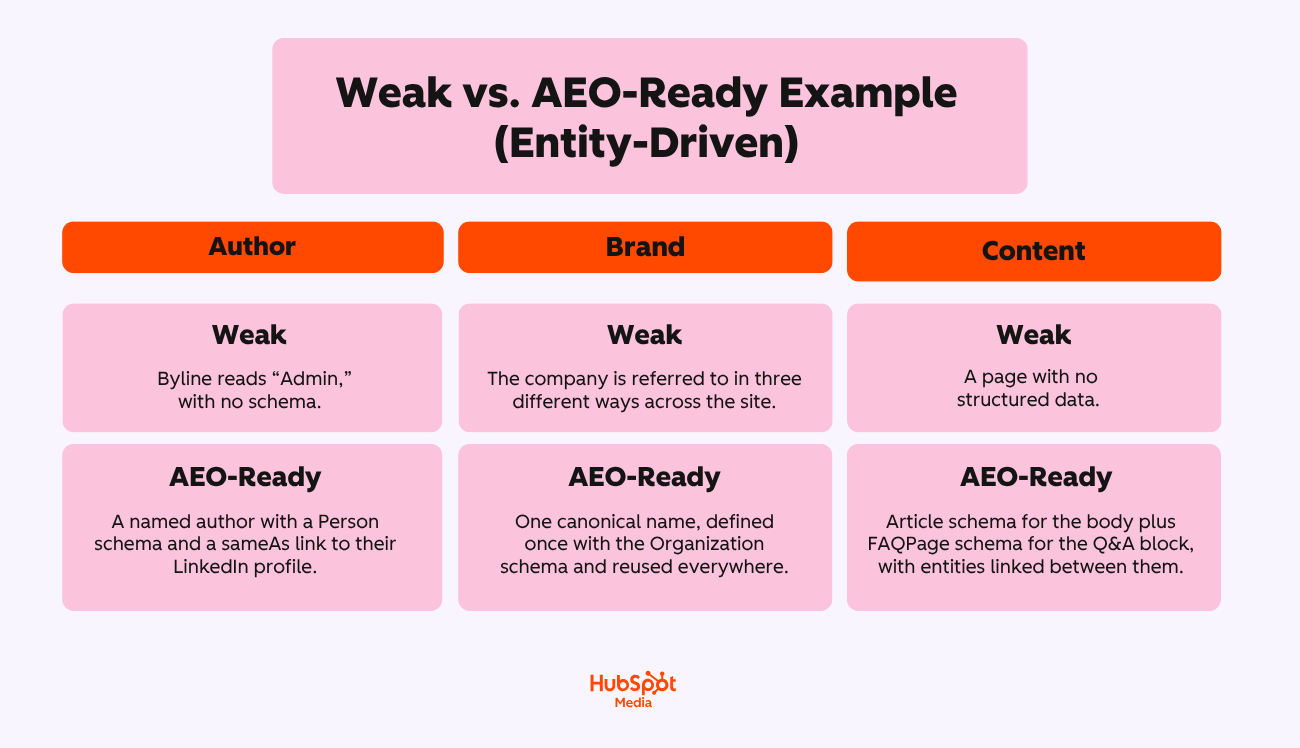
Beyond human-readable structure, AEO necessitates a machine-readable layer: semantic schema and robust entity modeling. This structured data provides explicit facts to answer engines about the nature of a page, its authorship, and the brand behind it, bridging any "weak-schema" gaps that might prevent otherwise strong content from being cited. While clear prose communicates meaning to humans, schema translates that meaning into a format machines can interpret and act upon with confidence.
Key schema types crucial for citations include Article (for blog posts and news), Organization (to define the brand), Product (for specific offerings), and Person (to identify authors and experts). These labels help engines understand the context and credibility of the information. Entity modeling further refines this by consistently defining people, brands, and products as distinct, connected entities rather than isolated words. By explicitly linking authors to their organizations and products, and consistently referencing these entities across a site, brands strengthen the machine’s confidence in their source over time. This foundational layer is vital for Google’s AI Overviews and broader AEO visibility, enabling engines to confidently attribute information to its source. Tools like HubSpot’s AEO Grader can help marketers benchmark their entity signals and identify areas for improvement.
III. Cultivating Trust: Authoritative Signals and Brand Verification
In the age of AI, trust is a paramount currency. Answer engines are designed to prioritize and cite information from verifiable, authoritative sources. This emphasis on trustworthiness, often encapsulated by Google’s E-E-A-T (Experience, Expertise, Authoritativeness, Trustworthiness) guidelines, means that two equally well-written answers may yield different citation outcomes based on the perceived credibility of their origins.
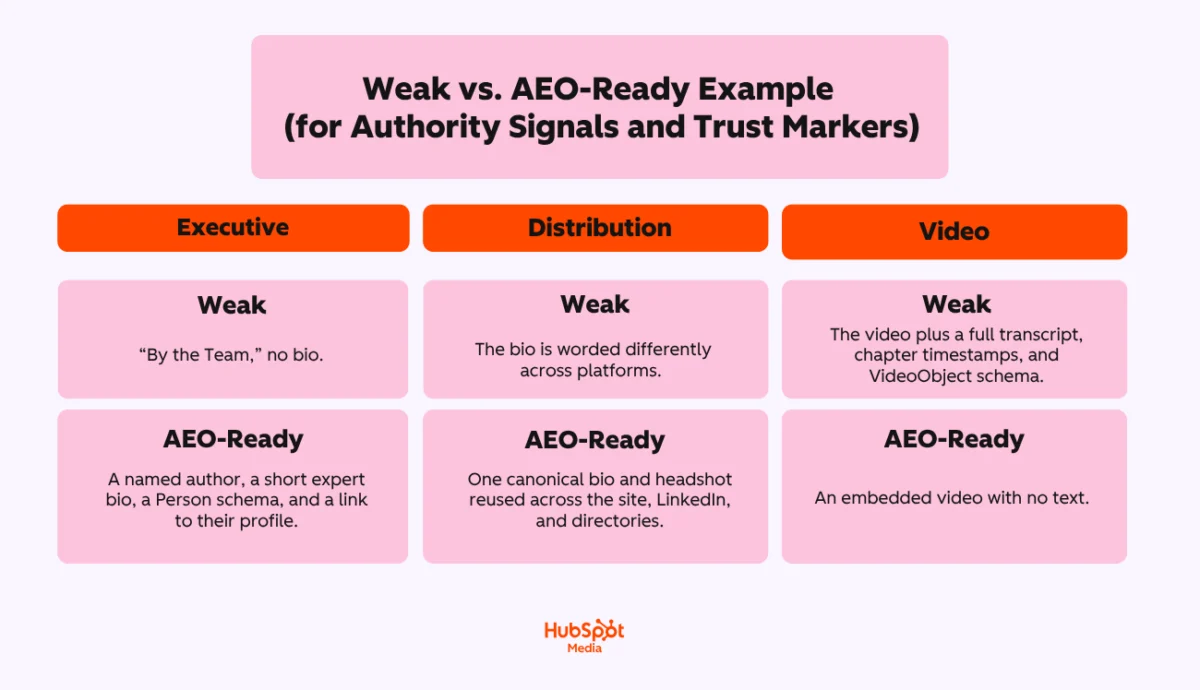
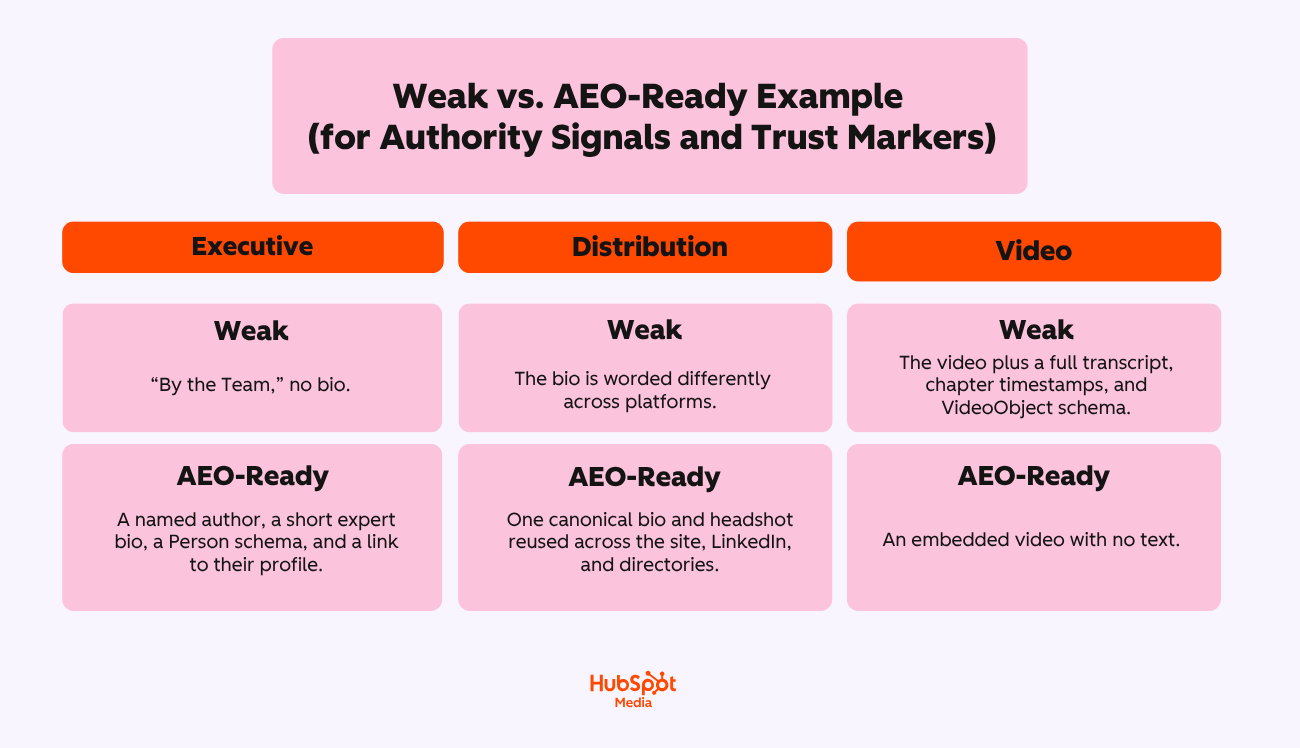
Authoritative signals manifest in several ways. Robust brand, executive, and product profiles that are stable, well-described, and easily recognizable by engines are critical. These profiles should clearly articulate who or what they represent, providing verifiable information. Furthermore, the distribution of content and entities across trusted ecosystems acts as a powerful corroboration signal. Mentions, links, and citations from reputable third-party sources, industry publications, and established platforms reinforce a brand’s authority. Even video content, traditionally challenging for engines to parse, can contribute to authority through the inclusion of comprehensive transcripts, precise timestamps, and VideoObject schema, making its content machine-readable and therefore citable. Consistently presenting these trust markers transforms content from merely answering a question into being recognized as "the source an engine is willing to name."

IV. Architectural Excellence: Strategic Internal Linking
Internal linking, often viewed as a technical SEO component, is a powerful site-level expression of content structure in the AEO landscape. Strategic internal linking helps answer engines crawl, group, and establish trust signals across related content. A weak or haphazard internal linking strategy can leave valuable answers isolated and difficult for AI to associate with broader topics, quietly capping potential citations.
A "hub-and-spoke" model, where a central, authoritative "hub" page links to several focused "spoke" pages covering sub-topics, is highly effective. This architecture clearly communicates topical depth and relationships to AI. Similarly, glossary pages that define key terms and sibling links that connect related articles within a cluster reinforce semantic connections. The clarity of anchor text – the visible, clickable text of a hyperlink – is crucial, as it tells search engines what the linked page is about. Early placement of internal links within content also signals their importance. By organizing content into comprehensive topic clusters and ensuring robust, descriptive internal linking, websites can present a cohesive, authoritative knowledge base that AI can confidently navigate and cite. This site-level optimization is foundational for durable AI Overview performance.
V. Precision at the Micro-Level: Passage Optimization for Extraction
The most granular level of AEO involves "passage-level optimization for extraction," which is the practice of writing each content segment so it can be lifted and cited independently, without reliance on surrounding text. A "passage" can be any self-contained unit – a paragraph, a list item, a table row, or a definition. The overarching goal is for each passage to make complete sense, even when taken out of its original context.
This "passage-first" mindset requires deliberate writing. Each paragraph should ideally address a single question or concept and stand on its own. This means opening with the answer directly and then providing supporting details, while consciously avoiding pronouns (e.g., "this," "that approach") that refer back to earlier text, as these break the passage’s coherence when extracted. Structured formats such as bulleted or numbered lists, tables, and definition boxes are particularly snippet-friendly, offering clear, concise units of information that AI can easily identify and cite. Furthermore, concise, extractable sentences are paramount. Eliminating jargon, ambiguity, and overly complex sentence structures ensures that an engine can cleanly quote the content, maximizing its potential for citation. When content is optimized passage by passage, it provides engines with readily digestible, self-contained units, significantly increasing its chances of being featured in AI-generated answers.
Navigating Google’s Quality Mandate: Trust and Transparency
Crucially, structural optimization alone is insufficient without genuinely helpful, high-quality content. Google’s overarching philosophy remains centered on "people-first" content. AEO tactics that attempt to game the system by prioritizing structure over substance are likely to backfire. The structural themes highlighted – clear headings, direct answers, schema – are designed to amplify quality, not to mask its absence.
Google evaluates content against core dimensions of accuracy, quality, relevance, and user context. These are non-negotiable prerequisites for any AEO endeavor. Before optimizing a page’s structure, content creators must first ensure the underlying substance is robust enough to satisfy a searcher even without an AI summary. Transparency regarding AI-assisted content is also vital. While Google deems AI-generated content acceptable if it’s helpful and not solely produced for ranking manipulation, clear disclosure protects reader trust. Adding an editor’s note like "Reviewed and fact-checked by [Name], [Title]" signals accountability to both readers and search engines, reinforcing the human oversight crucial for quality.
Establishing clear "Do’s and Don’ts" guardrails within content teams ensures consistent adherence to quality standards. This includes focusing on user intent, providing unique value, maintaining factual accuracy, and demonstrating clear expertise. Conversely, practices like keyword stuffing, thin content, or deceptive practices are to be avoided. Consistent entity signals that unify brand, product, and expert perspectives, along with honest attribution, are how Google perceives trustworthiness. Ultimately, even advanced AI passage optimization must serve the reader first, reinforcing Google’s quality bar rather than contending with it.
Measuring Success in the AI Era: KPIs and Iterative Improvement
Proving the efficacy of AEO is as critical as its implementation. Without robust measurement, AEO remains a speculative endeavor. Structural impact must be tied to specific citation outcomes to validate the strategy. This means shifting focus from traditional SEO metrics to KPIs directly relevant to answer engine performance.
Three key performance indicators (KPIs) are essential for tracking AEO success:
- Citation Volume: The total number of times a brand’s content is cited across answer engines. This metric quantifies overall visibility.
- Citation Quality: An assessment of the prominence and context of citations (e.g., being the primary source cited versus a secondary reference). This evaluates the impact and authority of mentions.
- Citation Share of Voice: The percentage of citations a brand earns within its competitive landscape for relevant topics. This metric indicates competitive performance and market presence in the AI search space.
A continuous "Diagnose, Test, Measure, Iterate" loop is crucial. AEO should be treated as a series of testable hypotheses. Content teams should diagnose areas for improvement, test structural changes, measure their impact on citation KPIs, and then iterate based on data-backed insights. This systematic approach transforms AEO into a repeatable, data-driven advantage.
Operationalizing AEO: From Strategy to Workflow
For AEO to deliver sustained results, its winning structural themes must be systematized and embedded into daily content workflows. Operationalizing AEO means transitioning from one-off optimizations to a repeatable process, ensuring every piece of content ships with a consistent, citation-ready structure.
This operationalization typically involves two main components:
- Role-Based Checklists: Assigning clear ownership for each stage of the AEO process – from content ideation and outlining to schema implementation, internal linking, and final review – ensures accountability and prevents crucial steps from being overlooked.
- Templates in Content Hubs: Developing reusable content templates that pre-incorporate the structural themes (e.g., question-led headings, direct-answer summaries, schema placeholders) removes guesswork for writers. Platforms like HubSpot’s Content Hub can facilitate the creation and application of these templates, standardizing the output. AI drafting tools, such as Breeze AI, can further expedite the creation of initial Q&A blocks and TL;DR sections, which are then refined and fact-checked by human editors to maintain quality standards. This integration ensures that optimizing content for answer engines becomes the default workflow, not an exceptional effort.
Strategic Outlook: A New Competitive Frontier
The transition to AEO, while initially daunting, is fundamentally a learnable discipline rooted in structure. AI models favor content that is clear, direct, and explicitly organized. The challenge is not to reinvent content entirely but to make existing valuable information easily discoverable, extractable, and attributable by intelligent systems. This systematic approach, focusing on clarity, authority, and meticulous organization, transforms AEO from a guessing game into a durable competitive advantage.
By consistently applying structured templates, leveraging role-based checklists, and continually measuring performance against relevant KPIs, brands can ensure their content remains visible and impactful in the evolving AI search era. The fastest path to success begins with understanding current performance and then strategically adapting to the new rules of engagement. HubSpot AEO offers tools to facilitate this critical transition, enabling businesses to turn their content’s structure into consistent, high-value citations.