The landscape of North American affiliate marketing experienced a seismic shift during the second week of January 2026, as two of the industry’s most prominent networks took unprecedented disciplinary action against one of the largest players in the space. PayPal Honey, the browser extension and shopping tool acquired by PayPal for $4 billion in 2020, was removed from the affiliate networks of Rakuten Advertising and Impact.com. This development follows a series of high-profile investigations into the extension’s technical behavior, specifically regarding attribution manipulation and the violation of "stand-down" protocols. The removal of such a high-revenue publisher signals a turning point in how affiliate networks enforce compliance and protect the integrity of the partnership economy.
The Genesis of the Controversy: Investigations and Technical Non-Compliance
The catalyst for these removals can be traced back to two primary sources of investigation: a detailed video exposé by technical investigator MegaLag and a comprehensive forensic analysis by Ben Edelman, a well-known expert in online advertising fraud and a former Harvard Business School professor. Edelman’s investigation focused on Honey’s "detecting testers" behavior, where the software allegedly identified when it was being monitored by compliance tools and altered its behavior to appear compliant, while continuing to engage in prohibited practices during standard user sessions.
The core of the allegations involves "attribution manipulation." In the affiliate marketing ecosystem, most programs operate on a "last-click-wins" basis, where the last affiliate to refer a customer before a purchase receives the full commission. To prevent unfair competition, many programs implement "stand-down" rules for browser extensions. These rules mandate that an extension must not fire its own affiliate link if another affiliate’s cookie is already present in the user’s browser. The investigations suggested that PayPal Honey was intentionally violating these stand-down rules, effectively "hijacking" credit for sales that were actually driven by other content creators, bloggers, or loyalty sites.
A Chronology of the Network Terminations
The timeline of Honey’s removal unfolded rapidly during one of the industry’s most significant annual gatherings, Affiliate Summit West, creating a backdrop of intense professional scrutiny.
Monday, January 12, 2026: Rakuten Advertising Takes Action
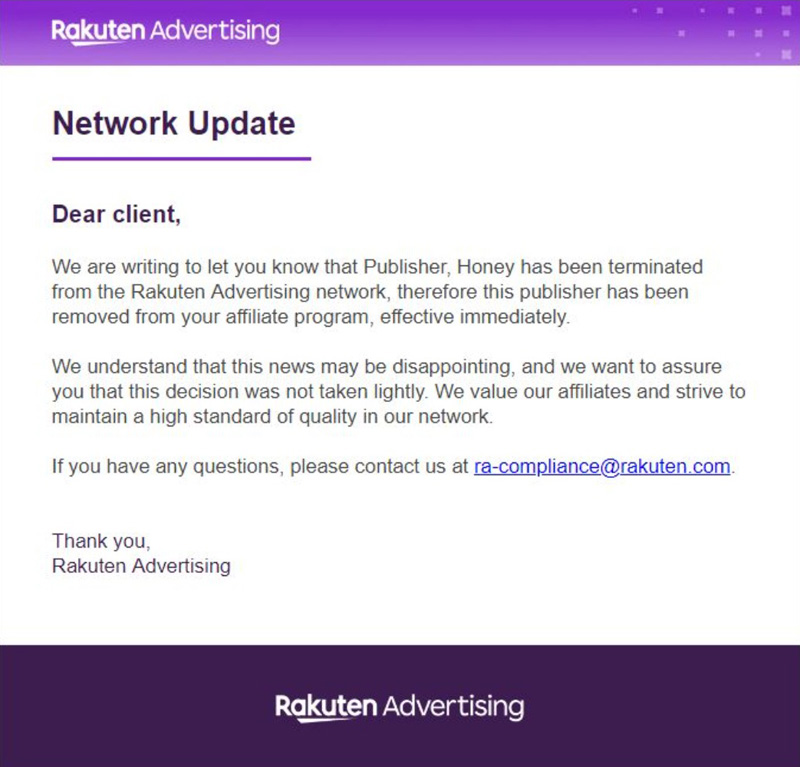
On the opening day of Affiliate Summit West, Rakuten Advertising issued a formal announcement stating that Honey had been "terminated from the network." The network’s communications emphasized that this was a necessary step to "maintain a high standard of quality." The timing of the announcement, occurring when thousands of industry professionals were gathered in Las Vegas, served as a powerful public statement regarding Rakuten’s commitment to network hygiene.
Friday, January 16, 2026: Impact.com Suspends Operations
Following Rakuten’s lead, Impact.com announced on Friday that Honey was found to be "out of compliance" with the platform’s policies. Specifically, Impact.com’s leadership cited "attribution manipulation" as the primary cause for the software’s removal from their Discovery Marketplace. While Impact.com characterized the move as a suspension rather than a permanent termination, the impact was immediate, effectively severing Honey’s access to thousands of brand partnerships hosted on the platform. David Yovanno, CEO of Impact.com, underscored that such behaviors undermine the fundamental trust required for the partnership economy to function.

Financial Context and the Scale of PayPal Honey
To understand the gravity of these removals, one must consider the scale of the entity involved. When PayPal acquired Honey Science Corp. in early 2020 for approximately $4 billion, it was the largest acquisition in PayPal’s history. At the time, Honey boasted over 17 million monthly active users and partnerships with approximately 30,000 retailers.
The acquisition was intended to give PayPal a foothold earlier in the customer’s shopping journey, moving beyond the checkout page and into the discovery and deal-seeking phase. For years, Honey was considered a "premium" publisher, often receiving preferential commission rates and exclusive access to top-tier brands. Its removal from Rakuten and Impact.com represents a significant loss of potential revenue for PayPal’s shopping division and a massive disruption for the retailers who had come to rely on Honey for volume, albeit volume that is now being questioned for its incremental value.
Technical Analysis: Stand-Down Rules and Attribution Hijacking
The technical crux of the Honey controversy lies in the "stand-down" mechanism. In a healthy affiliate ecosystem, different types of affiliates serve different purposes. A content creator might introduce a user to a product (top-of-funnel), while a browser extension might offer a coupon code at the point of sale (bottom-of-funnel).
To ensure fairness, many brands require extensions to "stand down" if a content creator’s cookie is already present. This ensures the content creator, who did the heavy lifting of product education, gets paid. By allegedly circumventing these rules and concealing the behavior from automated detection tools, Honey was accused of overwriting those original cookies. This practice, often called "cookie stuffing" or "cookie overwriting," results in the brand paying a commission to the extension for a sale that would have happened anyway, or for a sale that another affiliate earned.
Broader Industry Implications: The "One Bad Apple" Effect
The Honey incident highlights a systemic issue in affiliate marketing: the "one bad apple" theory. In this context, a single large-scale violator does not just steal commissions; they degrade the entire program. High-quality content publishers—such as professional reviewers, news outlets, and niche bloggers—often monitor the programs they join. If they see that a program allows "predatory" extensions to overwrite their hard-earned cookies, they will often leave the program or stop promoting the brand entirely.
The removal of Honey is seen by many as a victory for these "top-of-funnel" publishers. It signals that networks are finally willing to prioritize the long-term health of the ecosystem over the short-term GMV (Gross Merchandise Volume) generated by massive, albeit non-compliant, publishers.
Strategic Lessons for Affiliate Managers and Brands
The fallout from the PayPal Honey case provides five critical lessons for brands and affiliate managers looking to safeguard their marketing spend and maintain healthy partnerships.
1. The Priority of Internal Policing
Brands cannot solely rely on affiliate networks to monitor compliance. While networks like Rakuten and Impact have compliance departments, they are often incentivized by the volume of sales passing through their platforms. Brands must take ownership of their own Terms and Conditions (Ts & Cs) and use third-party monitoring tools to ensure their rules are being followed at the program level.
2. Understanding Technical Intricacies
Affiliate managers must move beyond surface-level metrics and understand the technology behind Downloadable Software Publishers (DSPs). This includes staying informed on the difference between "soft clicks" and "stand-down" violations. The Affiliate & Partner Marketing Association (APMA) recently conducted an audit of thirty brands across ten networks, highlighting the complexity of attribution rules. Staying educated on these audits is essential for intelligent policing.
3. Avoiding Generalization
While the Honey case is a significant blow to the reputation of browser extensions, it is vital not to generalize all software-based publishers. Many extensions operate ethically and provide genuine value to consumers and brands. The goal should be individual evaluation rather than the wholesale banning of an entire affiliate category.
4. The Necessity of Diversification
A major takeaway from the Honey suspension is the danger of "all eggs in one basket." Many affiliate programs discovered that 50% or more of their revenue was tied to a single publisher type. To build a resilient program, brands should diversify across at least 28 different affiliate types, including:
- Content Producers and Mass Media: Providing brand awareness and education.
- Loyalty and Reward Sites: Encouraging repeat purchases.
- Niche Influencers and Educators: Reaching specific, high-intent audiences.
- Card-Linked Offers and Post-Checkout Solutions: Integrating rewards into the banking and payment experience.
- Podcasters and Video Marketers: Leveraging the power of audio and visual storytelling.
5. Transparency as a Competitive Advantage
In a post-Honey environment, transparency will become a primary currency. Affiliates will gravitate toward brands that can prove they protect their partners’ cookies. Brands that implement clear, enforceable stand-down policies and demonstrate a willingness to terminate non-compliant players will attract the highest-quality traffic and partnerships.
Conclusion: The Future of Affiliate Compliance
The removal of PayPal Honey from major U.S. networks marks a definitive moment in the maturation of the affiliate marketing industry. It serves as a reminder that even the largest players, backed by multi-billion-dollar parent companies, are not immune to the rules of the marketplace. As we move through 2026, the focus will likely shift toward more robust, automated compliance tools and a renewed emphasis on "incremental" value—ensuring that affiliates are being rewarded for driving new business, rather than simply manipulating the technicalities of the digital clickstream. For affiliate managers, the mandate is clear: prioritize quality, enforce the rules, and diversify the base to ensure long-term program stability.